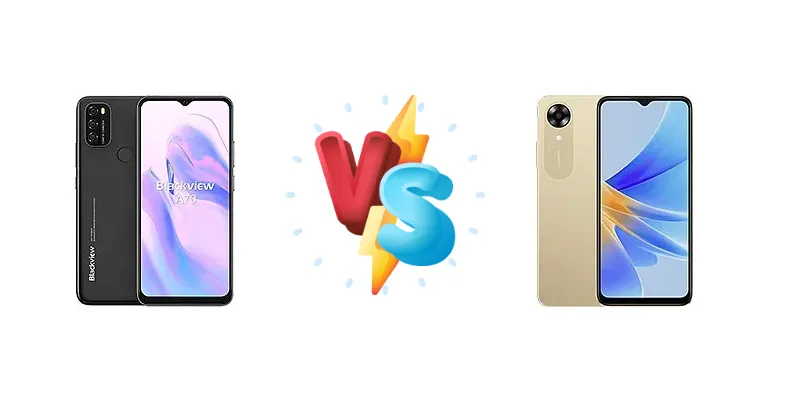
The Blackview A70 and Oppo A17k represent the ultra-budget end of the smartphone spectrum, targeting first-time buyers or those needing a reliable secondary device. While both aim for affordability, they take different approaches to achieving it, primarily through chipset selection. This comparison dissects those choices and reveals which phone delivers the best experience for the price.
🏆 Quick Verdict
For the average user prioritizing overall responsiveness and slightly better efficiency, the Oppo A17k is the stronger choice. Its Mediatek Helio G35, built on a 12nm process, offers a performance advantage over the Blackview A70’s older 28nm Unisoc SC9863A, despite similar core counts. However, the A70 may appeal to those seeking a larger display.
| Network |
|---|
| 2G bands | GSM 850 / 900 / 1800 / 1900 | GSM 850 / 900 / 1800 / 1900 |
| 3G bands | HSDPA 850 / 900 / 2100 | HSDPA 850 / 900 / 2100 |
| 4G bands | 1, 3, 7, 8, 20, 40, 41 | 1, 3, 5, 8, 38, 40, 41 |
| Speed | HSPA, LTE | HSPA, LTE |
| Technology | GSM / HSPA / LTE | GSM / HSPA / LTE |
| Launch |
|---|
| Announced | 2021, January 26 | 2022, October 13 |
| Status | Available. Released 2021, February | Available. Released 2022, October 18 |
| Body |
|---|
| Dimensions | 165.3 x 77.5 x 8.3 mm (6.51 x 3.05 x 0.33 in) | 164.2 x 75.6 x 8.3 mm (6.46 x 2.98 x 0.33 in) |
| SIM | Nano-SIM + Nano-SIM | Nano-SIM + Nano-SIM |
| Weight | 205 g (7.23 oz) | 189 g (6.67 oz) |
| | - | IPX4 water resistance |
| Display |
|---|
| Protection | - | Panda Glass |
| Resolution | 720 x 1600 pixels, 20:9 ratio (~269 ppi density) | 720 x 1612 pixels, 20:9 ratio (~269 ppi density) |
| Size | 6.52 inches, 102.6 cm2 (~80.1% screen-to-body ratio) | 6.56 inches, 103.4 cm2 (~83.3% screen-to-body ratio) |
| Type | IPS LCD | IPS LCD, 480 nits (typ), 600 nits (HBM) |
| Platform |
|---|
| CPU | Octa-core (4x1.6 GHz Cortex-A55 & 4x1.2 GHz Cortex-A55) | Octa-core (4x2.3 GHz Cortex-A53 & 4x1.8 GHz Cortex-A53) |
| Chipset | Unisoc SC9863A (28 nm) | Mediatek MT6765 Helio G35 (12 nm) |
| GPU | IMG8322 | PowerVR GE8320 |
| OS | Android 11 | Android 12, ColorOS 12.1 |
| Memory |
|---|
| Card slot | microSDXC | microSDXC |
| Internal | 32GB 3GB RAM | 64GB 3GB RAM |
| | eMMC | eMMC 5.1 |
| Main Camera |
|---|
| Features | LED flash | LED flash, panorama |
| Single | 5 MP, f/2.2, (wide) | 8 MP, f/2.0, (wide), AF |
| Triple | 13 MP, f/2.2, (wide), AF
other unspecified cameras | - |
| Video | 1080p@30fps | 1080p@30fps |
| Selfie camera |
|---|
| Single | 5 MP, f/2.2, (wide) | 5 MP, f/2.2, (wide) |
| Video | Yes | 1080p@30fps |
| Sound |
|---|
| 3.5mm jack | Yes | Yes |
| 35mm jack | Yes | Yes |
| Loudspeaker | Yes | Yes |
| Comms |
|---|
| Bluetooth | 4.2, A2DP, LE | 5.3, A2DP, LE, aptX HD |
| NFC | No | No |
| Positioning | GPS, GLONASS, BDS | GPS, GLONASS, BDS, GALILEO |
| Radio | FM radio | Unspecified |
| USB | microUSB 2.0, OTG | microUSB 2.0, OTG |
| WLAN | Wi-Fi 802.11 b/g/n | Wi-Fi 802.11 a/b/g/n/ac, dual-band |
| Features |
|---|
| Sensors | Fingerprint (rear-mounted), accelerometer, proximity | Fingerprint (side-mounted), accelerometer, proximity, compass |
| Battery |
|---|
| Charging | 10W wired | - |
| Type | 5380 mAh | Li-Po 5000 mAh |
| Misc |
|---|
| Colors | Black, Blue, Red, Green | Navy Blue, Gold |
| Models | - | CPH2471 |
| Price | About 120 EUR | About 130 EUR |
Blackview A70
- Potentially larger display size (based on Blackview’s typical design)
- Lower price point (potentially, depending on retailer)
- May offer more storage options
- Less efficient Unisoc SC9863A chipset
- Likely slower performance in apps and games
- Higher potential for thermal throttling
Oppo A17k
- More efficient Mediatek Helio G35 chipset
- Faster CPU clock speeds for improved responsiveness
- Better thermal management due to 12nm process
- Potentially smaller display size
- May have limited storage options
- Oppo’s software can include bloatware
Display Comparison
Neither device’s display specifications are provided, but given their price point, both likely utilize LCD panels with 720p+ resolution. The lack of information prevents a direct comparison of brightness or color accuracy. However, Blackview often opts for larger displays in its A-series, potentially giving the A70 an edge for media consumption. Bezels are expected to be substantial on both devices, typical of this price bracket.
Camera Comparison
Without detailed camera specifications, a meaningful comparison is difficult. Both phones likely feature a primary camera and potentially a depth sensor. The absence of information regarding sensor size or aperture suggests both will struggle in low-light conditions. Any secondary cameras (often 2MP macro lenses) are unlikely to provide significant image quality improvements and should be considered a marketing feature rather than a practical benefit. Image processing will likely be basic on both devices.
Performance
The core difference lies in the chipsets. The Oppo A17k’s Mediatek Helio G35, fabricated on a 12nm process, is significantly more efficient than the Blackview A70’s Unisoc SC9863A (28nm). While both are octa-core CPUs, the Helio G35 features Cortex-A53 cores clocked at 2.3 GHz, compared to the A70’s Cortex-A55 cores at 1.6 GHz and 1.2 GHz. This translates to faster single-core and multi-core performance for the A17k, resulting in snappier app launches and smoother multitasking. The older 28nm process of the Unisoc chip will likely result in more heat generation under load, potentially leading to thermal throttling. The A17k will benefit users who engage in light gaming or frequently switch between applications.
Battery Life
Battery capacity isn’t specified for either device. However, the Oppo A17k’s more efficient Helio G35 chipset will likely translate to longer battery life on a similar capacity battery. Both phones feature 10W wired charging, which is slow by modern standards. Expect approximately 2-3 hours for a full charge from 0%, regardless of the battery size. The A17k’s efficiency advantage will allow for more screen-on time between charges.
Buying Guide
Buy the Blackview A70 if you prioritize a potentially larger screen size (though not specified in the data, Blackview often favors larger displays in this segment) and are comfortable with potentially slower performance in demanding apps. Buy the Oppo A17k if you value a more responsive user experience, slightly better power efficiency thanks to the 12nm Helio G35, and a brand with a more established reputation for software support.
Frequently Asked Questions
❓ Will the Oppo A17k struggle with popular social media apps like TikTok and Instagram?
While the Helio G35 isn't a powerhouse, it's sufficient for running most social media apps smoothly. Expect acceptable performance for browsing feeds and recording short videos. However, intensive tasks like editing videos within the app might experience some lag.
❓ Is the Unisoc SC9863A in the Blackview A70 capable of playing any mobile games?
The Blackview A70 can run less demanding 2D games and older 3D titles. However, graphically intensive games like PUBG Mobile or Call of Duty: Mobile will likely require significant graphics settings reductions and may still experience noticeable frame rate drops and stuttering due to the chipset's limitations and the 28nm process.
❓ Does the Oppo A17k support fast charging, or is 10W the only option?
The Oppo A17k is limited to 10W wired charging. While Oppo offers SuperVOOC fast charging on its higher-end devices, this technology is not implemented in the A17k. Expect a relatively slow charging time of around 2-3 hours for a full charge.
❓ How does the software experience differ between the Blackview A70 and Oppo A17k?
Oppo typically uses its ColorOS skin on top of Android, which offers a more polished and feature-rich experience, but can also include pre-installed bloatware. Blackview’s software is generally closer to stock Android, potentially offering a cleaner experience, but with less refinement and potentially less frequent software updates.