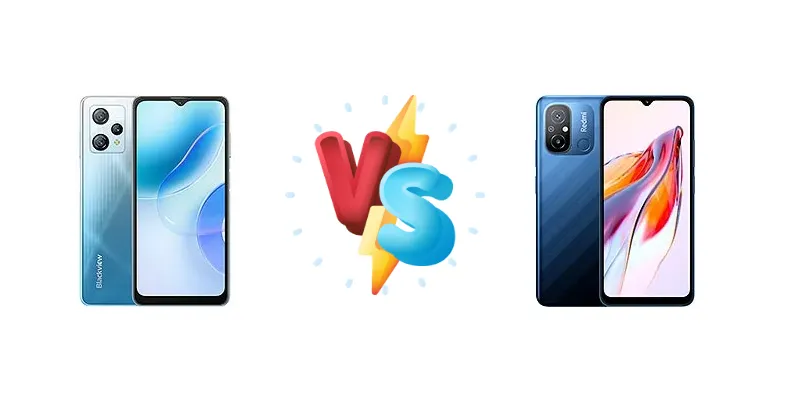
The sub-$150 smartphone market is fiercely competitive. Both the Blackview A53 and Xiaomi Redmi 12C aim to deliver essential smartphone functionality at an incredibly accessible price point. However, significant differences in their core hardware – specifically the chipset – dictate vastly different user experiences. This comparison dissects those differences to help you choose the right device.
🏆 Quick Verdict
For most users, the Xiaomi Redmi 12C is the superior choice. Its Helio G85 chipset provides a substantial performance uplift over the Blackview A53’s Helio A22, making it noticeably faster for everyday tasks and even light gaming. While both offer 10W charging, the Redmi 12C’s processing power justifies the slight price premium.
| Network |
|---|
| 2G bands | GSM 850 / 900 / 1800 / 1900 | GSM 850 / 900 / 1800 / 1900 |
| 3G bands | HSDPA 850 / 1700(AWS) / 1900 - USA | HSDPA 850 / 900 / 2100 |
| 4G bands | 1, 3, 7, 8, 20, 40 - International | 1, 3, 5, 7, 8, 20, 28, 38, 40, 41 - International |
| Speed | HSPA, LTE | HSPA, LTE |
| Technology | GSM / HSPA / LTE | GSM / CDMA / HSPA / EVDO / LTE |
| | 2, 3, 4, 5, 7, 8, 12, 13, 17, 25, 26, 28, 41, 66 - USA | CDMA2000 1xEV-DO |
| Launch |
|---|
| Announced | 2023, March 03 | 2022, December 31 |
| Status | Available. Released 2023, March | Available. Released 2023, January 01 |
| Body |
|---|
| Build | Glass front, plastic frame, plastic back | - |
| Dimensions | 164.6 x 76.9 x 9.4 mm (6.48 x 3.03 x 0.37 in) | 168.8 x 76.4 x 8.8 mm (6.65 x 3.01 x 0.35 in) |
| SIM | Nano-SIM + Nano-SIM | Nano-SIM + Nano-SIM |
| Weight | 193 g (6.81 oz) | 192 g (6.77 oz) |
| Display |
|---|
| Resolution | 720 x 1600 pixels, 20:9 ratio (~270 ppi density) | 720 x 1650 pixels (~268 ppi density) |
| Size | 6.5 inches, 102.0 cm2 (~80.6% screen-to-body ratio) | 6.71 inches, 106.5 cm2 (~82.6% screen-to-body ratio) |
| Type | IPS LCD | IPS LCD, 500 nits (typ) |
| Platform |
|---|
| CPU | Quad-core 2.0 GHz Cortex-A53 | Octa-core (2x2.0 GHz Cortex-A75 & 6x1.8 GHz Cortex-A55) |
| Chipset | Mediatek MT6761 Helio A22 (12 nm) | Mediatek MT6769Z Helio G85 (12 nm) |
| GPU | PowerVR GE8320 | Mali-G52 MC2 |
| OS | Android 12, Doke OS 3.0 | Android 12, MIUI 13 |
| Memory |
|---|
| Card slot | microSDXC (uses shared SIM slot) | microSDXC (dedicated slot) |
| Internal | 16GB 3GB RAM | 32GB 2GB RAM, 32GB 3GB RAM, 32GB 4GB RAM, 64GB 3GB RAM, 64GB 4GB RAM, 128GB 3GB RAM, 128GB 4GB RAM, 128GB 6GB RAM |
| | eMMC 5.0 | eMMC 5.1 |
| Main Camera |
|---|
| Dual | - | 50 MP, (wide), PDAF
0.08 MP (depth) |
| Features | LED flash | LED flash, HDR |
| Single | 5 MP | 50 MP, f/1.8, (wide), 1/2.76", PDAF
Auxiliary lens |
| Triple | 12 MP
other unspecified camera | - |
| Video | 1080p@30fps | 1080p@30fps |
| Selfie camera |
|---|
| Single | 5 MP | 5 MP, f/2.2, (wide) |
| Video | Yes | 1080p@30fps |
| Sound |
|---|
| 3.5mm jack | Yes | Yes |
| 35mm jack | Yes | Yes |
| Loudspeaker | Yes | Yes |
| Comms |
|---|
| Bluetooth | 5.0, A2DP, LE | 5.1, A2DP, LE |
| NFC | No | Yes (market/region dependent) |
| Positioning | GPS, GLONASS, GALILEO, BDS | GPS, GLONASS, BDS, GALILEO |
| Radio | FM radio | FM radio |
| USB | USB Type-C, OTG | microUSB 2.0 |
| WLAN | Wi-Fi 802.11 a/b/g/n/ac | Wi-Fi 802.11 a/b/g/n/ac, dual-band, Wi-Fi Direct |
| Features |
|---|
| Sensors | Unspecified | Fingerprint (rear-mounted), accelerometer |
| | - | Virtual proximity sensing |
| Battery |
|---|
| Charging | 10W wired | 10W wired |
| Type | 5080 mAh | Li-Po 5000 mAh |
| Misc |
|---|
| Colors | Rock Grey, Murky Black, Starry Blue | Graphite Gray, Ocean Blue, Mint Green, Lavender Purple |
| Models | - | 22120RN86G, 22120RN86I, 22126RN91Y, 2212ARNC4L |
| Price | - | £ 132.99 / € 107.41 |
| SAR | - | 1.08 W/kg (head) 0.64 W/kg (body) |
| SAR EU | - | 0.98 W/kg (head) 0.99 W/kg (body) |
Blackview A53
- Extremely affordable
- Functional for basic tasks
- Simple and easy to use
- Slow performance
- Struggles with multitasking
- Limited gaming capabilities
Xiaomi Redmi 12C
- Significantly faster performance
- Better multitasking capabilities
- More responsive user experience
- Slightly more expensive
- 10W charging is slow
- Camera quality is still basic
Display Comparison
Neither device boasts a standout display. Both likely utilize LCD panels, a common cost-saving measure in this segment. While specific details like peak brightness and color gamut are unavailable, the focus here is on performance, not visual fidelity. Bezels are expected to be relatively thick on both, contributing to a larger overall footprint. The display quality will likely be adequate for basic consumption but won't impress.
Camera Comparison
Camera performance is likely to be similar in real-world usage, given the focus on affordability. Both devices will likely feature a primary camera and potentially a depth sensor. However, the image processing capabilities of the Helio G85 in the Redmi 12C may offer slightly better results in terms of dynamic range and noise reduction. The presence of a 2MP macro camera on either device is largely a marketing gimmick and shouldn't be a deciding factor. Expect acceptable photos in good lighting conditions, but struggles in low light.
Performance
The core difference lies in the chipsets. The Blackview A53’s Mediatek Helio A22, a quad-core processor clocked at 2.0 GHz, is designed for minimal power consumption and basic functionality. In contrast, the Xiaomi Redmi 12C’s Mediatek Helio G85 is an octa-core processor (2x2.0 GHz Cortex-A75 & 6x1.8 GHz Cortex-A55) built for more demanding workloads. The G85’s architecture, featuring more cores and higher-performance Cortex-A75 cores, translates to significantly faster app launch times, smoother multitasking, and a more responsive user interface. The A22 will struggle with anything beyond the most basic apps, while the G85 can handle moderate gaming and more complex applications.
Battery Life
Both phones feature 10W wired charging, indicating similar charging speeds – expect around 2.5 to 3 hours for a full charge. While battery capacity isn't specified, the more efficient Helio G85 in the Redmi 12C may offer slightly better battery life despite potentially having a similar capacity. The A22’s lower performance demands less power, but the G85’s optimizations can offset this advantage.
Buying Guide
Buy the Blackview A53 if you prioritize extreme affordability and only need a phone for the most basic tasks – calls, texts, and very light app usage. It’s a functional device for those on a severely restricted budget. Buy the Xiaomi Redmi 12C if you want a smoother, more responsive experience, even for moderate multitasking, social media browsing, and casual gaming. The G85 chipset offers a significant quality-of-life improvement for a small increase in cost.
Frequently Asked Questions
❓ Will the Redmi 12C be able to run popular games like PUBG Mobile?
The Helio G85 in the Redmi 12C is capable of running PUBG Mobile, but you'll likely need to use low to medium graphics settings for a smooth experience. The Blackview A53’s Helio A22 will struggle significantly with PUBG Mobile and is not recommended for gaming.
❓ Is the difference in performance between the Helio A22 and Helio G85 really that noticeable for everyday use?
Yes, the difference is substantial. The Helio G85’s octa-core architecture and more powerful cores result in significantly faster app launch times, smoother scrolling, and a more responsive overall experience. The Helio A22 will feel sluggish and may exhibit noticeable lag when switching between apps.
❓ Does either phone support fast charging, or are they both limited to 10W?
Both the Blackview A53 and Xiaomi Redmi 12C are limited to 10W wired charging. This means charging times will be relatively slow, taking around 2.5 to 3 hours for a full charge.
❓ Which phone is better for someone who primarily uses their phone for calls, texts, and WhatsApp?
While both phones can handle these basic tasks, the Xiaomi Redmi 12C offers a more future-proof experience. Even for basic usage, the smoother performance will be appreciated, and the phone will remain usable for longer as apps become more demanding.