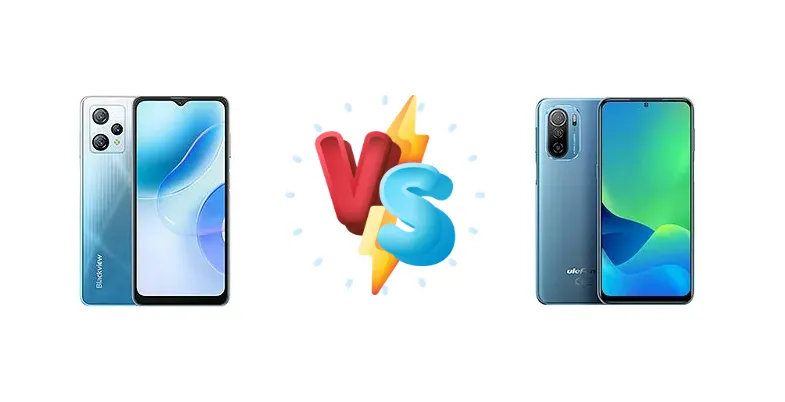
The Blackview A53 and Ulefone Note 13P represent the ultra-budget end of the Android smartphone market. Both aim to deliver essential functionality at the lowest possible price point, but significant differences in their core processing power dictate which device is better suited for different users. This comparison dives deep into the specifications to reveal which phone offers the best value.
🏆 Quick Verdict
For most users, the Ulefone Note 13P is the better choice. Its MediaTek Helio G35 chipset, featuring an octa-core CPU, provides a noticeable performance boost over the Blackview A53’s quad-core Helio A22. While both offer similar 10W charging, the Note 13P’s extra processing power translates to a smoother user experience.
| Network |
|---|
| 2G bands | GSM 850 / 900 / 1800 / 1900 | GSM 850 / 900 / 1800 / 1900 |
| 3G bands | HSDPA 850 / 1700(AWS) / 1900 - USA | HSDPA 850 / 900 / 1700(AWS) / 1900 / 2100 |
| 4G bands | 1, 3, 7, 8, 20, 40 - International | 1, 2, 3, 4, 5, 7, 8, 12, 13, 17, 18, 19, 20, 25, 26, 28 |
| Speed | HSPA, LTE | HSPA, LTE |
| Technology | GSM / HSPA / LTE | GSM / HSPA / LTE |
| | 2, 3, 4, 5, 7, 8, 12, 13, 17, 25, 26, 28, 41, 66 - USA | - |
| Launch |
|---|
| Announced | 2023, March 03 | 2021, November 24 |
| Status | Available. Released 2023, March | Available. Released 2021, November 24 |
| Body |
|---|
| Build | Glass front, plastic frame, plastic back | - |
| Dimensions | 164.6 x 76.9 x 9.4 mm (6.48 x 3.03 x 0.37 in) | 162.3 x 75.7 x 9.9 mm (6.39 x 2.98 x 0.39 in) |
| SIM | Nano-SIM + Nano-SIM | Nano-SIM + Nano-SIM |
| Weight | 193 g (6.81 oz) | 198.5 g (7.02 oz) |
| Display |
|---|
| Resolution | 720 x 1600 pixels, 20:9 ratio (~270 ppi density) | 1080 x 2400 pixels, 20:9 ratio (~405 ppi density) |
| Size | 6.5 inches, 102.0 cm2 (~80.6% screen-to-body ratio) | 6.5 inches, 102.0 cm2 (~83.0% screen-to-body ratio) |
| Type | IPS LCD | IPS LCD |
| Platform |
|---|
| CPU | Quad-core 2.0 GHz Cortex-A53 | Octa-core (4x2.3 GHz Cortex-A53 & 4x1.8 GHz Cortex-A53) |
| Chipset | Mediatek MT6761 Helio A22 (12 nm) | Mediatek MT6765G Helio G35 (12 nm) |
| GPU | PowerVR GE8320 | PowerVR GE8320 |
| OS | Android 12, Doke OS 3.0 | Android 11 |
| Memory |
|---|
| Card slot | microSDXC (uses shared SIM slot) | microSDXC (dedicated slot) |
| Internal | 16GB 3GB RAM | 64GB 4GB RAM |
| | eMMC 5.0 | eMMC 5.1 |
| Main Camera |
|---|
| Dual | - | 20 MP, f/1.8, 25mm (wide), 1/2.78, 1.0µm, AF
2 MP (macro) |
| Features | LED flash | LED flash, HDR, panorama |
| Single | 5 MP | 16 MP, f/2.2, (wide), 1/3.09, 1.0µm |
| Triple | 12 MP
other unspecified camera | - |
| Video | 1080p@30fps | 1080p@30fps |
| Selfie camera |
|---|
| Features | - | HDR |
| Single | 5 MP | 16 MP, f/2.2, (wide), 1/3.09, 1.0µm |
| Video | Yes | 1080p@30fps |
| Sound |
|---|
| 3.5mm jack | Yes | Yes |
| 35mm jack | Yes | Yes |
| Loudspeaker | Yes | Yes |
| Comms |
|---|
| Bluetooth | 5.0, A2DP, LE | 5.0, A2DP, LE |
| NFC | No | Yes |
| Positioning | GPS, GLONASS, GALILEO, BDS | GPS, GLONASS, GALILEO, BDS |
| Radio | FM radio | Stereo FM radio, RDS, recording |
| USB | USB Type-C, OTG | USB Type-C 2.0 |
| WLAN | Wi-Fi 802.11 a/b/g/n/ac | Wi-Fi 802.11 a/b/g/n/ac, dual-band |
| Features |
|---|
| Sensors | Unspecified | Fingerprint (side-mounted), accelerometer, proximity, compass |
| Battery |
|---|
| Charging | 10W wired | 10W wired |
| Type | 5080 mAh | Li-Po 5180 mAh |
| Misc |
|---|
| Colors | Rock Grey, Murky Black, Starry Blue | Starry Black, Mystery Blue |
| Price | - | About 130 EUR |
Blackview A53
- Lowest possible price point
- Simple and easy to use
- Reliable for basic communication
- Poor performance for anything beyond basic tasks
- Limited multitasking capabilities
- Outdated chipset
Ulefone Note 13P
- Significantly better performance than the A53
- Octa-core processor enables smoother multitasking
- More responsive user experience
- Still limited by the budget chipset
- 10W charging is slow
- Camera quality is likely basic
Display Comparison
Neither Blackview nor Ulefone provide detailed display specifications beyond the basic panel type. Given the price point, both likely utilize IPS LCD panels. The absence of information regarding peak brightness, color gamut coverage, or refresh rates suggests a focus on cost reduction. Bezels are expected to be substantial on both devices, and color accuracy will likely be standard for this segment. Without further data, a direct comparison is impossible, but the display experience will likely be similar on both.
Camera Comparison
Both phones likely feature basic camera setups geared towards casual photography. Without detailed sensor information, it’s difficult to make a precise comparison. However, the market segment suggests both will rely on relatively low-resolution sensors. The presence of a 2MP macro camera on either device is largely a marketing tactic, offering limited practical benefit due to the small sensor size and lack of optical image stabilization (OIS). Image processing will likely be minimal, resulting in images that are acceptable in good lighting conditions but suffer in low light.
Performance
The core difference lies in the chipsets. The Ulefone Note 13P’s MediaTek Helio G35 is a significant upgrade over the Blackview A53’s Helio A22. The G35 boasts an octa-core configuration (4x2.3 GHz Cortex-A53 & 4x1.8 GHz Cortex-A53) compared to the A22’s quad-core 2.0 GHz Cortex-A53. This means the Note 13P can handle more simultaneous tasks and complex applications with greater ease. While both are based on a 12nm process, the G35’s architecture provides a substantial performance advantage in CPU-intensive workloads. The A53 will struggle with anything beyond basic app usage, while the G35 offers a more fluid experience.
Battery Life
Both devices are equipped with 10W wired charging, indicating similar charging speeds. While battery capacity isn’t specified, the Helio G35 in the Ulefone Note 13P is more power-efficient than the Helio A22 in the Blackview A53. This means the Note 13P may achieve comparable or slightly better battery life despite potentially having a similar capacity. Expect a full charge to take approximately 2-3 hours on both devices.
Buying Guide
Buy the Blackview A53 if you prioritize absolute simplicity and minimal cost for basic tasks like calls, texts, and light social media use. It’s ideal for first-time smartphone users or as a reliable backup device. Buy the Ulefone Note 13P if you need a phone capable of handling more demanding apps, occasional gaming, or multitasking without significant slowdowns. The extra cores provide a tangible improvement in responsiveness and overall usability.
Frequently Asked Questions
❓ Will the Ulefone Note 13P handle popular social media apps like TikTok and Instagram smoothly?
Yes, the Ulefone Note 13P’s Helio G35 chipset is capable of running TikTok and Instagram without significant lag. While it won’t offer a high-end experience, it will provide a usable and reasonably smooth experience for browsing and creating content. The Blackview A53 may struggle with these apps, especially when multitasking.
❓ Is the 10W charging on either phone fast enough for daily use?
No, 10W charging is relatively slow by modern standards. Expect a full charge to take around 2-3 hours. This is acceptable for overnight charging, but inconvenient if you need a quick top-up. Both phones prioritize affordability over fast charging technology.
❓ Can the Ulefone Note 13P run basic Android games like Candy Crush or Subway Surfers?
Yes, the Ulefone Note 13P should be able to run less demanding games like Candy Crush and Subway Surfers without major issues. However, don't expect high frame rates or detailed graphics. The Helio G35 is an entry-level chipset and will struggle with more graphically intensive games. The Blackview A53 will likely have even more difficulty with gaming.