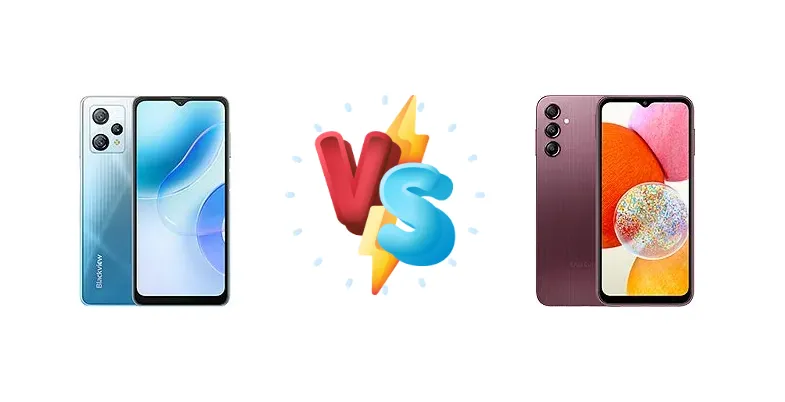
The Blackview A53 and Samsung Galaxy A14 represent two approaches to the ultra-budget smartphone market. The A53 focuses on delivering a functional experience at the lowest possible price, while the A14 aims for a more polished experience with a wider feature set, albeit with some configuration variations. This comparison dissects their key differences to determine which device offers the best value.
🏆 Quick Verdict
For most users, the Samsung Galaxy A14 is the better choice. While the Blackview A53 offers a compelling price, the A14’s significantly more powerful Helio G80 (or Exynos 850) chipset delivers a smoother, more responsive experience, especially for multitasking and gaming. The 15W charging is also a welcome upgrade.
| Network |
|---|
| 2G bands | GSM 850 / 900 / 1800 / 1900 | GSM 850 / 900 / 1800 / 1900 |
| 3G bands | HSDPA 850 / 1700(AWS) / 1900 - USA | HSDPA 850 / 900 / 2100 |
| 4G bands | 1, 3, 7, 8, 20, 40 - International | 1, 3, 5, 7, 8, 20, 28, 38, 40, 41 |
| Speed | HSPA, LTE | HSPA, LTE |
| Technology | GSM / HSPA / LTE | GSM / HSPA / LTE |
| | 2, 3, 4, 5, 7, 8, 12, 13, 17, 25, 26, 28, 41, 66 - USA | - |
| Launch |
|---|
| Announced | 2023, March 03 | 2023, February 28 |
| Status | Available. Released 2023, March | Available. Released 2023, March 27 |
| Body |
|---|
| Build | Glass front, plastic frame, plastic back | Glass front, plastic back, plastic frame |
| Dimensions | 164.6 x 76.9 x 9.4 mm (6.48 x 3.03 x 0.37 in) | 167.7 x 78 x 9.1 mm (6.60 x 3.07 x 0.36 in) |
| SIM | Nano-SIM + Nano-SIM | · Nano-SIM· Nano-SIM + Nano-SIM |
| Weight | 193 g (6.81 oz) | 201 g (7.09 oz) |
| Display |
|---|
| Resolution | 720 x 1600 pixels, 20:9 ratio (~270 ppi density) | 1080 x 2408 pixels, 20:9 ratio (~400 ppi density) |
| Size | 6.5 inches, 102.0 cm2 (~80.6% screen-to-body ratio) | 6.6 inches, 104.9 cm2 (~80.2% screen-to-body ratio) |
| Type | IPS LCD | PLS LCD |
| Platform |
|---|
| CPU | Quad-core 2.0 GHz Cortex-A53 | Octa-core (2x2.0 GHz Cortex-A75 & 6x1.8 GHz Cortex-A55) - Version AOcta-core (4x2.0 GHz Cortex-A55 & 4x2.0 GHz Cortex-A55) - Version B |
| Chipset | Mediatek MT6761 Helio A22 (12 nm) | Mediatek MT6769 Helio G80 (12 nm) - Version AExynos 850 (8 nm) - Version B |
| GPU | PowerVR GE8320 | Mali-G52 MC2 |
| OS | Android 12, Doke OS 3.0 | Android 13, upgradable to Android 15, One UI 7 |
| Memory |
|---|
| Card slot | microSDXC (uses shared SIM slot) | microSDXC (dedicated slot) |
| Internal | 16GB 3GB RAM | 64GB 4GB RAM, 128GB 4GB RAM, 128GB 6GB RAM |
| | eMMC 5.0 | - |
| Main Camera |
|---|
| Features | LED flash | LED flash, panorama, HDR |
| Single | 5 MP | 13 MP, f/2.0, (wide) |
| Triple | 12 MP
other unspecified camera | 50 MP, f/1.8, 26mm (wide), 1/2.75", 0.64µm, PDAF
5 MP, f/2.2, 17mm (ultrawide), 1/5.0", 1.12µm
2 MP (macro) |
| Video | 1080p@30fps | 1080p@30fps |
| Selfie camera |
|---|
| Single | 5 MP | 13 MP, f/2.0, 26mm (wide), 1/3.1", 1.12µm |
| Video | Yes | 1080p@30fps |
| Sound |
|---|
| 3.5mm jack | Yes | Yes |
| 35mm jack | Yes | Yes |
| Loudspeaker | Yes | Yes |
| Comms |
|---|
| Bluetooth | 5.0, A2DP, LE | 5.1 or 5.3, A2DP, LE |
| NFC | No | Yes (market/region dependent) |
| Positioning | GPS, GLONASS, GALILEO, BDS | GPS, GALILEO, GLONASS, BDS, QZSS |
| Radio | FM radio | Unspecified |
| USB | USB Type-C, OTG | USB Type-C 2.0 |
| WLAN | Wi-Fi 802.11 a/b/g/n/ac | Wi-Fi 802.11 a/b/g/n/ac, dual-band, Wi-Fi Direct |
| Features |
|---|
| Sensors | Unspecified | Fingerprint (side-mounted), accelerometer, proximity, compass |
| Battery |
|---|
| Charging | 10W wired | 15W wired |
| Type | 5080 mAh | Li-Po 5000 mAh |
| Misc |
|---|
| Colors | Rock Grey, Murky Black, Starry Blue | Black, Dark Red, Silver, Green |
| Models | - | SM-A145F, SM-A145F/DSN, SM-A145M, SM-A145M/DS, SM-A145P, SM-A145R |
| Price | - | € 85.76 / $ 147.60 / £ 79.95 |
| SAR EU | - | 0.46 W/kg (head) 1.37 W/kg (body) |
Blackview A53
- Extremely affordable price point
- Functional for basic smartphone tasks
- Simple and easy-to-use interface
- Weak processor performance
- Slow charging speed
- Likely lower-quality display
Samsung Galaxy A14
- Significantly better performance (Helio G80/Exynos 850)
- Faster 15W charging
- More refined software experience
- Higher price than the Blackview A53
- Potential for chipset variation (Helio G80 vs Exynos 850)
- Camera quality still limited by budget constraints
Display Comparison
Neither device boasts a standout display. Both utilize 12nm chipsets, suggesting a focus on cost reduction over display technology. Specifics like panel type (IPS vs. TFT) and resolution are missing for the A53, but it's likely a lower-resolution panel than the A14. The A14’s larger screen size is a benefit for media consumption. While neither is expected to have high peak brightness, the A14’s potential for a higher-quality panel makes it the likely winner in terms of viewing experience.
Camera Comparison
Camera performance is likely to be a weak point on both devices, but the A14 has a potential advantage. While both likely feature a primary camera and multiple auxiliary lenses (often 2MP macro/depth sensors of limited utility), the A14’s chipset has a more powerful ISP (Image Signal Processor). This allows for better image processing, noise reduction, and dynamic range. The A53’s Helio A22 lacks the processing power for sophisticated computational photography. Expect the A14 to produce more detailed and usable photos, especially in challenging lighting conditions.
Performance
The performance gap is the most significant differentiator. The Blackview A53’s MediaTek Helio A22, a quad-core processor, is designed for basic tasks. The Samsung Galaxy A14, however, offers two chipset options: the Helio G80 and the Exynos 850. The Helio G80, an octa-core processor with a mix of Cortex-A75 and A55 cores, provides a substantial performance boost over the A22, particularly in gaming and multitasking. The Exynos 850, built on an 8nm process, offers even better efficiency and sustained performance. The A14’s CPU architecture is far more modern, translating to faster app launch times and smoother operation. The A53 will struggle with demanding applications.
Battery Life
Battery life will depend heavily on usage patterns. While specific battery capacities are not provided, the A14’s 15W charging is a clear advantage over the A53’s 10W charging. This means the A14 will reach a full charge significantly faster. The more efficient chipsets in the A14 (Helio G80 or Exynos 850) will also contribute to longer battery life, especially during demanding tasks. The A53’s less efficient processor will drain the battery more quickly.
Buying Guide
Buy the Blackview A53 if you need a basic, functional smartphone for essential tasks like calls, texts, and light web browsing, and your budget is extremely limited. Buy the Samsung Galaxy A14 if you prioritize a smoother user experience, better performance for apps and games, and a more reliable brand reputation, even if it means spending a bit more.
Frequently Asked Questions
❓ Does the Samsung Galaxy A14’s Exynos 850 chip overheat during prolonged gaming sessions?
The Exynos 850 is an 8nm chip, offering better thermal efficiency than the Helio A22 in the Blackview A53. While it may get warm during extended gaming, it’s unlikely to experience significant throttling, providing a more consistent gaming experience than the A53.
❓ Is the 2MP macro camera on either phone actually useful for taking detailed close-up photos?
Generally, 2MP macro cameras on budget phones are of limited utility. The low resolution results in images lacking detail and sharpness. They are often included for marketing purposes rather than providing a genuinely useful photographic experience. Expect minimal improvement over standard close-up shots with the main camera.
❓ Can the Samsung Galaxy A14 handle popular games like PUBG Mobile at reasonable frame rates?
The Samsung Galaxy A14, especially the version with the Helio G80, should be capable of running PUBG Mobile at medium settings with a stable frame rate. The Exynos 850 version will offer even better performance. The Blackview A53 will struggle to provide a playable experience due to its weaker processor.
❓ What type of charging cable and adapter does the Blackview A53 use, and is it included in the box?
The Blackview A53 uses a Micro-USB port for charging, which is becoming less common. It supports 10W wired charging. A charger and cable are typically included in the box, but it's always best to confirm with the retailer.