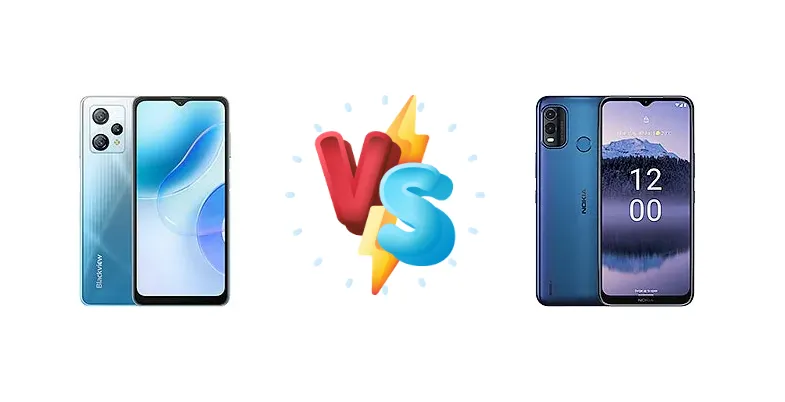
The Blackview A53 and Nokia G11 Plus represent the ultra-budget end of the smartphone spectrum. Both aim to deliver essential functionality at a minimal cost, but they take different approaches to achieving this. The A53 relies on Mediatek’s older Helio A22, while the G11 Plus opts for the newer Unisoc T606. This comparison dives deep into the architectural differences and real-world implications of these chipsets to determine which phone offers the best value.
🏆 Quick Verdict
For most users, the Nokia G11 Plus is the better choice. Its Unisoc T606 chipset, featuring a combination of Cortex-A75 and A55 cores, provides a significantly more responsive experience for everyday tasks and light multitasking compared to the Blackview A53’s quad-core Helio A22. While both phones share the same slow 10W charging, the G11 Plus’s superior processing power justifies the slight price difference.
| Network |
|---|
| 2G bands | GSM 850 / 900 / 1800 / 1900 | GSM 850 / 900 / 1800 / 1900 |
| 3G bands | HSDPA 850 / 1700(AWS) / 1900 - USA | HSDPA 850 / 900 / 2100 - International |
| 4G bands | 1, 3, 7, 8, 20, 40 - International | 1, 3, 5, 7, 8, 20, 28, 38, 40, 41 - International |
| Speed | HSPA, LTE | HSPA 42.2/5.76 Mbps, LTE Cat4 150/50 Mbps |
| Technology | GSM / HSPA / LTE | GSM / HSPA / LTE |
| | 2, 3, 4, 5, 7, 8, 12, 13, 17, 25, 26, 28, 41, 66 - USA | 1, 3, 5, 8, 40, 41 - India |
| Launch |
|---|
| Announced | 2023, March 03 | 2022, June 29 |
| Status | Available. Released 2023, March | Available. Released 2022, July 20 |
| Body |
|---|
| Build | Glass front, plastic frame, plastic back | Glass front, plastic frame, plastic back |
| Dimensions | 164.6 x 76.9 x 9.4 mm (6.48 x 3.03 x 0.37 in) | 164.8 x 75.9 x 8.6 mm (6.49 x 2.99 x 0.34 in) |
| SIM | Nano-SIM + Nano-SIM | · Nano-SIM· Nano-SIM + Nano-SIM |
| Weight | 193 g (6.81 oz) | 192 g (6.77 oz) |
| | - | Splash protection |
| Display |
|---|
| Resolution | 720 x 1600 pixels, 20:9 ratio (~270 ppi density) | 720 x 1600 pixels, 20:9 ratio (~269 ppi density) |
| Size | 6.5 inches, 102.0 cm2 (~80.6% screen-to-body ratio) | 6.52 inches, 102.6 cm2 (~82.1% screen-to-body ratio) |
| Type | IPS LCD | IPS LCD, 90Hz, 400 nits (typ) |
| Platform |
|---|
| CPU | Quad-core 2.0 GHz Cortex-A53 | Octa-core (2x1.6 GHz Cortex-A75 & 6x1.6 GHz Cortex-A55) |
| Chipset | Mediatek MT6761 Helio A22 (12 nm) | Unisoc T606 (12 nm) |
| GPU | PowerVR GE8320 | Mali-G57 MP1 |
| OS | Android 12, Doke OS 3.0 | Android 12, upgradable to Android 13 |
| Memory |
|---|
| Card slot | microSDXC (uses shared SIM slot) | microSDXC (dedicated slot) |
| Internal | 16GB 3GB RAM | 32GB 3GB RAM, 64GB 3GB RAM, 64GB 4GB RAM, 128GB 3GB RAM |
| | eMMC 5.0 | eMMC 5.1 |
| Main Camera |
|---|
| Dual | - | 50 MP, f/1.8, (wide), 1/2.67", PDAF
Auxiliary lens |
| Features | LED flash | LED flash |
| Single | 5 MP | 8 MP, f/2.0, (wide), 1/4.0" |
| Triple | 12 MP
other unspecified camera | - |
| Video | 1080p@30fps | 1080p@30fps |
| Selfie camera |
|---|
| Single | 5 MP | 8 MP, f/2.0, (wide), 1/4.0" |
| Video | Yes | 1080p@30fps |
| Sound |
|---|
| 3.5mm jack | Yes | Yes |
| 35mm jack | Yes | Yes |
| Loudspeaker | Yes | Yes |
| Comms |
|---|
| Bluetooth | 5.0, A2DP, LE | 5.0, A2DP, LE |
| NFC | No | No |
| Positioning | GPS, GLONASS, GALILEO, BDS | GPS |
| Radio | FM radio | FM radio |
| USB | USB Type-C, OTG | USB Type-C 2.0, OTG |
| WLAN | Wi-Fi 802.11 a/b/g/n/ac | Wi-Fi 802.11 a/b/g/n/ac, dual-band, Wi-Fi Direct |
| Features |
|---|
| Sensors | Unspecified | Fingerprint (rear-mounted), accelerometer, proximity |
| Battery |
|---|
| Charging | 10W wired | 10W wired |
| Type | 5080 mAh | Li-Ion 5000 mAh |
| Misc |
|---|
| Colors | Rock Grey, Murky Black, Starry Blue | Lake Blue, Charcoal Grey |
| Price | - | About 130 EUR |
Blackview A53
- Extremely affordable price point
- Simple and easy-to-use interface
- Durable build quality (typical of Blackview)
- Significantly slower performance
- Outdated processor architecture
- Slow 10W charging
Nokia G11 Plus
- More powerful and efficient processor
- Smoother user experience
- Better multitasking capabilities
- Slow 10W charging
- Still limited by budget components
- May be slightly more expensive than the A53
Display Comparison
Neither Blackview nor Nokia provide detailed display specifications beyond resolution. However, given the price point, both likely utilize IPS LCD panels. The key differentiator lies within the processing power driving the display, which impacts UI responsiveness. While panel quality is likely similar, the Unisoc T606 in the G11 Plus will render animations and transitions more fluidly.
Camera Comparison
Both phones are expected to feature basic camera setups. Without detailed sensor information, it’s difficult to make a definitive judgment. However, the processing capabilities of the Unisoc T606 in the Nokia G11 Plus will likely result in slightly better image processing, particularly in terms of noise reduction and dynamic range. Expect both to perform adequately in good lighting conditions, but struggle in low-light scenarios. The presence of a 2MP macro lens on either device is largely a marketing gimmick and shouldn't be a deciding factor.
Performance
The core difference between these phones is the chipset. The Blackview A53’s Mediatek Helio A22 is a quad-core processor built on a 12nm process, utilizing four Cortex-A53 cores clocked at 2.0 GHz. This is a relatively old architecture. In contrast, the Nokia G11 Plus features the Unisoc T606, also on a 12nm process, but with an octa-core configuration: two Cortex-A75 cores at 1.6 GHz and six Cortex-A55 cores at 1.6 GHz. The inclusion of the more powerful Cortex-A75 cores in the G11 Plus provides a substantial performance advantage in multi-threaded tasks and app launch times. The A22 will struggle with even moderate multitasking, while the T606 offers a more usable experience.
Battery Life
Both the Blackview A53 and Nokia G11 Plus are equipped with 10W wired charging. This is a significant limitation, meaning a full charge will take a considerable amount of time – likely over 3 hours. While battery capacity isn’t specified, the power efficiency of the Unisoc T606 might translate to slightly better battery life in the G11 Plus, offsetting any potential capacity differences. The slow charging speed is a major drawback for both devices.
Buying Guide
Buy the Blackview A53 if your primary need is a very basic, extremely affordable phone for calls, texts, and minimal app usage. It’s a suitable option for those who prioritize absolute cost savings above all else. Buy the Nokia G11 Plus if you want a smoother, more capable experience for social media, web browsing, and occasional light gaming. The G11 Plus offers a noticeable performance uplift that makes it a more versatile daily driver.
Frequently Asked Questions
❓ Will the Nokia G11 Plus be able to handle popular social media apps like Facebook and Instagram without significant lag?
Yes, the Unisoc T606 in the Nokia G11 Plus is sufficiently powerful to run Facebook, Instagram, and other common social media apps smoothly. While it won't offer a flagship-level experience, it will provide a much more responsive and enjoyable experience compared to the Blackview A53's Helio A22.
❓ Is the Blackview A53 a suitable phone for elderly users who primarily need to make calls and send texts?
Yes, the Blackview A53 is a viable option for elderly users with basic needs. Its simplicity and affordability make it a good choice for those who only require calling and texting functionality. However, be aware that the performance will be slow, and it may struggle with even simple tasks like opening the contacts app.
❓ Can either of these phones handle basic mobile games like Candy Crush or Subway Surfers?
The Nokia G11 Plus will handle basic mobile games like Candy Crush or Subway Surfers with acceptable performance, though don't expect high frame rates or detailed graphics. The Blackview A53 will struggle even with these simple games, experiencing noticeable lag and slowdowns.
❓ What type of storage does the Nokia G11 Plus use, and is it expandable?
While not explicitly stated in the provided data, Nokia G11 Plus typically comes with eMMC storage, which is common in this price range. It also usually includes a microSD card slot for expandable storage, allowing you to add more space for photos, videos, and apps.