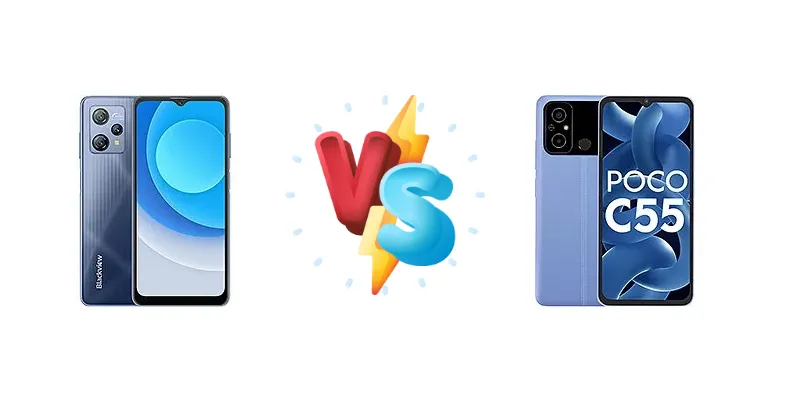
The sub-$150 smartphone market is fiercely competitive. Both the Blackview A53 Pro and Xiaomi Poco C55 aim to deliver the most features for the least amount of money. However, they take different approaches to achieving this, primarily through their chipset choices. This comparison will dissect those differences and determine which phone offers the best overall experience.
🏆 Quick Verdict
For most users, the Xiaomi Poco C55 emerges as the better choice. Its Helio G85 chipset provides a noticeable performance uplift over the Blackview A53 Pro’s Helio G35, translating to smoother multitasking and a more responsive gaming experience, despite both phones sharing the same 10W charging.
| Network |
|---|
| 2G bands | GSM 850 / 900 / 1800 / 1900 | GSM 850 / 900 / 1800 / 1900 |
| 3G bands | HSDPA 850 / 1700(AWS) / 1900 - USA | HSDPA 850 / 900 / 2100 |
| 4G bands | 1, 3, 7, 8, 20, 40 - International | 1, 3, 5, 8, 40, 41 |
| Speed | HSPA, LTE | HSPA, LTE |
| Technology | GSM / HSPA / LTE | GSM / HSPA / LTE |
| | 2, 3, 4, 5, 7, 8, 12, 13, 17, 25, 26, 28, 41, 66 - USA | - |
| Launch |
|---|
| Announced | 2023, March 03 | 2023, February 21 |
| Status | Available. Released 2023, March | Available. Released 2023, February 28 |
| Body |
|---|
| Build | Glass front, plastic frame, plastic back | Glass front (Panda Glass), eco leather back |
| Dimensions | 164.6 x 76.9 x 9.4 mm (6.48 x 3.03 x 0.37 in) | 168.8 x 76.4 x 8.8 mm (6.65 x 3.01 x 0.35 in) |
| SIM | Nano-SIM + Nano-SIM | Nano-SIM + Nano-SIM |
| Weight | 194.6 g (6.88 oz) | 192 g (6.77 oz) |
| | - | Dust and splash resistant |
| Display |
|---|
| Protection | - | Panda Glass |
| Resolution | 720 x 1600 pixels, 20:9 ratio (~270 ppi density) | 720 x 1650 pixels (~268 ppi density) |
| Size | 6.5 inches, 102.0 cm2 (~80.6% screen-to-body ratio) | 6.71 inches, 106.5 cm2 (~82.6% screen-to-body ratio) |
| Type | IPS LCD | IPS LCD |
| Platform |
|---|
| CPU | Octa-core (4x2.3 GHz Cortex-A53 & 4x1.8 GHz Cortex-A53) | Octa-core (2x2.0 GHz Cortex-A75 & 6x1.8 GHz Cortex-A55) |
| Chipset | Mediatek MT6765 Helio G35 (12 nm) | Mediatek MT6769Z Helio G85 (12 nm) |
| GPU | PowerVR GE8320 | Mali-G52 MC2 |
| OS | Android 12, Doke OS 3.0 | Android 12, MIUI 13 for POCO |
| Memory |
|---|
| Card slot | microSDXC (uses shared SIM slot) | microSDXC (dedicated slot) |
| Internal | 64GB 4GB RAM | 64GB 4GB RAM, 128GB 6GB RAM |
| | eMMC 5.0 | eMMC 5.1 |
| Main Camera |
|---|
| Dual | - | 50 MP, f/1.8, (wide), PDAF
0.08 MP (depth) |
| Features | LED flash | LED flash, HDR |
| Single | 8 MP | 50 MP, f/1.8, (wide), PDAF
Auxiliary lens |
| Triple | 12 MP
other unspecified camera | - |
| Video | 1080p@30fps | 1080p@30fps |
| Selfie camera |
|---|
| Features | - | HDR |
| Single | 8 MP | 5 MP |
| Video | Yes | 1080p@30fps |
| Sound |
|---|
| 3.5mm jack | Yes | Yes |
| 35mm jack | Yes | Yes |
| Loudspeaker | Yes | Yes |
| Comms |
|---|
| Bluetooth | 5.0, A2DP, LE | 5.0, A2DP, LE |
| NFC | No | No |
| Positioning | GPS, GLONASS, GALILEO, BDS | GPS, GLONASS, GALILEO, BDS, QZSS |
| Radio | FM radio | FM radio, recording |
| USB | USB Type-C, OTG | microUSB 2.0, OTG |
| WLAN | Wi-Fi 802.11 b/g/n/ac | Wi-Fi 802.11 a/b/g/n/ac, dual-band |
| Features |
|---|
| Sensors | Unspecified | Fingerprint (rear-mounted), accelerometer |
| | - | Virtual proximity sensing |
| Battery |
|---|
| Charging | 10W wired | 10W wired |
| Type | 5080 mAh | Li-Po 5000 mAh |
| Misc |
|---|
| Colors | Rock Grey, Murky Black, Starry Blue | Cool Blue, Power Black, Forest Green |
| Models | - | 22127PC95I |
| Price | - | About 110 EUR |
| SAR | - | 0.87 W/kg (head) 0.77 W/kg (body) |
Blackview A53 Pro
- Potentially more rugged build quality (Blackview's brand focus)
- Simple, straightforward Android experience
- Competitive price point
- Significantly weaker processor performance
- Less refined software experience
- Limited gaming capabilities
Xiaomi Poco C55
- More powerful Helio G85 processor
- Improved multitasking and gaming performance
- Better software optimization from Xiaomi
- 10W charging is slow
- May include bloatware (common with Xiaomi)
- Build quality may not be as robust as Blackview
Display Comparison
Neither device boasts a standout display. Both likely utilize LCD panels, common in this price bracket. The focus here isn't on visual fidelity, but functionality. Without specific display specs, we can assume similar resolutions and brightness levels. The real difference will be in color calibration and viewing angles, areas where Xiaomi typically demonstrates a slight edge in software optimization. Bezels are likely comparable, prioritizing cost savings over premium aesthetics.
Camera Comparison
Both phones likely feature basic camera setups geared towards casual photography. Without detailed sensor information, it’s safe to assume both will include a primary camera and potentially a depth or macro sensor. The image processing capabilities of Xiaomi’s software are generally more sophisticated, potentially resulting in better dynamic range and color accuracy in photos taken with the Poco C55. The A53 Pro will likely rely on more basic algorithms. The presence of a 2MP macro lens on either device is largely a marketing tactic, offering limited practical benefit due to the low resolution and lack of optical image stabilization.
Performance
The core difference lies in the chipsets. The Poco C55’s Mediatek Helio G85 (12nm) is a significant upgrade over the Blackview A53 Pro’s Helio G35 (12nm). The G85 features a more modern CPU configuration – 2x2.0 GHz Cortex-A75 cores and 6x1.8 GHz Cortex-A55 cores – compared to the G35’s 4x2.3 GHz Cortex-A53 and 4x1.8 GHz Cortex-A53. The Cortex-A75 cores in the G85 offer substantially better single-core performance, crucial for app launch speeds and general responsiveness. While both use the same 12nm process, the architectural improvements in the G85 translate to a smoother user experience, particularly noticeable when multitasking or playing demanding games. The G85's GPU is also more powerful, offering better frame rates in games.
Battery Life
Both devices are equipped with 10W wired charging, indicating a similar charging experience – expect around 2.5-3 hours for a full charge. Battery capacity isn't specified, but given the price point, both likely fall in the 5000mAh range. The Helio G85 in the Poco C55 is slightly more power-efficient than the G35, potentially leading to marginally better battery life under heavy use. However, the difference will likely be minimal for typical users.
Buying Guide
Buy the Blackview A53 Pro if you prioritize a brand with a reputation for ruggedness and are primarily focused on basic smartphone tasks like calling, texting, and light social media use. Buy the Xiaomi Poco C55 if you want a more capable all-rounder, especially if you enjoy mobile gaming or frequently switch between apps, and value a slightly more refined software experience.
Frequently Asked Questions
❓ Will the Poco C55 be able to run popular games like PUBG Mobile smoothly?
The Helio G85 in the Poco C55 is capable of running PUBG Mobile at medium settings with reasonable frame rates. While it won't deliver a flagship gaming experience, it's a significant improvement over the Helio G35 in the Blackview A53 Pro, which would struggle with consistent performance.
❓ Is the software on the Blackview A53 Pro heavily customized, and will it receive regular updates?
Blackview typically uses a near-stock Android experience, which is a positive for users who prefer a clean interface. However, Blackview's update track record is less consistent than Xiaomi's. Expect fewer software updates and potentially a delayed upgrade to newer Android versions.
❓ Does either phone support fast charging, or am I limited to 10W with both?
Unfortunately, both the Blackview A53 Pro and the Xiaomi Poco C55 are limited to 10W wired charging. This means charging times will be relatively slow compared to phones with 18W or higher fast charging capabilities. Plan for approximately 2.5 to 3 hours for a full charge.
❓ I'm concerned about bloatware. Which phone has less pre-installed unwanted apps?
Xiaomi is known to include some pre-installed apps (bloatware) on its phones, although this has improved in recent years. Blackview generally offers a cleaner software experience with fewer pre-installed apps. However, you can often uninstall or disable most of the bloatware on Xiaomi devices.