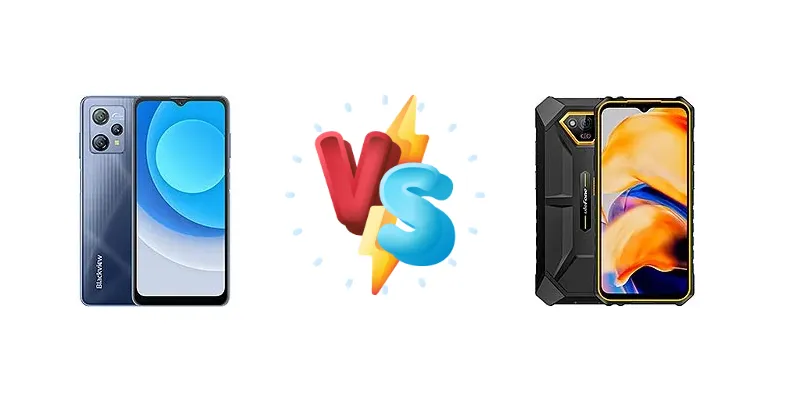
The Blackview A53 Pro and Ulefone Armor X13 represent the fiercely competitive sub-$150 smartphone market. Both devices aim to deliver essential functionality at an incredibly low price point, but they take slightly different approaches. The A53 Pro focuses on a more conventional design, while the Armor X13 leans into ruggedness and extended battery life. This comparison will dissect their key specifications to determine which offers the best value.
🏆 Quick Verdict
For the average user prioritizing longevity and reliability, the Ulefone Armor X13 is the better choice. Its Helio G36 chipset, coupled with a reported 83:15h endurance and 1000 charge cycles, provides a more robust user experience than the Blackview A53 Pro's Helio G35 and standard 10W charging.
| Network |
|---|
| 2G bands | GSM 850 / 900 / 1800 / 1900 | GSM 850 / 900 / 1800 / 1900 |
| 3G bands | HSDPA 850 / 1700(AWS) / 1900 - USA | HSDPA 850 / 900 / 1700(AWS) / 1900 / 2100 |
| 4G bands | 1, 3, 7, 8, 20, 40 - International | 1, 2, 3, 4, 5, 7, 8, 12, 17, 19, 20, 28, 34, 38, 39, 40, 41, 66 |
| Speed | HSPA, LTE | HSPA, LTE |
| Technology | GSM / HSPA / LTE | GSM / HSPA / LTE |
| | 2, 3, 4, 5, 7, 8, 12, 13, 17, 25, 26, 28, 41, 66 - USA | - |
| Launch |
|---|
| Announced | 2023, March 03 | 2023, August |
| Status | Available. Released 2023, March | Available. Released 2023, August |
| Body |
|---|
| Build | Glass front, plastic frame, plastic back | - |
| Dimensions | 164.6 x 76.9 x 9.4 mm (6.48 x 3.03 x 0.37 in) | 173 x 83 x 13.6 mm (6.81 x 3.27 x 0.54 in) |
| SIM | Nano-SIM + Nano-SIM | Nano-SIM + Nano-SIM |
| Weight | 194.6 g (6.88 oz) | 300 g (10.58 oz) |
| Display |
|---|
| Protection | - | Mohs level 4 |
| Resolution | 720 x 1600 pixels, 20:9 ratio (~270 ppi density) | 720 x 1600 pixels, 20:9 ratio (~269 ppi density) |
| Size | 6.5 inches, 102.0 cm2 (~80.6% screen-to-body ratio) | 6.52 inches, 102.6 cm2 (~71.5% screen-to-body ratio) |
| Type | IPS LCD | IPS LCD |
| Platform |
|---|
| CPU | Octa-core (4x2.3 GHz Cortex-A53 & 4x1.8 GHz Cortex-A53) | Octa-core (4x2.2 GHz Cortex-A53 & 4x1.7 GHz Cortex-A53) |
| Chipset | Mediatek MT6765 Helio G35 (12 nm) | Mediatek Helio G36 (12 nm) |
| GPU | PowerVR GE8320 | PowerVR GE8320 |
| OS | Android 12, Doke OS 3.0 | Android 13 |
| Memory |
|---|
| Card slot | microSDXC (uses shared SIM slot) | microSDXC (dedicated slot) |
| Internal | 64GB 4GB RAM | 64GB 6GB RAM |
| | eMMC 5.0 | - |
| Main Camera |
|---|
| Dual | - | 50 MP, f/1.8, (wide), 0.64µm, PDAF
24 MP, f/1.8, (night vision), 2 infrared night vision lights |
| Features | LED flash | LED flash |
| Single | 8 MP | - |
| Triple | 12 MP
other unspecified camera | - |
| Video | 1080p@30fps | 1080p@30fps |
| Selfie camera |
|---|
| Single | 8 MP | 8 MP, f/2.0, (wide), 1.12µm |
| Video | Yes | Yes |
| Sound |
|---|
| 3.5mm jack | Yes | - |
| 35mm jack | Yes | Yes |
| Loudspeaker | Yes | Yes |
| Comms |
|---|
| Bluetooth | 5.0, A2DP, LE | 5.0, A2DP, LE |
| NFC | No | Yes |
| Positioning | GPS, GLONASS, GALILEO, BDS | GPS, GLONASS, GALILEO, BDS |
| Radio | FM radio | Wireless FM radio, RDS, recording |
| USB | USB Type-C, OTG | USB Type-C 2.0 |
| WLAN | Wi-Fi 802.11 b/g/n/ac | Wi-Fi 802.11 a/b/g/n/ac, dual-band |
| Features |
|---|
| Sensors | Unspecified | Accelerometer, proximity |
| Battery |
|---|
| Charging | 10W wired | 10W wired |
| Type | 5080 mAh | Li-Po 6320 mAh |
| Misc |
|---|
| Colors | Rock Grey, Murky Black, Starry Blue | Black, Black/Orange |
| Price | - | About 130 EUR |
| EU LABEL |
|---|
| Battery | - | 83:15h endurance, 1000 cycles |
| Energy | - | Class A |
| Free fall | - | Class A (270 falls) |
| Repairability | - | Class C |
Blackview A53 Pro
- Slightly higher CPU clock speed (potentially faster single-core performance)
- More conventional smartphone design
- Lower price (potentially, depending on retailer)
- Inferior battery endurance compared to Ulefone
- No stated battery cycle life
- Likely less durable build quality
Ulefone Armor X13
- Exceptional battery life (83:15h endurance)
- 1000 charge cycle rating for long-term reliability
- Potentially more durable build (implied by 'Armor' branding)
- Slightly lower CPU clock speed
- May be bulkier due to ruggedized design
- Potentially higher price
Display Comparison
Neither device provides display specifications beyond the basic panel type. Given the price point, expect 720p+ resolution LCD panels. The focus here isn't on visual fidelity. The absence of details like peak brightness or color gamut suggests both prioritize cost savings over display quality. Users should anticipate a functional, but not exceptional, viewing experience.
Camera Comparison
Detailed camera specifications are absent for both devices. Given the market segment, expect basic camera setups focused on functionality rather than image quality. The absence of information suggests neither phone will excel in photography. Users should manage expectations and view the cameras as adequate for casual snapshots rather than serious photography. The focus is on providing a camera for basic documentation, not artistic expression.
Performance
Both phones utilize Mediatek’s Helio series, but the Ulefone Armor X13 boasts the slightly newer Helio G36 chipset clocked at 2.2 GHz versus the A53 Pro’s Helio G35 at 2.3 GHz. While the A53 Pro’s CPU clock speed is marginally higher, the G36’s architectural improvements and integrated GPU likely translate to smoother performance in gaming and multitasking. Both CPUs share the same core configuration (4x2.3/2.2 GHz Cortex-A53 & 4x1.8/1.7 GHz Cortex-A53), meaning the difference will be felt in sustained performance rather than peak speeds. The G36’s improved efficiency could also contribute to better battery life.
Battery Life
The Ulefone Armor X13 significantly differentiates itself with a reported 83:15h endurance rating and a claimed 1000 charge cycles. This is a substantial advantage over the Blackview A53 Pro, which offers only 10W wired charging without any stated endurance figures. The Armor X13’s battery longevity is a key selling point for users who frequently find themselves away from power outlets or require a phone that can withstand heavy usage. While both charge at 10W, the Armor X13’s larger capacity and optimized power management provide a clear benefit.
Buying Guide
Buy the Blackview A53 Pro if you need a basic smartphone for everyday tasks like calling, texting, and light social media use, and are comfortable with potentially shorter battery life. Buy the Ulefone Armor X13 if you prioritize battery endurance, require a more durable device for outdoor activities or demanding work environments, and want a phone that will reliably last through a full day – and beyond – on a single charge.
Frequently Asked Questions
❓ Is the Ulefone Armor X13 truly as durable as its 'Armor' branding suggests?
While specific durability certifications (like IP68 or MIL-STD-810G) aren't provided in the context data, the 'Armor' branding strongly implies a more ruggedized design than the Blackview A53 Pro. This likely means improved resistance to drops, dust, and water, making it suitable for outdoor use or demanding work environments. However, without official certifications, the extent of its durability remains uncertain.
❓ Will the Helio G36 in the Ulefone Armor X13 handle basic gaming adequately?
The Helio G36 is capable of handling less demanding mobile games at lower settings. While it won't deliver a high-end gaming experience, it should be sufficient for casual gaming and titles like PUBG Mobile or Call of Duty Mobile at reduced graphics settings. The A53 Pro's G35 will perform similarly, but the G36's slight architectural advantage may provide a marginally smoother experience.
❓ How long will the 10W charging take to fully charge the Ulefone Armor X13, given its large battery?
While the exact 0-100% charging time isn't specified, expect it to take several hours (likely 3-5 hours) to fully charge the Ulefone Armor X13 due to its larger battery capacity and the slow 10W charging rate. However, the exceptional battery endurance means you won't need to fully charge it as frequently as the Blackview A53 Pro.