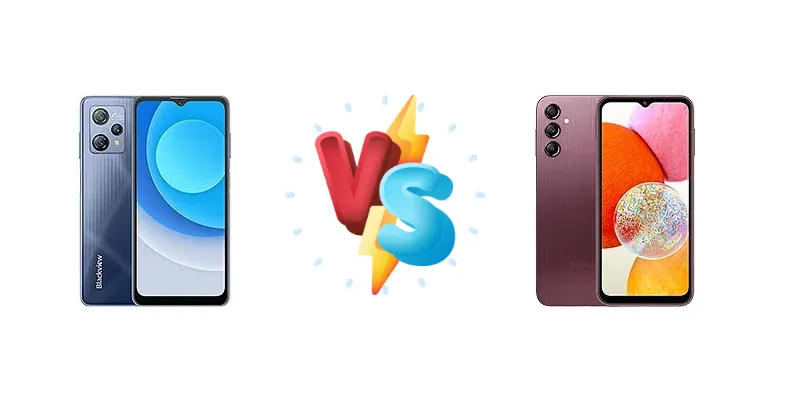
The sub-$200 smartphone market is fiercely competitive. The Blackview A53 Pro and Samsung Galaxy A14 both aim to deliver essential smartphone functionality at an accessible price point. However, they take different approaches to achieving this, with the A14 offering a choice of chipsets and the A53 Pro focusing on a streamlined experience. This comparison dissects their key differences to determine which device offers the best value.
🏆 Quick Verdict
For most users, the Samsung Galaxy A14 (specifically the Helio G80 version) is the better choice. Its more powerful chipset provides a noticeably smoother experience, especially with multitasking and demanding apps. While the A53 Pro is cheaper, the performance trade-off is significant.
| Network |
|---|
| 2G bands | GSM 850 / 900 / 1800 / 1900 | GSM 850 / 900 / 1800 / 1900 |
| 3G bands | HSDPA 850 / 1700(AWS) / 1900 - USA | HSDPA 850 / 900 / 2100 |
| 4G bands | 1, 3, 7, 8, 20, 40 - International | 1, 3, 5, 7, 8, 20, 28, 38, 40, 41 |
| Speed | HSPA, LTE | HSPA, LTE |
| Technology | GSM / HSPA / LTE | GSM / HSPA / LTE |
| | 2, 3, 4, 5, 7, 8, 12, 13, 17, 25, 26, 28, 41, 66 - USA | - |
| Launch |
|---|
| Announced | 2023, March 03 | 2023, February 28 |
| Status | Available. Released 2023, March | Available. Released 2023, March 27 |
| Body |
|---|
| Build | Glass front, plastic frame, plastic back | Glass front, plastic back, plastic frame |
| Dimensions | 164.6 x 76.9 x 9.4 mm (6.48 x 3.03 x 0.37 in) | 167.7 x 78 x 9.1 mm (6.60 x 3.07 x 0.36 in) |
| SIM | Nano-SIM + Nano-SIM | · Nano-SIM· Nano-SIM + Nano-SIM |
| Weight | 194.6 g (6.88 oz) | 201 g (7.09 oz) |
| Display |
|---|
| Resolution | 720 x 1600 pixels, 20:9 ratio (~270 ppi density) | 1080 x 2408 pixels, 20:9 ratio (~400 ppi density) |
| Size | 6.5 inches, 102.0 cm2 (~80.6% screen-to-body ratio) | 6.6 inches, 104.9 cm2 (~80.2% screen-to-body ratio) |
| Type | IPS LCD | PLS LCD |
| Platform |
|---|
| CPU | Octa-core (4x2.3 GHz Cortex-A53 & 4x1.8 GHz Cortex-A53) | Octa-core (2x2.0 GHz Cortex-A75 & 6x1.8 GHz Cortex-A55) - Version AOcta-core (4x2.0 GHz Cortex-A55 & 4x2.0 GHz Cortex-A55) - Version B |
| Chipset | Mediatek MT6765 Helio G35 (12 nm) | Mediatek MT6769 Helio G80 (12 nm) - Version AExynos 850 (8 nm) - Version B |
| GPU | PowerVR GE8320 | Mali-G52 MC2 |
| OS | Android 12, Doke OS 3.0 | Android 13, upgradable to Android 15, One UI 7 |
| Memory |
|---|
| Card slot | microSDXC (uses shared SIM slot) | microSDXC (dedicated slot) |
| Internal | 64GB 4GB RAM | 64GB 4GB RAM, 128GB 4GB RAM, 128GB 6GB RAM |
| | eMMC 5.0 | - |
| Main Camera |
|---|
| Features | LED flash | LED flash, panorama, HDR |
| Single | 8 MP | 13 MP, f/2.0, (wide) |
| Triple | 12 MP
other unspecified camera | 50 MP, f/1.8, 26mm (wide), 1/2.75", 0.64µm, PDAF
5 MP, f/2.2, 17mm (ultrawide), 1/5.0", 1.12µm
2 MP (macro) |
| Video | 1080p@30fps | 1080p@30fps |
| Selfie camera |
|---|
| Single | 8 MP | 13 MP, f/2.0, 26mm (wide), 1/3.1", 1.12µm |
| Video | Yes | 1080p@30fps |
| Sound |
|---|
| 3.5mm jack | Yes | Yes |
| 35mm jack | Yes | Yes |
| Loudspeaker | Yes | Yes |
| Comms |
|---|
| Bluetooth | 5.0, A2DP, LE | 5.1 or 5.3, A2DP, LE |
| NFC | No | Yes (market/region dependent) |
| Positioning | GPS, GLONASS, GALILEO, BDS | GPS, GALILEO, GLONASS, BDS, QZSS |
| Radio | FM radio | Unspecified |
| USB | USB Type-C, OTG | USB Type-C 2.0 |
| WLAN | Wi-Fi 802.11 b/g/n/ac | Wi-Fi 802.11 a/b/g/n/ac, dual-band, Wi-Fi Direct |
| Features |
|---|
| Sensors | Unspecified | Fingerprint (side-mounted), accelerometer, proximity, compass |
| Battery |
|---|
| Charging | 10W wired | 15W wired |
| Type | 5080 mAh | Li-Po 5000 mAh |
| Misc |
|---|
| Colors | Rock Grey, Murky Black, Starry Blue | Black, Dark Red, Silver, Green |
| Models | - | SM-A145F, SM-A145F/DSN, SM-A145M, SM-A145M/DS, SM-A145P, SM-A145R |
| Price | - | € 85.76 / $ 147.60 / £ 79.95 |
| SAR EU | - | 0.46 W/kg (head) 1.37 W/kg (body) |
Blackview A53 Pro
- Lower price point makes it very accessible.
- Simple and straightforward user experience.
- Potentially longer software support than some ultra-budget brands.
- Significantly weaker performance compared to the Galaxy A14.
- Slower charging speed.
- Likely limited software updates.
Samsung Galaxy A14
- More powerful chipset options (Helio G80 or Exynos 850).
- Faster charging (15W).
- Samsung’s brand reputation and software support.
- Slightly higher price.
- Performance can vary depending on the chipset version.
- May include bloatware.
Display Comparison
Neither device boasts a standout display. Both utilize 12nm chipsets, suggesting similar power constraints impacting display capabilities. Specifics like panel type (IPS vs. LCD) and resolution are missing, but both likely target a 720p+ resolution. The A14 benefits from Samsung’s display expertise, potentially offering slightly better color accuracy and viewing angles. However, without detailed specs, it's difficult to quantify the difference. Bezels are likely comparable, reflecting the budget nature of both devices.
Camera Comparison
Camera performance is likely to be similar in real-world usage, given both phones target the budget segment. Both will likely feature a primary camera accompanied by auxiliary lenses (depth, macro). The A14’s potential for better image processing, thanks to Samsung’s software, could give it a slight edge. However, the absence of sensor size information makes a definitive comparison impossible. The 2MP macro cameras on both devices are unlikely to deliver significant detail and are primarily for marketing purposes. Focusing on the main sensor’s capabilities is crucial, and the A14’s chipset may allow for faster image processing and better low-light performance.
Performance
The performance gap is the most significant differentiator. The Samsung Galaxy A14 offers two chipset options: the Mediatek Helio G80 and the Exynos 850. The Helio G80 (12nm) features a more modern CPU architecture – Cortex-A75 cores – compared to the Blackview A53 Pro’s Helio G35 (12nm) which uses older Cortex-A53 cores. This translates to a substantial advantage in CPU-intensive tasks. The Exynos 850 (8nm) version of the A14 further widens the gap, offering improved efficiency and potentially better sustained performance due to the smaller fabrication node. The A53 Pro’s Helio G35 is adequate for basic tasks, but will struggle with demanding apps or heavy multitasking. The A14’s GPU is also superior, offering a better gaming experience.
Battery Life
The battery capacity is not specified for either device, but both likely fall in the 4000-5000mAh range, typical for this price point. The Samsung Galaxy A14’s 15W charging is slightly faster than the Blackview A53 Pro’s 10W charging. While not a massive difference, it will result in quicker top-ups. The more efficient Exynos 850 version of the A14 could also contribute to longer battery life, offsetting any potential capacity differences.
Buying Guide
Buy the Blackview A53 Pro if you prioritize absolute affordability and only need a phone for basic tasks like calls, texts, and light social media. It's a good option for first-time smartphone users or as a reliable backup device. Buy the Samsung Galaxy A14 if you value a more responsive user experience, better app performance, and the backing of a major brand with a longer software support commitment. It's ideal for users who stream videos, play casual games, or multitask frequently.
Frequently Asked Questions
❓ Does the Exynos 850 chip in the Galaxy A14 overheat during prolonged gaming sessions?
The Exynos 850 (8nm) is generally efficient and well-managed. While it may get warm during extended gaming, it's unlikely to experience significant throttling due to its fabrication process and Samsung’s thermal management. The Helio G35 in the A53 Pro is more prone to throttling under sustained load.
❓ Is the 2MP macro camera on either phone actually useful for taking detailed close-up photos?
Unfortunately, no. 2MP macro cameras on budget phones typically lack the resolution and optics to capture truly detailed close-up images. They are primarily included for marketing purposes and generally produce blurry or soft results. Focus on the main camera for better image quality.
❓ Can the Samsung Galaxy A14 (Helio G80 version) handle popular games like PUBG Mobile at reasonable frame rates?
The Helio G80 version of the Galaxy A14 can run PUBG Mobile, but you'll likely need to use medium graphics settings and potentially lower the frame rate to achieve a smooth experience. Expect around 30-40 FPS. The A53 Pro’s Helio G35 will struggle to maintain playable frame rates even on the lowest settings.
❓ How long can I expect software updates to be supported on the Blackview A53 Pro?
Blackview’s software support is typically shorter than Samsung’s. Expect potentially one major Android update and limited security patches. The Samsung Galaxy A14, being a Samsung device, is likely to receive at least two major Android updates and several years of security patches.