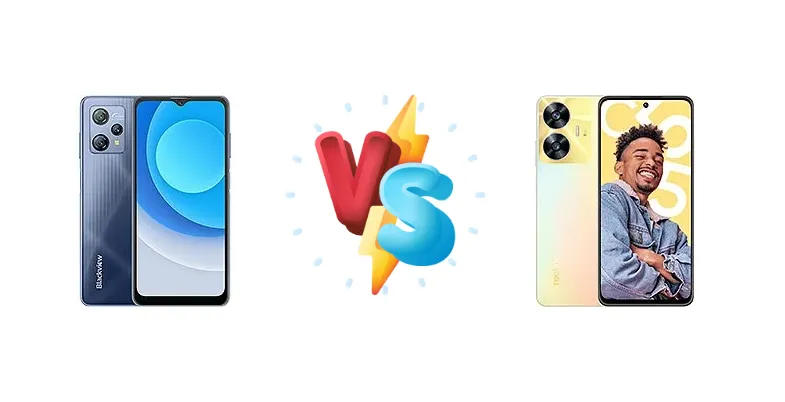
The sub-$200 smartphone market is fiercely competitive. The Blackview A53 Pro and Realme C55 both aim to deliver essential features at an accessible price point, but they take different approaches. The A53 Pro focuses on a basic, functional experience, while the C55 attempts to elevate the budget segment with faster charging and a more modern chipset. This comparison dissects their key differences to determine which device offers the best value.
🏆 Quick Verdict
For most users, the Realme C55 is the superior choice. Its Helio G88 chipset provides a noticeable performance boost over the A53 Pro’s Helio G35, and the 33W fast charging significantly reduces downtime. While both phones offer similar battery endurance ratings, the C55’s charging speed is a game-changer for convenience.
| Network |
|---|
| 2G bands | GSM 850 / 900 / 1800 / 1900 | GSM 850 / 900 / 1800 / 1900 |
| 3G bands | HSDPA 850 / 1700(AWS) / 1900 - USA | HSDPA 850 / 900 / 2100 |
| 4G bands | 1, 3, 7, 8, 20, 40 - International | 1, 3, 5, 8, 38, 40, 41 |
| Speed | HSPA, LTE | HSPA, LTE |
| Technology | GSM / HSPA / LTE | GSM / HSPA / LTE |
| | 2, 3, 4, 5, 7, 8, 12, 13, 17, 25, 26, 28, 41, 66 - USA | - |
| Launch |
|---|
| Announced | 2023, March 03 | 2023, March 07 |
| Status | Available. Released 2023, March | Available. Released 2023, March 08 |
| Body |
|---|
| Build | Glass front, plastic frame, plastic back | Glass front, plastic frame, plastic back |
| Dimensions | 164.6 x 76.9 x 9.4 mm (6.48 x 3.03 x 0.37 in) | 165.6 x 75.9 x 7.9 mm (6.52 x 2.99 x 0.31 in) |
| SIM | Nano-SIM + Nano-SIM | Nano-SIM + Nano-SIM |
| Weight | 194.6 g (6.88 oz) | 189.5 g (6.70 oz) |
| Display |
|---|
| Resolution | 720 x 1600 pixels, 20:9 ratio (~270 ppi density) | 1080 x 2400 pixels, 20:9 ratio (~392 ppi density) |
| Size | 6.5 inches, 102.0 cm2 (~80.6% screen-to-body ratio) | 6.72 inches, 109.0 cm2 (~86.7% screen-to-body ratio) |
| Type | IPS LCD | IPS LCD, 90Hz, 680 nits (peak) |
| Platform |
|---|
| CPU | Octa-core (4x2.3 GHz Cortex-A53 & 4x1.8 GHz Cortex-A53) | Octa-core (2x2.0 GHz Cortex-A75 & 6x1.8 GHz Cortex-A55) |
| Chipset | Mediatek MT6765 Helio G35 (12 nm) | Mediatek MT6769H Helio G88 (12 nm) |
| GPU | PowerVR GE8320 | Mali-G52 MC2 |
| OS | Android 12, Doke OS 3.0 | Android 13, Realme UI 4.0 |
| Memory |
|---|
| Card slot | microSDXC (uses shared SIM slot) | microSDXC (dedicated slot) |
| Internal | 64GB 4GB RAM | 64GB 4GB RAM, 64GB 6GB RAM, 128GB 4GB RAM, 128GB 6GB RAM, 128GB 8GB RAM, 256GB 8GB RAM |
| | eMMC 5.0 | - |
| Main Camera |
|---|
| Dual | - | 64 MP, (wide), 1/2.0", PDAF
Auxiliary lens |
| Features | LED flash | LED flash, HDR, panorama |
| Single | 8 MP | 8 MP, (wide) |
| Triple | 12 MP
other unspecified camera | - |
| Video | 1080p@30fps | 1080p@30/60fps |
| Selfie camera |
|---|
| Features | - | HDR, panorama |
| Single | 8 MP | 8 MP, (wide) |
| Video | Yes | 1080p@30fps |
| Sound |
|---|
| 3.5mm jack | Yes | Yes |
| 35mm jack | Yes | Yes |
| Loudspeaker | Yes | Yes |
| Comms |
|---|
| Bluetooth | 5.0, A2DP, LE | 5.2, A2DP, LE |
| NFC | No | Yes, 360˚ (market/region dependent) |
| Positioning | GPS, GLONASS, GALILEO, BDS | GPS, GLONASS, GALILEO, BDS |
| Radio | FM radio | No |
| USB | USB Type-C, OTG | USB Type-C 2.0 |
| WLAN | Wi-Fi 802.11 b/g/n/ac | Wi-Fi 802.11 a/b/g/n/ac, dual-band |
| Features |
|---|
| Sensors | Unspecified | Fingerprint (side-mounted), accelerometer, proximity, compass |
| Battery |
|---|
| Charging | 10W wired | 33W wired, 50% in 29 min |
| Type | 5080 mAh | 5000 mAh |
| Misc |
|---|
| Colors | Rock Grey, Murky Black, Starry Blue | Sun Shower, Rainy Night, Rainforest |
| Models | - | RMX3710 |
| Price | - | ₹ 8,399 |
| Tests |
|---|
| Battery life | - |
Endurance rating 123h
|
| Camera | - |
Photo / Video |
| Display | - |
Contrast ratio: 1264:1 (nominal) |
| Loudspeaker | - |
-31.8 LUFS (Below average)
|
| Performance | - |
AnTuTu: 257263 (v9)
GeekBench: 1452 (v5.1), 1413 (v6)
GFXBench: 9fps (ES 3.1 onscreen) |
Blackview A53 Pro
- Lowest possible price point
- Functional for basic tasks
- Acceptable battery endurance
- Slow Helio G35 chipset
- Extremely slow 10W charging
- Likely subpar display quality
Realme C55
- Faster Helio G88 chipset
- 33W fast charging (50% in 29 min)
- Brighter and more vibrant display
- Slightly higher price
- Camera performance likely average
- May not be ideal for intensive gaming
Display Comparison
The Realme C55 boasts a measured peak brightness of 659 nits and a 1264:1 contrast ratio, offering a more vibrant and visible display experience, particularly outdoors. While the Blackview A53 Pro’s display specifications are not provided, it’s reasonable to assume it falls behind in both brightness and contrast, typical for its price bracket. The C55’s higher brightness is a tangible benefit for users who frequently use their phones in sunlight. The identical contrast ratios suggest similar panel technology, but the Realme’s higher peak brightness is the key differentiator.
Camera Comparison
Both devices are listed as having Photo/Video capabilities, but detailed camera specifications are absent. Given the market positioning, it’s likely both rely on relatively basic camera sensors. Without specific megapixel counts or aperture information, it’s difficult to make a definitive judgment. However, Realme generally invests more in image processing algorithms, potentially giving the C55 an advantage in image quality, even with similar hardware. The absence of details suggests neither phone will excel in challenging lighting conditions.
Performance
The Realme C55’s Mediatek Helio G88 chipset represents a significant upgrade over the Blackview A53 Pro’s Helio G35. The G88 features two Cortex-A75 cores clocked at 2.0 GHz alongside six Cortex-A55 cores, compared to the A53 Pro’s four Cortex-A53 cores at 2.3 GHz and another four at 1.8 GHz. This architectural difference translates to faster application loading times and smoother multitasking on the C55. The G88’s more efficient core design also contributes to better sustained performance under load. While the A53 Pro’s higher clock speed on some cores might offer a slight edge in single-core tasks, the C55’s overall architecture is superior for real-world usage.
Battery Life
Both the Blackview A53 Pro and Realme C55 achieve an endurance rating of 123 hours, indicating comparable battery life under similar usage patterns. However, the Realme C55’s 33W wired charging is a substantial advantage. It can reach 50% charge in just 29 minutes, while the A53 Pro is limited to a slow 10W charging speed. This difference in charging speed dramatically impacts the user experience, allowing the C55 to quickly top up its battery when needed, minimizing downtime. The faster charging effectively mitigates any potential battery life differences.
Buying Guide
Buy the Blackview A53 Pro if you prioritize absolute affordability and need a functional smartphone for basic tasks like calls, texts, and light social media. It’s a suitable option for first-time smartphone users or those on a very tight budget. Buy the Realme C55 if you value performance, faster charging, and a more responsive user experience. It’s ideal for users who enjoy occasional gaming, streaming, or multitasking.
Frequently Asked Questions
❓ Is the Realme C55’s Helio G88 chipset capable of handling popular games like PUBG Mobile?
The Helio G88 is capable of running PUBG Mobile, but you’ll likely need to use medium graphics settings for a smooth experience. It’s not a gaming powerhouse, but it’s a significant step up from the Helio G35 in the Blackview A53 Pro, offering a more playable experience.
❓ How much faster is the 33W charging on the Realme C55 compared to the 10W charging on the Blackview A53 Pro in real-world use?
The difference is substantial. The Realme C55 can reach 50% charge in approximately 29 minutes, while the Blackview A53 Pro will take well over two hours to achieve the same level. This means you can quickly top up the C55 during a short break, whereas the A53 Pro requires overnight charging for a full refill.
❓ Does the Realme C55 support any form of video stabilization?
Details on video stabilization are not provided in the specifications. However, given its price point, it's unlikely to feature advanced optical image stabilization (OIS). It may offer electronic image stabilization (EIS), but the effectiveness will likely be limited.