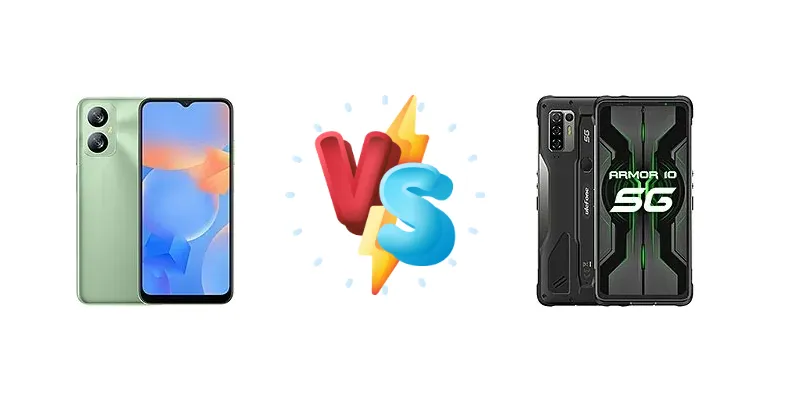
The rugged smartphone market is heating up, offering durable devices at increasingly competitive prices. We pit the Blackview A52 Pro, a budget-focused option, against the Ulefone Armor 10 5G, which aims for a balance of durability and performance, to determine which offers the best value for users needing a tough, reliable phone.
🏆 Quick Verdict
For the average user prioritizing performance and 5G connectivity, the Ulefone Armor 10 5G is the clear winner. Its Mediatek Dimensity 800 chipset delivers significantly faster processing speeds and supports 5G networks, while the A52 Pro's Unisoc T606 is geared towards basic tasks. However, the A52 Pro may appeal to those on a tighter budget.
| Network |
|---|
| 2G bands | GSM 850 / 900 / 1800 / 1900 | GSM 850 / 900 / 1800 / 1900 |
| 3G bands | HSDPA 900 / 2100 | HSDPA 850 / 900 / 1700(AWS) / 1900 / 2100 |
| 4G bands | 1, 3, 7, 8, 20 | 1, 2, 3, 4, 5, 7, 8, 12, 13, 17, 18, 19, 20, 25, 26, 28, 34, 38, 39, 40, 41, 66 |
| 5G bands | - | 1, 3, 41, 77, 78, 79 SA/NSA |
| Speed | HSPA, LTE | HSPA, LTE, 5G |
| Technology | GSM / HSPA / LTE | GSM / CDMA / HSPA / EVDO / LTE / 5G |
| | - | CDMA2000 1xEV-DO |
| Launch |
|---|
| Announced | 2023, February | 2020, November 17. Released 2020, December 07 |
| Status | Available. Released 2023, February | Discontinued |
| Body |
|---|
| Build | - | Front glass, aluminum back with rubber, aluminum frame |
| Dimensions | 164.2 x 62 x 9.1 mm (6.46 x 2.44 x 0.36 in) | 176.5 x 82.8 x 14.6 mm (6.95 x 3.26 x 0.57 in) |
| SIM | Nano-SIM + Nano-SIM | Nano-SIM + Nano-SIM |
| Weight | 183.6 g (6.49 oz) | 328 g (11.57 oz) |
| | - | IP68 dust/water resistant (up to 1.5m for 30 min)
Drop-to-concrete resistance from up to 1.2m
MIL-STD-810G compliant |
| Display |
|---|
| Protection | - | Scratch-resistant glass, oleophobic coating |
| Resolution | 720 x 1600 pixels, 20:9 ratio (~270 ppi density) | 1080 x 2400 pixels, 20:9 ratio (~395 ppi density) |
| Size | 6.5 inches, 102.0 cm2 (~100.2% screen-to-body ratio) | 6.67 inches, 107.4 cm2 (~73.5% screen-to-body ratio) |
| Type | IPS LCD | IPS LCD |
| Platform |
|---|
| CPU | Octa-core (2x1.6 GHz Cortex-A75 & 6x1.6 GHz Cortex-A55) | Octa-core (4x2.0 GHz Cortex-A76 & 4x2.0 GHz Cortex-A55) |
| Chipset | Unisoc T606 (12 nm) | Mediatek Dimensity 800 (7 nm) |
| GPU | Mali-G57 MP1 | Mali-G57 MP4 |
| OS | Android 13, Doke OS 4.0 | Android 10, planned upgrade to Android 11 |
| Memory |
|---|
| Card slot | microSDXC (uses shared SIM slot) | microSDXC (uses shared SIM slot) |
| Internal | 128GB 4GB RAM, 128GB 6GB RAM | 128GB 8GB RAM |
| Main Camera |
|---|
| Dual | 13 MP
other unspecified camera | - |
| Features | LED flash | LED flash, Panorama, HDR |
| Quad | - | 64 MP, f/1.9, 26mm (wide), 1/1.72", 0.8µm, PDAF
8 MP, f/2.2, 119˚ (ultrawide)
5 MP (macro)
Auxiliary lens |
| Video | 1080p@30fps | 4K@30fps, 1080p@30fps |
| Selfie camera |
|---|
| Single | 5 MP | 16 MP, f/2.2 |
| Video | Yes | 1080p@30fps |
| Sound |
|---|
| 3.5mm jack | - | Yes |
| 35mm jack | Yes | Yes |
| Loudspeaker | Yes | Yes |
| Comms |
|---|
| Bluetooth | 4.2, A2DP | 5.2, A2DP, LE |
| NFC | No | Yes |
| Positioning | GPS, GLONASS, GALILEO | GPS, GLONASS, GALILEO, BDS |
| Radio | Unspecified | FM radio, RDS, recording |
| USB | USB Type-C | USB Type-C 2.0, OTG |
| WLAN | Wi-Fi 802.11 b/g/n | Wi-Fi 802.11 a/b/g/n/ac, Wi-Fi Direct |
| Features |
|---|
| Sensors | Fingerprint (side-mounted); unspecified sensors | Fingerprint (side-mounted), accelerometer, gyro, proximity, compass, baroceptor, coulombmeter |
| Battery |
|---|
| Charging | - | 15W wired
15W wireless |
| Type | 5180 mAh | Li-Po 5800 mAh |
| Misc |
|---|
| Colors | Polar Night, Vitality Green, Ice Blue | Black |
| Price | About 100 EUR | About 420 EUR |
Blackview A52 Pro
- More affordable price point
- Rugged design for durability
- Potentially longer battery life due to less powerful processor (depending on battery capacity)
- Significantly slower processor
- No 5G connectivity
- Likely lower-quality display
Ulefone Armor 10 5G
- Faster and more efficient Mediatek Dimensity 800 chipset
- 5G connectivity for faster data speeds
- Wireless charging convenience
- Higher price tag
- 15W charging is relatively slow
- 5G connectivity can drain battery faster
Display Comparison
Neither device boasts a standout display. While specific display specs (resolution, brightness) are missing for the A52 Pro, its price point suggests a lower-tier panel. The Armor 10 5G, similarly, doesn't advertise premium display features. Both likely utilize IPS LCD technology, prioritizing durability over visual fidelity. The lack of high refresh rates on either device indicates a focus on power efficiency rather than a fluid user experience.
Camera Comparison
Camera details beyond sensor existence are limited. However, the Armor 10 5G likely benefits from the processing power of the Dimensity 800, enabling more sophisticated image processing algorithms. The A52 Pro’s Unisoc T606 may struggle with complex computational photography tasks. Without specific sensor size information, it’s difficult to definitively declare a winner, but the Armor 10 5G’s chipset gives it a clear advantage in image quality and processing speed. The presence of 5G also allows for faster uploads of photos and videos.
Performance
The performance gap between these two is substantial. The Ulefone Armor 10 5G’s Mediatek Dimensity 800 (7nm) significantly outperforms the Blackview A52 Pro’s Unisoc T606 (12nm). The Dimensity 800 features a more modern CPU architecture – Cortex-A76 cores versus the A75 in the T606 – resulting in faster single-core and multi-core performance. The 7nm process node also contributes to better power efficiency and thermal management, potentially reducing throttling during sustained workloads. This translates to a smoother experience with demanding apps and games for the Armor 10 5G.
Battery Life
Battery capacity is not specified for the A52 Pro, but rugged phones typically prioritize large batteries. The Ulefone Armor 10 5G offers both 15W wired and 15W wireless charging, providing convenient charging options. While 15W isn't fast charging by modern standards, it's adequate for overnight charging. The Armor 10 5G’s 5G connectivity will consume more power, but the Dimensity 800’s efficiency helps mitigate this. Without knowing the A52 Pro’s battery size, it’s difficult to compare endurance, but the Armor 10 5G’s charging versatility is a definite plus.
Buying Guide
Buy the Blackview A52 Pro if you need a highly affordable, basic rugged phone for essential communication and light tasks, and 5G isn't a priority. Buy the Ulefone Armor 10 5G if you prefer a more powerful processor for smoother multitasking, gaming, and future-proofing with 5G connectivity, and are willing to spend a bit more.
Frequently Asked Questions
❓ Will the Mediatek Dimensity 800 in the Ulefone Armor 10 5G overheat during prolonged gaming sessions?
The Dimensity 800 is a relatively efficient chipset, and Ulefone likely incorporates thermal management solutions within the ruggedized design. While some heat is expected during intensive gaming, the 7nm process node and the phone's construction should prevent significant throttling, offering a more consistent gaming experience than the A52 Pro.
❓ Is the 5G connectivity on the Ulefone Armor 10 5G worth the extra cost if I don't have 5G coverage in my area?
Even without immediate 5G access, the Armor 10 5G's 5G modem future-proofs the device for when 5G networks expand. It also generally offers improved 4G LTE performance compared to phones without 5G modems, due to advancements in modem technology. However, if 5G is unlikely to become available in your region anytime soon, the A52 Pro's lower price might be more appealing.
❓ How durable is the Blackview A52 Pro compared to other rugged phones?
While the A52 Pro is marketed as rugged, its specific IP rating (Ingress Protection) is not provided. This means its level of water and dust resistance is unknown. The Ulefone Armor 10 5G typically adheres to higher IP ratings, offering more robust protection against the elements. Therefore, the Armor 10 5G is likely the more durable option.