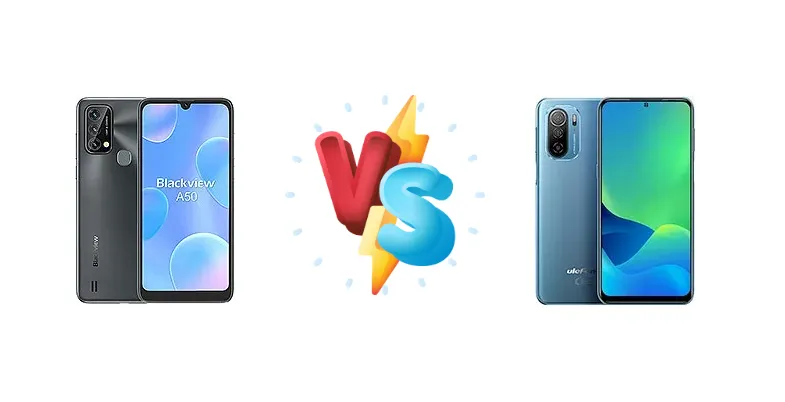
The Blackview A50 and Ulefone Note 13P represent the fiercely competitive sub-$150 Android smartphone market. Both aim to deliver essential functionality at an incredibly low price point, but they take different approaches to achieving this. The A50 leverages a newer Unisoc chipset, while the Note 13P opts for a Mediatek Helio G35. This comparison dives deep into the architectural differences and real-world implications of these choices.
🏆 Quick Verdict
For the average user prioritizing responsiveness in everyday tasks, the Blackview A50 emerges as the better choice. Its Unisoc Tiger T310, featuring a Cortex-A75 core, provides a noticeable performance edge over the Ulefone Note 13P’s all-Cortex-A53 Helio G35, despite the latter’s octa-core configuration. However, the Note 13P’s 10W charging is a significant drawback.
| Network |
|---|
| 2G bands | GSM 850 / 900 / 1800 / 1900 | GSM 850 / 900 / 1800 / 1900 |
| 3G bands | HSDPA 900 / 2100 | HSDPA 850 / 900 / 1700(AWS) / 1900 / 2100 |
| 4G bands | 1, 3, 7, 8, 20, 40 | 1, 2, 3, 4, 5, 7, 8, 12, 13, 17, 18, 19, 20, 25, 26, 28 |
| Speed | HSPA, LTE | HSPA, LTE |
| Technology | GSM / HSPA / LTE | GSM / HSPA / LTE |
| Launch |
|---|
| Announced | 2022, March 04 | 2021, November 24 |
| Status | Available. Released 2022, March | Available. Released 2021, November 24 |
| Body |
|---|
| Dimensions | 156.4 x 72.9 x 8.9 mm (6.16 x 2.87 x 0.35 in) | 162.3 x 75.7 x 9.9 mm (6.39 x 2.98 x 0.39 in) |
| SIM | Nano-SIM + Nano-SIM | Nano-SIM + Nano-SIM |
| Weight | 156 g (5.50 oz) | 198.5 g (7.02 oz) |
| Display |
|---|
| Resolution | 720 x 1560 pixels, 19.5:9 ratio (~286 ppi density) | 1080 x 2400 pixels, 20:9 ratio (~405 ppi density) |
| Size | 6.01 inches, 88.7 cm2 (~77.8% screen-to-body ratio) | 6.5 inches, 102.0 cm2 (~83.0% screen-to-body ratio) |
| Type | IPS LCD | IPS LCD |
| Platform |
|---|
| CPU | Quad-core (1x2.0 GHz Cortex-A75 & 3x1.8 GHz Cortex-A55) | Octa-core (4x2.3 GHz Cortex-A53 & 4x1.8 GHz Cortex-A53) |
| Chipset | Unisoc Tiger T310 (12 nm) | Mediatek MT6765G Helio G35 (12 nm) |
| GPU | PowerVR GE8300 | PowerVR GE8320 |
| OS | Android 11 | Android 11 |
| Memory |
|---|
| Card slot | microSDXC | microSDXC (dedicated slot) |
| Internal | 64GB 3GB RAM | 64GB 4GB RAM |
| | eMMC | eMMC 5.1 |
| Main Camera |
|---|
| Dual | - | 20 MP, f/1.8, 25mm (wide), 1/2.78, 1.0µm, AF
2 MP (macro) |
| Features | LED flash | LED flash, HDR, panorama |
| Single | 5 MP, f/2.2, (wide) | 16 MP, f/2.2, (wide), 1/3.09, 1.0µm |
| Triple | 13 MP, f/2.0, (wide), AF
other unspecified cameras | - |
| Video | 1080p@30fps | 1080p@30fps |
| Selfie camera |
|---|
| Features | - | HDR |
| Single | 5 MP, f/2.2, (wide) | 16 MP, f/2.2, (wide), 1/3.09, 1.0µm |
| Video | Yes | 1080p@30fps |
| Sound |
|---|
| 3.5mm jack | Yes | Yes |
| 35mm jack | Yes | Yes |
| Loudspeaker | Yes | Yes |
| Comms |
|---|
| Bluetooth | 5.0, A2DP, LE | 5.0, A2DP, LE |
| NFC | No | Yes |
| Positioning | GPS, GLONASS | GPS, GLONASS, GALILEO, BDS |
| Radio | FM radio | Stereo FM radio, RDS, recording |
| USB | microUSB 2.0, OTG | USB Type-C 2.0 |
| WLAN | Wi-Fi 802.11 b/g/n/ac | Wi-Fi 802.11 a/b/g/n/ac, dual-band |
| Features |
|---|
| Sensors | Fingerprint (rear-mounted), accelerometer, proximity | Fingerprint (side-mounted), accelerometer, proximity, compass |
| Battery |
|---|
| Charging | - | 10W wired |
| Type | 4280 mAh | Li-Po 5180 mAh |
| Misc |
|---|
| Colors | Black, Green, Blue, Gradient | Starry Black, Mystery Blue |
| Price | About 120 EUR | About 130 EUR |
Blackview A50
- More responsive CPU due to Cortex-A75 core
- Potentially faster image processing
- Likely better overall user experience for demanding tasks
- Charging speed is unknown and could be slow
- Limited detailed specifications available
Ulefone Note 13P
- Octa-core CPU (though less powerful cores)
- Wider software support potentially due to Mediatek's larger ecosystem
- Simple and straightforward operation
- Significantly slower CPU performance
- Very slow 10W charging
- Limited performance for multitasking or gaming
Display Comparison
Neither Blackview nor Ulefone provide detailed display specifications for these models. Assuming typical IPS LCD panels for this price bracket, the display experience will likely be similar in terms of color accuracy and viewing angles. The absence of high refresh rates or advanced features like LTPO is expected. Bezels are likely to be substantial on both devices, maximizing screen real estate within a budget-friendly design.
Camera Comparison
Detailed camera specifications are lacking for both devices. Given the price point, expect basic image sensors. The focus should be on adequate performance in good lighting conditions rather than low-light photography. The presence of multiple cameras on both phones is likely for marketing purposes, with the 2MP macro lenses offering limited practical benefit. Image processing will likely be minimal, relying heavily on the chipset’s ISP capabilities. Without specific sensor size or aperture information, a direct comparison is difficult, but the A50’s slightly more powerful chipset *may* translate to faster image processing.
Performance
The core difference lies in the chipsets. The Blackview A50’s Unisoc Tiger T310 utilizes a quad-core configuration with a single high-performance Cortex-A75 core clocked at 2.0 GHz, paired with three Cortex-A55 cores at 1.8 GHz. This 'big.LITTLE' architecture allows for efficient task switching and better performance in demanding applications. Conversely, the Ulefone Note 13P’s Mediatek Helio G35 employs an octa-core setup, but all cores are the less powerful Cortex-A53, clocked at 2.3 GHz and 1.8 GHz respectively. While the G35 has more cores, the A75 in the A50 offers significantly higher single-core performance, crucial for app launch times and UI fluidity. The 12nm process node is shared by both, suggesting similar power efficiency, but the architectural advantage favors the A50.
Battery Life
Battery capacity is not specified for either device. However, given the target market, both likely feature batteries in the 4000-5000 mAh range. The Ulefone Note 13P’s 10W wired charging is a significant disadvantage. This slow charging speed will result in extended charging times, potentially taking several hours to reach a full charge. The Blackview A50’s charging speed is unspecified, but even a modest 15W charger would offer a substantially better user experience.
Buying Guide
Buy the Blackview A50 if you need a phone that feels snappier for daily use, including social media, browsing, and light multitasking. The A75 core offers a tangible boost in responsiveness. Buy the Ulefone Note 13P if your primary concern is absolute simplicity and you prioritize a slightly wider availability of software support, though you’ll sacrifice performance and charging speed.
Frequently Asked Questions
❓ Will the Ulefone Note 13P struggle with popular apps like Facebook or WhatsApp?
The Helio G35 in the Ulefone Note 13P is capable of running these apps, but you may experience noticeable lag when switching between them or loading content. The all-Cortex-A53 cores are less efficient at handling multitasking compared to the A75 core in the Blackview A50.
❓ Is the Blackview A50 a good choice for mobile gaming?
The Blackview A50 is not designed for demanding mobile games. While it can handle simpler titles, you'll likely need to lower graphics settings and accept lower frame rates in more intensive games. The Unisoc T310 is not a gaming-focused chipset.
❓ How long will it take to fully charge the Ulefone Note 13P with its 10W charger?
Expect a full charge to take approximately 3-4 hours, potentially longer depending on the battery capacity. 10W charging is a very slow standard, making it inconvenient for users who need a quick top-up.
❓ Does either phone support fast charging standards like USB Power Delivery?
Neither phone is likely to support fast charging standards like USB Power Delivery. Both utilize basic charging technology, and the Ulefone Note 13P is limited to a very slow 10W rate.