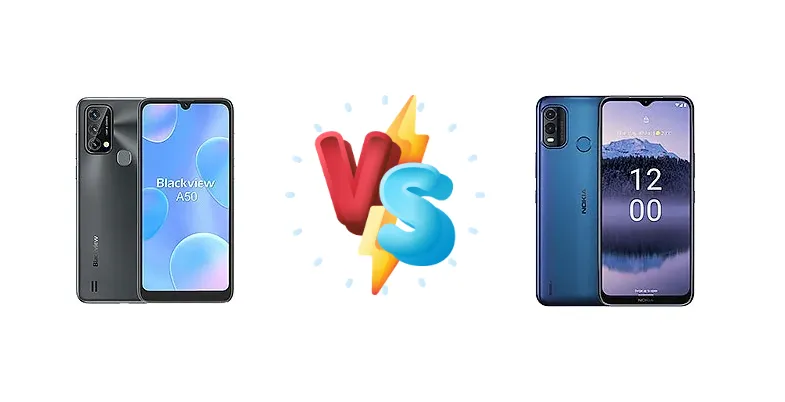
The Blackview A50 and Nokia G11 Plus represent two approaches to the ultra-budget smartphone market. Both leverage Unisoc chipsets to deliver affordability, but differ significantly in CPU core count and charging capabilities. This comparison dissects these differences to determine which device offers the best value for users prioritizing performance or longevity.
🏆 Quick Verdict
For users needing a slight performance edge in multitasking and app responsiveness, the Nokia G11 Plus is the better choice thanks to its octa-core processor. However, the Blackview A50’s potential for optimized software and potentially better thermal headroom (due to fewer cores) makes it a viable alternative, especially if priced aggressively.
| Network |
|---|
| 2G bands | GSM 850 / 900 / 1800 / 1900 | GSM 850 / 900 / 1800 / 1900 |
| 3G bands | HSDPA 900 / 2100 | HSDPA 850 / 900 / 2100 - International |
| 4G bands | 1, 3, 7, 8, 20, 40 | 1, 3, 5, 7, 8, 20, 28, 38, 40, 41 - International |
| Speed | HSPA, LTE | HSPA 42.2/5.76 Mbps, LTE Cat4 150/50 Mbps |
| Technology | GSM / HSPA / LTE | GSM / HSPA / LTE |
| | - | 1, 3, 5, 8, 40, 41 - India |
| Launch |
|---|
| Announced | 2022, March 04 | 2022, June 29 |
| Status | Available. Released 2022, March | Available. Released 2022, July 20 |
| Body |
|---|
| Build | - | Glass front, plastic frame, plastic back |
| Dimensions | 156.4 x 72.9 x 8.9 mm (6.16 x 2.87 x 0.35 in) | 164.8 x 75.9 x 8.6 mm (6.49 x 2.99 x 0.34 in) |
| SIM | Nano-SIM + Nano-SIM | · Nano-SIM· Nano-SIM + Nano-SIM |
| Weight | 156 g (5.50 oz) | 192 g (6.77 oz) |
| | - | Splash protection |
| Display |
|---|
| Resolution | 720 x 1560 pixels, 19.5:9 ratio (~286 ppi density) | 720 x 1600 pixels, 20:9 ratio (~269 ppi density) |
| Size | 6.01 inches, 88.7 cm2 (~77.8% screen-to-body ratio) | 6.52 inches, 102.6 cm2 (~82.1% screen-to-body ratio) |
| Type | IPS LCD | IPS LCD, 90Hz, 400 nits (typ) |
| Platform |
|---|
| CPU | Quad-core (1x2.0 GHz Cortex-A75 & 3x1.8 GHz Cortex-A55) | Octa-core (2x1.6 GHz Cortex-A75 & 6x1.6 GHz Cortex-A55) |
| Chipset | Unisoc Tiger T310 (12 nm) | Unisoc T606 (12 nm) |
| GPU | PowerVR GE8300 | Mali-G57 MP1 |
| OS | Android 11 | Android 12, upgradable to Android 13 |
| Memory |
|---|
| Card slot | microSDXC | microSDXC (dedicated slot) |
| Internal | 64GB 3GB RAM | 32GB 3GB RAM, 64GB 3GB RAM, 64GB 4GB RAM, 128GB 3GB RAM |
| | eMMC | eMMC 5.1 |
| Main Camera |
|---|
| Dual | - | 50 MP, f/1.8, (wide), 1/2.67", PDAF
Auxiliary lens |
| Features | LED flash | LED flash |
| Single | 5 MP, f/2.2, (wide) | 8 MP, f/2.0, (wide), 1/4.0" |
| Triple | 13 MP, f/2.0, (wide), AF
other unspecified cameras | - |
| Video | 1080p@30fps | 1080p@30fps |
| Selfie camera |
|---|
| Single | 5 MP, f/2.2, (wide) | 8 MP, f/2.0, (wide), 1/4.0" |
| Video | Yes | 1080p@30fps |
| Sound |
|---|
| 3.5mm jack | Yes | Yes |
| 35mm jack | Yes | Yes |
| Loudspeaker | Yes | Yes |
| Comms |
|---|
| Bluetooth | 5.0, A2DP, LE | 5.0, A2DP, LE |
| NFC | No | No |
| Positioning | GPS, GLONASS | GPS |
| Radio | FM radio | FM radio |
| USB | microUSB 2.0, OTG | USB Type-C 2.0, OTG |
| WLAN | Wi-Fi 802.11 b/g/n/ac | Wi-Fi 802.11 a/b/g/n/ac, dual-band, Wi-Fi Direct |
| Features |
|---|
| Sensors | Fingerprint (rear-mounted), accelerometer, proximity | Fingerprint (rear-mounted), accelerometer, proximity |
| Battery |
|---|
| Charging | - | 10W wired |
| Type | 4280 mAh | Li-Ion 5000 mAh |
| Misc |
|---|
| Colors | Black, Green, Blue, Gradient | Lake Blue, Charcoal Grey |
| Price | About 120 EUR | About 130 EUR |
Blackview A50
- Potentially better thermal management due to fewer CPU cores.
- May offer a simpler, less cluttered software experience.
- Could be more affordable, depending on market pricing.
- Quad-core processor may struggle with demanding multitasking.
- Charging speed is unknown and could be slow.
- Likely lacks advanced display features.
Nokia G11 Plus
- Octa-core processor offers better multi-tasking performance.
- Includes 10W wired charging (though slow, it's a defined spec).
- Potentially better future-proofing with more processing power.
- Octa-core processor may be more prone to thermal throttling.
- 10W charging is significantly slower than modern standards.
- Likely lacks advanced display features.
Display Comparison
Neither device boasts a standout display. Both utilize 12nm Unisoc chipsets, suggesting a focus on cost reduction over display quality. Without specific display specs (resolution, panel type, brightness), it’s reasonable to assume both feature basic LCD panels. The absence of high refresh rates or advanced features like LTPO is expected in this price bracket. Bezels are likely to be substantial on both, impacting the overall viewing experience.
Camera Comparison
Without detailed camera specifications, a meaningful comparison is difficult. Both phones likely feature basic camera setups geared towards casual photography. The market segment suggests the presence of a primary sensor and potentially a depth or macro lens on both. The absence of Optical Image Stabilization (OIS) is almost certain. Image processing will likely be heavily reliant on software algorithms, and the quality will depend on the manufacturer’s tuning. Any 2MP macro lenses present should be considered marketing features rather than genuine photographic tools.
Performance
The core difference lies in the CPU configuration. The Nokia G11 Plus’s Unisoc T606 features an octa-core setup (2x2.0 GHz Cortex-A75 & 6x1.8 GHz Cortex-A55), offering more cores and potentially better multi-tasking performance compared to the Blackview A50’s quad-core Unisoc Tiger T310 (1x2.0 GHz Cortex-A75 & 3x1.8 GHz Cortex-A55). While both utilize Cortex-A75 cores for peak performance, the additional A55 cores in the T606 will handle background tasks more efficiently. This translates to snappier app switching and a more responsive user interface on the Nokia. However, the T310’s fewer cores *could* lead to better thermal management under sustained load, preventing throttling. RAM configurations are unknown, but will significantly impact real-world performance.
Battery Life
Battery capacity is not specified for either device. However, the Nokia G11 Plus includes 10W wired charging, while the Blackview A50’s charging speed is unknown. 10W charging is notably slow by modern standards, meaning a full charge will take a considerable amount of time. A larger battery capacity on the Blackview A50, coupled with the potentially more efficient quad-core processor, could offset the slower charging if it exists. Real-world battery life will depend heavily on usage patterns and software optimization.
Buying Guide
Buy the Blackview A50 if you prioritize a potentially smoother experience with less background app interference, and are comfortable with a simpler software experience. It’s ideal for users who primarily use a few core apps and value simplicity. Buy the Nokia G11 Plus if you frequently multitask, run more demanding apps, or anticipate needing the extra processing power for future software updates. It’s better suited for users who want a more versatile device.
Frequently Asked Questions
❓ Will the Nokia G11 Plus struggle with graphically intensive games like PUBG Mobile?
The Unisoc T606 is an entry-level chipset. While it can run PUBG Mobile, expect to play at lower graphics settings and potentially experience frame drops during intense action. The phone is not designed for high-end gaming.
❓ Is the 10W charging on the Nokia G11 Plus a significant drawback?
Yes, 10W charging is quite slow compared to the 18W, 33W, or even 65W charging found on many modern smartphones. Expect a full charge to take several hours, making overnight charging essential.
❓ Does the Blackview A50 have any software bloatware?
Blackview phones have historically included some pre-installed apps. The extent of bloatware on the A50 is unknown, but users should expect to potentially uninstall unwanted applications after initial setup.
❓ Which phone is likely to receive more software updates?
Nokia generally provides more consistent software updates and security patches than Blackview, even on their budget devices. This is a significant advantage for long-term security and usability.