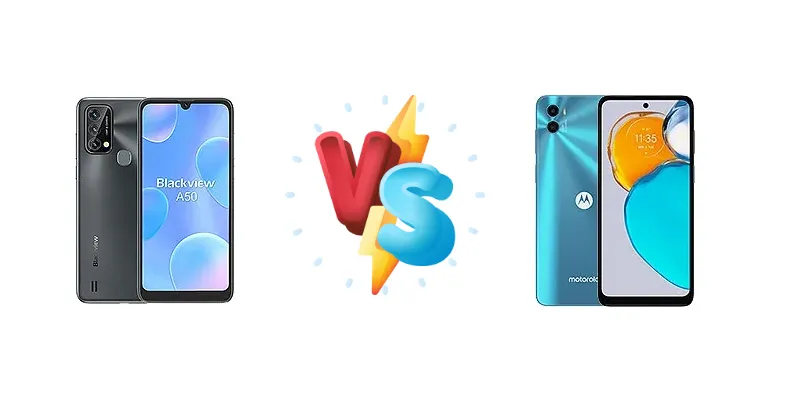
The Blackview A50 and Motorola Moto E22s represent the fiercely competitive sub-$150 smartphone market. Both aim to deliver essential smartphone functionality at an accessible price, but they take different approaches to achieving this. The A50 leverages a newer Unisoc chipset, while the Moto E22s opts for a MediaTek Helio G37. This comparison dives deep into the specifics to determine which device offers the best value.
🏆 Quick Verdict
For most users, the Motorola Moto E22s is the better choice. While the Blackview A50’s Unisoc Tiger T310 is a modern design, the Moto E22s’ Helio G37’s octa-core configuration provides a noticeable performance advantage in multi-tasking and app loading, despite both being fabricated on a 12nm process. The Moto E22s also benefits from a more established brand reputation and software support.
| Network |
|---|
| 2G bands | GSM 850 / 900 / 1800 / 1900 | GSM 850 / 900 / 1800 / 1900 |
| 3G bands | HSDPA 900 / 2100 | HSDPA 850 / 900 / 2100 |
| 4G bands | 1, 3, 7, 8, 20, 40 | 1, 3, 5, 7, 8, 20, 38, 40, 41 |
| Speed | HSPA, LTE | HSPA 42.2/5.76 Mbps, LTE Cat4 150/50 Mbps |
| Technology | GSM / HSPA / LTE | GSM / HSPA / LTE |
| Launch |
|---|
| Announced | 2022, March 04 | 2022, August 24 |
| Status | Available. Released 2022, March | Available. Released 2022, October 22 |
| Body |
|---|
| Build | - | Glass front, plastic frame, plastic back |
| Dimensions | 156.4 x 72.9 x 8.9 mm (6.16 x 2.87 x 0.35 in) | 164 x 75 x 8.5 mm (6.46 x 2.95 x 0.33 in) |
| SIM | Nano-SIM + Nano-SIM | Nano-SIM + Nano-SIM |
| Weight | 156 g (5.50 oz) | 185 g (6.53 oz) |
| | - | Water-repellent coating |
| Display |
|---|
| Resolution | 720 x 1560 pixels, 19.5:9 ratio (~286 ppi density) | 720 x 1600 pixels, 20:9 ratio (~270 ppi density) |
| Size | 6.01 inches, 88.7 cm2 (~77.8% screen-to-body ratio) | 6.5 inches, 102.0 cm2 (~82.9% screen-to-body ratio) |
| Type | IPS LCD | IPS LCD, 90Hz |
| Platform |
|---|
| CPU | Quad-core (1x2.0 GHz Cortex-A75 & 3x1.8 GHz Cortex-A55) | Octa-core (4x2.3 GHz Cortex-A53 & 4x1.8 GHz Cortex-A53) |
| Chipset | Unisoc Tiger T310 (12 nm) | Mediatek MT6765V/CB Helio G37 (12 nm) |
| GPU | PowerVR GE8300 | PowerVR GE8320 |
| OS | Android 11 | Android 12 |
| Memory |
|---|
| Card slot | microSDXC | microSDXC (dedicated slot) |
| Internal | 64GB 3GB RAM | 64GB 4GB RAM |
| | eMMC | eMMC 5.1 |
| Main Camera |
|---|
| Dual | - | 16 MP, f/2.2, (wide), 1.0µm, PDAF
Auxiliary lens |
| Features | LED flash | LED flash, HDR, panorama |
| Single | 5 MP, f/2.2, (wide) | - |
| Triple | 13 MP, f/2.0, (wide), AF
other unspecified cameras | - |
| Video | 1080p@30fps | 1080p@30fps |
| Selfie camera |
|---|
| Features | - | HDR |
| Single | 5 MP, f/2.2, (wide) | 8 MP, f/2.2, (wide), 1/4.0, 1.12µm |
| Video | Yes | 1080p@30fps |
| Sound |
|---|
| 3.5mm jack | Yes | Yes |
| 35mm jack | Yes | Yes |
| Loudspeaker | Yes | Yes |
| Comms |
|---|
| Bluetooth | 5.0, A2DP, LE | 5.0, A2DP, LE |
| NFC | No | No |
| Positioning | GPS, GLONASS | GPS, GLONASS, GALILEO |
| Radio | FM radio | Unspecified |
| USB | microUSB 2.0, OTG | USB Type-C 2.0 |
| WLAN | Wi-Fi 802.11 b/g/n/ac | Wi-Fi 802.11 a/b/g/n/ac, dual-band |
| Features |
|---|
| Sensors | Fingerprint (rear-mounted), accelerometer, proximity | Fingerprint (side-mounted), accelerometer, compass |
| Battery |
|---|
| Charging | - | 10W wired |
| Type | 4280 mAh | Li-Po 5000 mAh |
| Misc |
|---|
| Colors | Black, Green, Blue, Gradient | Iceberg Blue, Cosmic Black |
| Price | About 120 EUR | About 110 EUR |
Blackview A50
- Potentially longer software support from Blackview
- Modern Unisoc chipset architecture
- May offer faster charging (spec not confirmed)
- Quad-core CPU may struggle with multitasking
- Less established brand reputation
- Software experience may be less refined
Motorola Moto E22s
- Octa-core CPU provides smoother performance
- More established brand with better software support
- Generally more refined user interface
- Slower 10W charging
- Helio G37 is an older chipset design
- May receive fewer long-term software updates
Display Comparison
Neither device boasts a standout display. Both are likely to feature LCD panels, typical for this price bracket. Specifics like resolution and brightness are missing, but the focus here is on performance. The absence of high refresh rates or advanced features like LTPO is expected. Bezels are likely to be substantial on both, maximizing screen real estate within a compact form factor.
Camera Comparison
Camera performance is likely to be similar, with both devices targeting basic photography needs. Details on sensor sizes and apertures are unavailable, but it’s safe to assume both will feature a primary sensor and potentially a depth or macro lens. The inclusion of a 2MP macro camera on either device is largely a marketing tactic, offering limited practical benefit due to the low resolution. Image processing will likely be the differentiating factor, with Motorola’s software generally offering more refined results, though both will struggle in low-light conditions.
Performance
The core difference lies in the chipset architecture. The Blackview A50’s Unisoc Tiger T310 utilizes a quad-core configuration with a single high-performance Cortex-A75 core clocked at 2.0 GHz, paired with three Cortex-A55 cores. The Motorola Moto E22s, however, employs the MediaTek Helio G37, an octa-core processor featuring four Cortex-A53 cores at 2.3 GHz and another four Cortex-A53 cores at 1.8 GHz. While the A75 core in the A50 is individually more powerful, the Helio G37’s eight cores provide superior multi-threading capabilities, resulting in smoother performance when running multiple apps or demanding tasks. The Helio G37’s higher clock speed on its primary cores further contributes to this advantage. Both chips are built on a 12nm process, suggesting similar power efficiency, but the architectural advantage favors the Moto E22s.
Battery Life
Battery capacity is not specified for either device, but both likely house batteries in the 4000-5000 mAh range, typical for this segment. The Motorola Moto E22s is limited to 10W wired charging, suggesting a longer charge time. The Blackview A50’s charging speed is unknown, but even with a slightly smaller battery, faster charging could offset the difference in overall usage time. Real-world battery life will depend heavily on usage patterns, but the efficiency of the Unisoc T310 could provide a slight edge to the A50 if both have similar capacity batteries.
Buying Guide
Buy the Blackview A50 if you prioritize a potentially longer software support lifecycle from a brand increasingly focused on durability and are comfortable with a less refined software experience. Buy the Motorola Moto E22s if you value smoother everyday performance, a more polished user interface, and the reliability of a well-established brand, even if it means slightly slower long-term software updates.
Frequently Asked Questions
❓ Is the MediaTek Helio G37 in the Moto E22s powerful enough for casual gaming?
The Helio G37 is capable of handling casual games like Candy Crush or Subway Surfers without issue. However, demanding titles like PUBG Mobile will likely require significantly reduced graphics settings and may still experience frame drops. It's not a gaming-focused chipset, but it's adequate for light gaming.
❓ How does the Unisoc Tiger T310 in the Blackview A50 handle app switching and multitasking?
The Unisoc Tiger T310’s quad-core configuration may exhibit some lag when switching between multiple apps, especially if they are resource-intensive. While the A75 core provides a performance boost, it’s not sufficient to match the multi-threading capabilities of the Helio G37’s octa-core setup.
❓ What kind of software updates can I expect from Motorola and Blackview?
Motorola typically provides one major Android update and a few security patches for devices in this price range. Blackview is improving its software support, but updates may be less frequent and take longer to arrive. Expect a more consistent update schedule from Motorola.
❓ Does the Motorola Moto E22s support fast charging, and how long does it take to fully charge?
The Motorola Moto E22s supports only 10W wired charging. This is relatively slow, and a full charge from 0% to 100% will likely take around 2.5 to 3.5 hours, depending on usage during charging.