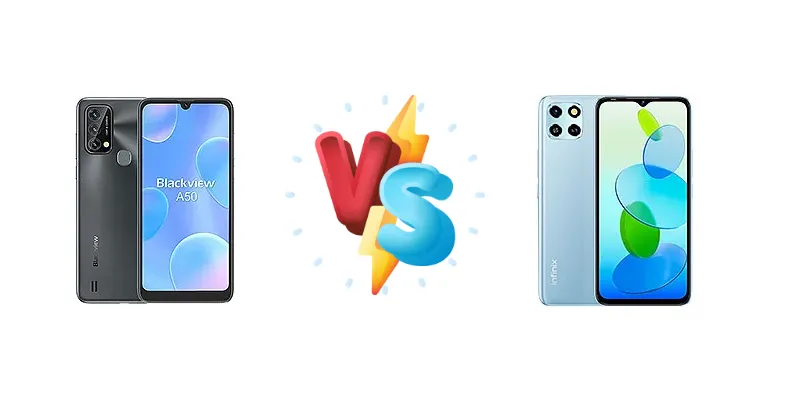
The Blackview A50 and Infinix Smart 6 HD represent the ultra-budget end of the smartphone spectrum. Both aim to deliver essential functionality at the lowest possible price point, but they take different approaches to achieving this. The key differentiator lies in their chipsets: the A50 utilizes the newer Unisoc Tiger T310, while the Smart 6 HD relies on the older Unisoc SC9863A. This comparison will dissect these differences and determine which device offers the best value for users prioritizing performance and efficiency.
🏆 Quick Verdict
For the average user seeking a responsive experience, the Blackview A50 is the better choice. Its Unisoc Tiger T310, built on a 12nm process, provides a noticeable performance advantage over the Infinix Smart 6 HD’s 28nm Unisoc SC9863A, despite the latter having more cores. While the Smart 6 HD offers 10W charging, the A50’s more efficient chipset will likely translate to better overall battery life.
| Network |
|---|
| 2G bands | GSM 850 / 900 / 1800 / 1900 | GSM 850 / 900 / 1800 / 1900 |
| 3G bands | HSDPA 900 / 2100 | HSDPA 850 / 900 / 2100 |
| 4G bands | 1, 3, 7, 8, 20, 40 | 1, 3, 5, 8, 38, 40, 41 |
| Speed | HSPA, LTE | HSPA, LTE |
| Technology | GSM / HSPA / LTE | GSM / HSPA / LTE |
| | - | 1, 3, 7, 8, 20 |
| Launch |
|---|
| Announced | 2022, March 04 | 2022, April 26 |
| Status | Available. Released 2022, March | Available. Released 2022, April 26 |
| Body |
|---|
| Build | - | Glass front, plastic back, plastic frame |
| Dimensions | 156.4 x 72.9 x 8.9 mm (6.16 x 2.87 x 0.35 in) | 165.6 x 76.4 x 9.1 mm (6.52 x 3.01 x 0.36 in) |
| SIM | Nano-SIM + Nano-SIM | Nano-SIM + Nano-SIM |
| Weight | 156 g (5.50 oz) | - |
| Display |
|---|
| Resolution | 720 x 1560 pixels, 19.5:9 ratio (~286 ppi density) | 720 x 1600 pixels, 20:9 ratio (~266 ppi density) |
| Size | 6.01 inches, 88.7 cm2 (~77.8% screen-to-body ratio) | 6.6 inches, 105.2 cm2 (~83.1% screen-to-body ratio) |
| Type | IPS LCD | IPS LCD, 500 nits (peak) |
| Platform |
|---|
| CPU | Quad-core (1x2.0 GHz Cortex-A75 & 3x1.8 GHz Cortex-A55) | Octa-core (4x1.6 GHz Cortex-A55 & 4x1.2 GHz Cortex-A55) |
| Chipset | Unisoc Tiger T310 (12 nm) | Unisoc SC9863A (28 nm) |
| GPU | PowerVR GE8300 | IMG8322 |
| OS | Android 11 | Android 11 (Go edition), XOS 7.6 |
| Memory |
|---|
| Card slot | microSDXC | microSDXC (dedicated slot) |
| Internal | 64GB 3GB RAM | 32GB 2GB RAM, 64GB 3GB RAM |
| | eMMC | eMMC 5.1 |
| Main Camera |
|---|
| Dual | - | 8 MP, AF
Auxiliary lens |
| Features | LED flash | Dual-LED flash |
| Single | 5 MP, f/2.2, (wide) | 5 MP |
| Triple | 13 MP, f/2.0, (wide), AF
other unspecified cameras | - |
| Video | 1080p@30fps | 1080p@30fps |
| Selfie camera |
|---|
| Features | - | LED flash |
| Single | 5 MP, f/2.2, (wide) | 5 MP |
| Video | Yes | 720p@30fps |
| Sound |
|---|
| 3.5mm jack | Yes | Yes |
| 35mm jack | Yes | Yes |
| Loudspeaker | Yes | Yes |
| Comms |
|---|
| Bluetooth | 5.0, A2DP, LE | Yes |
| NFC | No | No |
| Positioning | GPS, GLONASS | GPS |
| Radio | FM radio | FM radio |
| USB | microUSB 2.0, OTG | microUSB 2.0, OTG |
| WLAN | Wi-Fi 802.11 b/g/n/ac | Wi-Fi 802.11 b/g/n |
| Features |
|---|
| Sensors | Fingerprint (rear-mounted), accelerometer, proximity | Accelerometer, proximity |
| Battery |
|---|
| Charging | - | 10W wired |
| Type | 4280 mAh | 5000 mAh |
| Misc |
|---|
| Colors | Black, Green, Blue, Gradient | Force Black, Origin Blue, Aqua Sky |
| Models | - | X6512 |
| Price | About 120 EUR | About 80 EUR |
Blackview A50
- More modern and efficient Unisoc Tiger T310 chipset
- Potentially smoother user experience due to Cortex-A75 core
- Likely better battery life due to 12nm process
- Charging speed specification unavailable
- Display specifications are unknown
Infinix Smart 6 HD
- 10W wired charging
- Lower initial price point (likely)
- Octa-core processor (though less efficient)
- Older and less efficient Unisoc SC9863A chipset
- 28nm process leads to higher power consumption
- Slower overall performance
Display Comparison
Neither device boasts a standout display. Both are likely to feature LCD panels, typical for this price bracket. The absence of detailed display specifications necessitates a focus on the chipset’s impact on UI smoothness. A more powerful chipset, like the A50’s, can mitigate the visual shortcomings of a basic display by ensuring faster rendering of animations and transitions.
Camera Comparison
Given the price point, camera expectations should be tempered. Both devices likely feature basic camera setups. Without specific sensor details, it’s difficult to make a definitive judgment. However, the A50’s more capable chipset could potentially offer slightly better image processing capabilities, leading to marginally improved photo quality. The presence of a 2MP macro camera on either device is largely a marketing gimmick and unlikely to deliver significant value.
Performance
The core difference lies in the chipsets. The Blackview A50’s Unisoc Tiger T310 (12nm) features a quad-core configuration with a Cortex-A75 performance core clocked at 2.0 GHz, paired with three Cortex-A55 efficiency cores at 1.8 GHz. This architecture prioritizes single-core performance, crucial for responsive app launching and general UI navigation. Conversely, the Infinix Smart 6 HD’s Unisoc SC9863A (28nm) utilizes an octa-core setup with four Cortex-A55 cores at 1.6 GHz and four at 1.2 GHz. While more cores *can* be beneficial, the older 28nm process and less powerful core design result in lower individual core performance and significantly higher power consumption. The A50’s newer architecture will translate to a more fluid experience, especially when multitasking.
Battery Life
The Infinix Smart 6 HD includes 10W wired charging, a slight advantage over potentially slower charging on the A50 (specifications are unavailable). However, the A50’s more efficient Unisoc Tiger T310 (12nm) chipset will consume less power during operation. This means that despite potentially having a similar battery capacity (unspecified for both), the A50 is likely to offer longer real-world battery life, offsetting the Smart 6 HD’s faster charging speed. The 28nm process of the SC9863A is inherently less efficient, leading to quicker battery drain.
Buying Guide
Buy the Blackview A50 if you need a phone that feels reasonably snappy for everyday tasks like browsing, social media, and light messaging. Its more modern chipset architecture will provide a smoother user experience. Buy the Infinix Smart 6 HD if your primary concern is absolute lowest price and you only need a phone for very basic communication – calls and texts – and are willing to accept slower performance and potentially shorter battery life. The 10W charging is a minor benefit for those who prioritize a small charging convenience.
Frequently Asked Questions
❓ Will the Infinix Smart 6 HD struggle with popular apps like WhatsApp and Facebook?
The Unisoc SC9863A chipset in the Smart 6 HD is likely to exhibit noticeable lag when running multiple apps simultaneously, or even with moderately demanding apps like WhatsApp and Facebook. While it can handle basic functionality, expect slower loading times and occasional stuttering. The Blackview A50’s chipset will provide a smoother experience.
❓ Is the Blackview A50 a good choice for mobile gaming?
Neither device is well-suited for serious mobile gaming. The chipsets lack the graphical power to run demanding games at playable frame rates. However, the Blackview A50’s more powerful processor will handle simpler games and casual gaming better than the Infinix Smart 6 HD. Expect to play only very basic 2D games comfortably.
❓ How much storage do these phones typically offer, and can it be expanded?
Both devices likely come with limited internal storage (around 32GB or 64GB). Fortunately, both typically include a microSD card slot for storage expansion, allowing you to add more space for photos, videos, and apps. Check the specific model's specifications to confirm the maximum supported microSD card capacity.