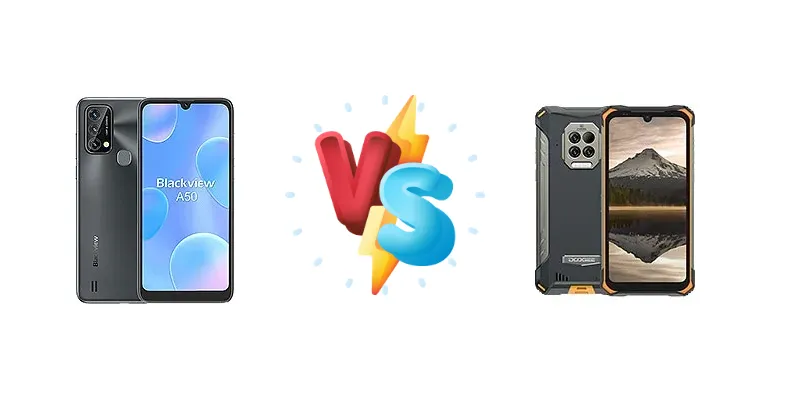
The Blackview A50 and Doogee S86 Pro represent a growing segment: affordable, rugged smartphones designed to withstand the elements. Both aim to provide durability without breaking the bank, but they take different approaches to performance and features. This comparison dissects their core components to determine which offers the best value for users needing a tough, reliable device.
🏆 Quick Verdict
For the average user prioritizing overall responsiveness and faster charging, the Doogee S86 Pro is the better choice. Its Helio P60 chipset, with its octa-core configuration, provides a noticeable performance advantage over the Blackview A50’s quad-core Tiger T310. While both offer rugged builds, the S86 Pro’s 24W charging is a significant convenience.
| Network |
|---|
| 2G bands | GSM 850 / 900 / 1800 / 1900 | GSM 850 / 900 / 1800 / 1900 |
| 3G bands | HSDPA 900 / 2100 | HSDPA 850 / 900 / 1700(AWS) / 1900 / 2100 |
| 4G bands | 1, 3, 7, 8, 20, 40 | 1, 2, 3, 4, 5, 7, 8, 12, 13, 17, 19, 20, 25, 26, 28, 66 |
| Speed | HSPA, LTE | HSPA, LTE |
| Technology | GSM / HSPA / LTE | GSM / HSPA / LTE |
| Launch |
|---|
| Announced | 2022, March 04 | 2021, June 04 |
| Status | Available. Released 2022, March | Available. Released 2021, June 15 |
| Body |
|---|
| Dimensions | 156.4 x 72.9 x 8.9 mm (6.16 x 2.87 x 0.35 in) | 164.6 x 81.2 x 16.8 mm (6.48 x 3.20 x 0.66 in) |
| SIM | Nano-SIM + Nano-SIM | Nano-SIM + Nano-SIM |
| Weight | 156 g (5.50 oz) | 323 g (11.39 oz) |
| Display |
|---|
| Protection | - | Corning Gorilla Glass |
| Resolution | 720 x 1560 pixels, 19.5:9 ratio (~286 ppi density) | 720 x 1560 pixels, 19.5:9 ratio (~282 ppi density) |
| Size | 6.01 inches, 88.7 cm2 (~77.8% screen-to-body ratio) | 6.1 inches, 91.3 cm2 (~68.3% screen-to-body ratio) |
| Type | IPS LCD | IPS LCD |
| Platform |
|---|
| CPU | Quad-core (1x2.0 GHz Cortex-A75 & 3x1.8 GHz Cortex-A55) | Octa-core (4x2.0 GHz Cortex-A73 & 4x2.0 GHz Cortex-A53) |
| Chipset | Unisoc Tiger T310 (12 nm) | Mediatek MT6771 Helio P60 (12 nm) |
| GPU | PowerVR GE8300 | Mali-G72 MP3 |
| OS | Android 11 | Android 10 |
| Memory |
|---|
| Card slot | microSDXC | microSDXC (uses shared SIM slot) |
| Internal | 64GB 3GB RAM | 128GB 8GB RAM |
| | eMMC | - |
| Main Camera |
|---|
| Features | LED flash | Quad-LED flash, HDR, panorama |
| Single | 5 MP, f/2.2, (wide) | - |
| Triple | 13 MP, f/2.0, (wide), AF
other unspecified cameras | 16 MP, f/2.0, (wide), PDAF
8 MP, f/2.2, 130˚, (ultrawide)
2 MP (macro) |
| Video | 1080p@30fps | 1080p |
| Selfie camera |
|---|
| Single | 5 MP, f/2.2, (wide) | 8 MP, f/2.2, (wide) |
| Video | Yes | 1080p |
| Sound |
|---|
| 3.5mm jack | Yes | - |
| 35mm jack | Yes | Yes |
| Loudspeaker | Yes | Yes |
| Comms |
|---|
| Bluetooth | 5.0, A2DP, LE | 5.0, A2DP, LE |
| NFC | No | Yes |
| Positioning | GPS, GLONASS | GPS, GLONASS, BDS, GALILEO |
| Radio | FM radio | FM radio |
| USB | microUSB 2.0, OTG | USB Type-C 2.0, OTG |
| WLAN | Wi-Fi 802.11 b/g/n/ac | Wi-Fi 802.11 a/b/g/n |
| Features |
|---|
| Sensors | Fingerprint (rear-mounted), accelerometer, proximity | Fingerprint (side-mounted), accelerometer, gyro, proximity, compass, infrared thermometer (surface temperature) |
| Battery |
|---|
| Charging | - | 24W wired |
| Type | 4280 mAh | 8500 mAh |
| Misc |
|---|
| Colors | Black, Green, Blue, Gradient | Black, Orange, Red |
| Price | About 120 EUR | About 230 EUR |
Blackview A50
- Potentially lower price point
- Rugged design for durability
- Suitable for basic smartphone tasks
- Quad-core processor may feel sluggish
- Likely slower charging speeds
- Limited multitasking capabilities
Doogee S86 Pro
- Octa-core Helio P60 offers better performance
- 24W fast charging for quicker top-ups
- More responsive user experience
- May be slightly more expensive
- Rugged design may add bulk
- Camera performance likely similar to A50
Display Comparison
Neither device’s display specifications are provided, so a direct comparison is limited. However, given their price points, both likely utilize IPS LCD panels. The focus here will be on durability; rugged phones prioritize screen protection. Expect both to feature reinforced glass, but details like Gorilla Glass version or scratch resistance are unknown. Bezels are likely to be substantial on both to contribute to structural integrity.
Camera Comparison
Without detailed camera specifications, a precise comparison is difficult. However, it’s safe to assume both phones will feature multiple rear cameras, likely including a main sensor, a depth sensor, and potentially a macro lens. The quality will heavily depend on the main sensor’s resolution and aperture. Given the price bracket, image processing will likely be software-focused, aiming to enhance details and reduce noise. The presence of Optical Image Stabilization (OIS) is unlikely on either device. Users shouldn’t expect flagship-level camera performance, but adequate results for social media and casual photography are reasonable.
Performance
The core difference lies in the chipsets. The Doogee S86 Pro’s MediaTek Helio P60 is an octa-core processor built on a 12nm process, featuring four Cortex-A73 cores clocked at 2.0 GHz and four Cortex-A53 cores at 2.0 GHz. This configuration provides a significant advantage in multi-threaded tasks compared to the Blackview A50’s Unisoc Tiger T310. The T310 is a quad-core chip with a single Cortex-A75 core at 2.0 GHz and three Cortex-A55 cores at 1.8 GHz. While both are 12nm, the Helio P60’s eight cores allow for better parallel processing, resulting in smoother app switching and a more responsive user experience. This translates to a benefit for users who frequently multitask or run demanding applications. The S86 Pro will likely handle gaming better, though neither is a gaming powerhouse.
Battery Life
Battery capacity isn’t specified for the Blackview A50, but rugged phones typically prioritize large batteries. The Doogee S86 Pro stands out with its 24W wired charging capability. This is a significant advantage over the likely slower charging speeds of the A50. While a larger mAh capacity doesn’t automatically equate to longer battery life (software optimization plays a role), the S86 Pro’s faster charging means less downtime. Users who frequently use their phones throughout the day will appreciate the ability to quickly top up the battery.
Buying Guide
Buy the Blackview A50 if you need a basic, durable phone for essential tasks like calls, texts, and light app usage, and prioritize a lower initial cost. Buy the Doogee S86 Pro if you prefer a more responsive experience for multitasking, occasional gaming, and appreciate the convenience of faster 24W wired charging, even if it means a slightly higher price point.
Frequently Asked Questions
❓ Will the Doogee S86 Pro’s Helio P60 overheat during prolonged use, like gaming or video recording?
The Helio P60 is a relatively efficient chip, and the S86 Pro’s rugged design likely incorporates heat dissipation features. While it may get warm during intensive tasks, it’s unlikely to overheat to the point of performance throttling, especially compared to more powerful, less efficiently cooled chips. However, extended gaming sessions may still result in some temperature increase.
❓ Is the Unisoc Tiger T310 in the Blackview A50 sufficient for running popular social media apps like Facebook and Instagram?
Yes, the Unisoc Tiger T310 is capable of running popular social media apps without significant issues. However, expect some lag when switching between multiple apps or loading complex content. It’s best suited for light usage and won’t provide a fluid experience for demanding tasks.
❓ How durable are these phones, and what kind of protection do they offer against drops and water?
Both phones are marketed as rugged, meaning they’re designed to withstand drops, dust, and water. However, specific IP ratings (e.g., IP68, IP69K) are not provided in the context data. Users should check the manufacturer’s specifications for precise details on water resistance and drop protection. Expect reinforced corners and a robust build, but avoid intentionally subjecting them to extreme conditions beyond their rated capabilities.