
Infinix Note 30 Pro vs Blackview A100: A Detailed Comparison
| Phones Images | |||||
|---|---|---|---|---|---|
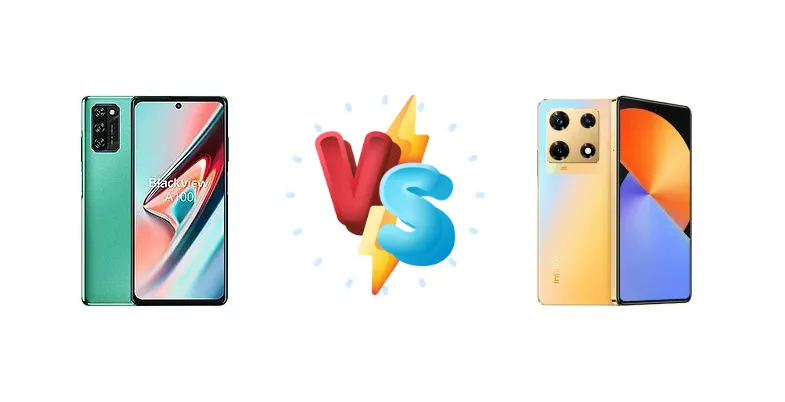
|
🏆 Quick Verdict
For most users, the Infinix Note 30 Pro is the superior choice. Its Helio G99 chipset, coupled with 68W fast charging and wireless charging capabilities, offers a significantly smoother and more convenient experience than the Blackview A100's older Helio P70 and slower 18W charging. The performance gap justifies the price difference.
| PHONES | ||
|---|---|---|
| Phone Names | Blackview A100 | Infinix Note 30 Pro |
| Network | ||
|---|---|---|
| 2G bands | GSM 850 / 900 / 1800 / 1900 | GSM 850 / 900 / 1800 / 1900 |
| 3G bands | HSDPA 850 / 900 / 1700(AWS) / 1900 / 2100 | HSDPA 850 / 900 / 1700(AWS) / 1900 / 2100 |
| 4G bands | 1, 2, 3, 4, 5, 7, 8, 12, 13, 17, 18, 19, 20, 25, 26, 28, 34, 38, 39, 40, 41, 66 | 1, 2, 3, 4, 5, 7, 8, 12, 17, 20, 28, 38, 40, 41, 66 |
| Speed | HSPA, LTE | HSPA, LTE |
| Technology | GSM / CDMA / HSPA / CDMA2000 / LTE | GSM / HSPA / LTE |
| Launch | ||
|---|---|---|
| Announced | 2021, June 21 | 2023, May 22 |
| Status | Available. Released 2021, June | Available. Released 2023, May 22 |
| Body | ||
|---|---|---|
| Build | - | Glass front, plastic frame, glass back |
| Dimensions | 166.3 x 77.6 x 8.8 mm (6.55 x 3.06 x 0.35 in) | 162.7 x 76 x 8.2 mm (6.41 x 2.99 x 0.32 in) |
| SIM | Nano-SIM + Nano-SIM | Nano-SIM + Nano-SIM |
| Weight | 195 g (6.88 oz) | 203 g (7.16 oz) |
| - | IP53 | |
| Display | ||
|---|---|---|
| Resolution | 1080 x 2400 pixels, 20:9 ratio (~395 ppi density) | 1080 x 2400 pixels, 20:9 ratio (~395 ppi density) |
| Size | 6.67 inches, 107.4 cm2 (~83.2% screen-to-body ratio) | 6.67 inches, 107.4 cm2 (~86.9% screen-to-body ratio) |
| Type | IPS LCD | AMOLED, 1B colors, 120Hz, 900 nits (peak) |
| - | * the display diagonal size and resolution is unconfirmed | |
| Platform | ||
|---|---|---|
| CPU | Octa-core (4x2.1 GHz Cortex-A73 & 4x2.0 GHz Cortex-A53) | Octa-core (2x2.2 GHz Cortex-A76 & 6x2.0 GHz Cortex-A55) |
| Chipset | Mediatek MT6771T Helio P70 (12 nm) | Mediatek Helio G99 (6 nm) |
| GPU | Mali-G72 MP3 | Mali-G57 MC2 |
| OS | Android 11 | Android 13, XOS 13 |
| Memory | ||
|---|---|---|
| Card slot | microSDXC | microSDXC (dedicated slot) |
| Internal | 128GB 6GB RAM | 256GB 8GB RAM |
| Main Camera | ||
|---|---|---|
| Features | LED flash | Quad-LED flash, HDR, panorama |
| Triple | 12 MP, f/1.8, (wide), dual pixel PDAF 8 MP, (ultrawide) Auxiliary lens | 108 MP, (wide), 1/1.67", PDAF 2 MP (macro) Auxiliary lens |
| Video | 1080p@30fps | 1440p@30fps, 1080p@30fps |
| Selfie camera | ||
|---|---|---|
| Features | - | LED flash, HDR |
| Single | 8 MP, (wide) | 32 MP, f/2.0, (wide), 1/2.8" |
| Video | 1080p@30fps | 1080p@30fps |
| Sound | ||
|---|---|---|
| 3.5mm jack | No | Yes |
| 35mm jack | No | Yes |
| Loudspeaker | Yes | Yes, with dual speakers |
| - | Sound by JBL 24-bit/192kHz audio | |
| Comms | ||
|---|---|---|
| Bluetooth | 4.2, A2DP, LE | Yes |
| NFC | Yes | Yes (market/region dependent) |
| Positioning | GPS, GLONASS, GALILEO, BDS | GPS |
| Radio | FM radio | FM radio |
| USB | USB Type-C 2.0, OTG | USB Type-C 2.0, OTG |
| WLAN | Wi-Fi 802.11 a/b/g/n/ac, dual-band | Wi-Fi 802.11 a/b/g/n/ac, dual-band, Wi-Fi Direct |
| Features | ||
|---|---|---|
| Sensors | Fingerprint (side-mounted), accelerometer, gyro, proximity, compass | Fingerprint (side-mounted), accelerometer, gyro, proximity, compass |
| Battery | ||
|---|---|---|
| Charging | 18W wired | 68W wired, PD3.0, 80% in 30 min 15W wireless Reverse wireless |
| Type | 4680 mAh | 5000 mAh |
| Misc | ||
|---|---|---|
| Colors | Gray, Blue, Green, Pink | Magic Black, Variable Gold |
| Models | - | X678B |
| Price | About 180 EUR | - |
Blackview A100
- Most affordable option
- Simple and straightforward user experience
- Potentially longer battery life due to less powerful chipset (depending on battery capacity)
- Outdated Helio P70 chipset
- Slow 18W charging
- Likely inferior camera performance
Infinix Note 30 Pro
- Faster and more efficient Helio G99 chipset
- 68W fast charging with PD3.0
- Wireless and reverse wireless charging
- Likely better camera performance
- Higher price point
- May require a separate charger to fully utilize 68W charging
Display Comparison
Neither device's display specifications are provided, so a direct comparison is limited. However, given the market positioning, the Blackview A100 likely utilizes an LCD panel, while the Infinix Note 30 Pro may feature an AMOLED display. The Note 30 Pro's potential for deeper blacks and more vibrant colors would be a significant advantage. Bezels are likely comparable, given both target budget-conscious consumers. Color accuracy is also unknown, but the Note 30 Pro, being newer, may benefit from improved calibration.
Camera Comparison
Without detailed camera specifications, a precise comparison is difficult. However, the market segment suggests the Infinix Note 30 Pro likely features a more advanced camera system. While both phones may include multiple lenses, the Note 30 Pro is more likely to have a larger main sensor with a wider aperture, resulting in better low-light performance and image quality. The P70’s image signal processor (ISP) is older, meaning the A100 will likely exhibit more noise and less dynamic range in photos. We can assume both phones will include a standard set of modes, but the Note 30 Pro’s processing capabilities will likely offer more refined image processing.
Performance
The Infinix Note 30 Pro’s Mediatek Helio G99 (6nm) represents a substantial upgrade over the Blackview A100’s Helio P70 (12nm). The G99 utilizes newer Cortex-A76 cores (2x2.2 GHz) compared to the P70’s Cortex-A73 cores (4x2.1 GHz). This architectural shift, combined with the more efficient 6nm process, translates to better single-core and multi-core performance, and improved power efficiency. The G99’s GPU will also deliver a noticeably smoother gaming experience. The P70, while capable for basic tasks, will struggle with demanding applications and modern games. The Note 30 Pro is the clear winner for users who prioritize responsiveness and gaming.
Battery Life
The battery capacity isn't specified for either device, but the charging capabilities are a major differentiator. The Infinix Note 30 Pro’s 68W wired charging, with a claimed 80% charge in 30 minutes, is significantly faster than the Blackview A100’s 18W charging. The addition of 15W wireless charging and reverse wireless charging on the Note 30 Pro adds further convenience. Even if the A100 has a slightly larger battery capacity, the Note 30 Pro’s faster charging will minimize downtime. The Note 30 Pro’s PD3.0 support also ensures compatibility with a wider range of chargers.
Buying Guide
Buy the Blackview A100 if you prioritize absolute affordability and basic smartphone functionality, and are willing to compromise on performance and charging speed. It's a suitable option for users with very light usage patterns. Buy the Infinix Note 30 Pro if you value faster performance for gaming and multitasking, significantly quicker charging, and the convenience of wireless charging – even if it means spending a bit more.