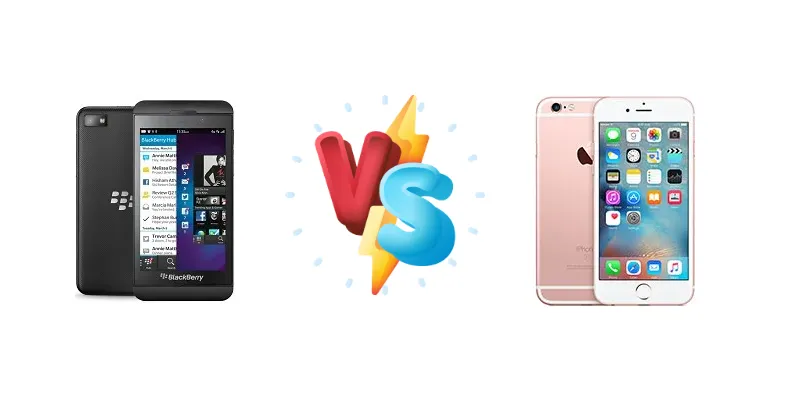
Remember the BlackBerry Z10, a bold attempt to challenge the smartphone status quo? Now, let's pit it against the iconic iPhone 6s, a device that defined a generation. This comparison dives deep into their specs, performance, and overall value to see which phone holds up best today.
🏆 Quick Verdict
The iPhone 6s wins this comparison. While the Z10 boasts impressive sunlight contrast, the iPhone 6s offers superior performance thanks to its A9 chip, longer battery life, and a more polished iOS experience. It's a classic for a reason.
| Network |
|---|
| 2G bands | GSM 850 / 900 / 1800 / 1900 - all versions | GSM 850 / 900 / 1800 / 1900 |
| 3G bands | HSDPA 850 / 900 / 1900 / 2100 - STL100-1 | HSDPA 850 / 900 / 1700 / 1900 / 2100 |
| 4G bands | 3, 7, 8, 20 - STL100-2 | 1, 2, 3, 4, 5, 7, 8, 12, 13, 17, 18, 19, 20, 25, 26, 28, 29 - A1688 |
| Speed | HSPA 21.1/5.76 Mbps, LTE, EV-DO Rev.A 3.1 Mbps | HSPA 42.2/5.76 Mbps, LTE (2CA) Cat6 300/50 Mbps, EV-DO Rev.A 3.1 Mbps |
| Technology | GSM / CDMA / HSPA / LTE | GSM / CDMA / HSPA / EVDO / LTE |
| | 13 - STL100-4 | 1, 2, 3, 4, 5, 7, 8, 12, 13, 17, 18, 19, 20, 25, 26, 28, 29, 30, 38, 39, 40, 41 - A1687 |
| Launch |
|---|
| Announced | 2013, January. Released 2013, January | 2015, September 09. Released 2015, September 25 |
| Status | Discontinued | Discontinued |
| Body |
|---|
| Build | Glass front, plastic back, plastic frame | Glass front (Corning-made glass), aluminum back, aluminum frame |
| Dimensions | 130 x 65.6 x 9 mm (5.12 x 2.58 x 0.35 in) | 138.3 x 67.1 x 7.1 mm (5.44 x 2.64 x 0.28 in) |
| SIM | Micro-SIM | Nano-SIM |
| Weight | 137.5 g (4.83 oz) | 143 g (5.04 oz) |
| | - | Apple Pay (Visa, MasterCard, AMEX certified) |
| Display |
|---|
| Protection | - | Ion-strengthened glass, oleophobic coating |
| Resolution | 768 x 1280 pixels, 5:3 ratio (~355 ppi density) | 750 x 1334 pixels, 16:9 ratio (~326 ppi density) |
| Size | 4.2 inches, 50.2 cm2 (~58.9% screen-to-body ratio) | 4.7 inches, 60.9 cm2 (~65.6% screen-to-body ratio) |
| Type | TFT | IPS LCD, 500 nits |
| | - | 3D Touch |
| Platform |
|---|
| CPU | Dual-core 1.5 GHz Krait | Dual-core 1.84 GHz Twister |
| Chipset | Qualcomm MSM8960 Snapdragon S4 Plus | Apple A9 (14/16 nm - maker dependant) |
| GPU | Adreno 225 | PowerVR GT7600 (six-core graphics) |
| OS | BlackBerry OS 10, upgradable to 10.3.1 | iOS 9, upgradable to iOS 15.8.5 |
| Memory |
|---|
| Card slot | microSDXC (dedicated slot) | No |
| Internal | 16GB 2GB RAM | 16GB 2GB RAM, 32GB 2GB RAM, 64GB 2GB RAM, 128GB 2GB RAM |
| Main Camera |
|---|
| Features | LED flash, HDR, panorama | Dual-LED dual-tone flash, HDR |
| Single | 8 MP, f/2.2, 31mm (standard), AF | 12 MP, f/2.2, 29mm (standard), 1/3.0", 1.22µm, PDAF |
| Video | 1080p@30fps | 4K@30fps, 1080p@60fps,1080p@120fps, 720p@240fps |
| Selfie camera |
|---|
| Features | - | Face detection, HDR, panorama |
| Single | 2 MP | 5 MP, f/2.2, 31mm (standard) |
| Video | 720p@30fps | 720p@30fps |
| Sound |
|---|
| 3.5mm jack | Yes | Yes |
| 35mm jack | Yes | Yes |
| Loudspeaker | Yes | Yes |
| | - | 16-bit/44.1kHz audio
|
| Comms |
|---|
| Bluetooth | 4.0, A2DP, LE | 4.2, A2DP, LE |
| NFC | Yes | Yes (Apple Pay only) |
| Positioning | GPS | GPS, GLONASS, GALILEO, QZSS |
| Radio | No | No |
| USB | microUSB 2.0 | Lightning, USB 2.0 |
| WLAN | Wi-Fi 802.11 a/b/g/n, dual-band, DLNA, hotspot | Wi-Fi 802.11 a/b/g/n/ac, dual-band, hotspot |
| Features |
|---|
| Sensors | Accelerometer, gyro, proximity, compass | Fingerprint (front-mounted), accelerometer, gyro, proximity, compass, barometer |
| | HDMI port | - |
| Battery |
|---|
| Stand-by | Up to 312 h | Up to 240 h (3G) |
| Talk time | Up to 10 h | Up to 14 h (3G) |
| Type | Li-Ion 1800 mAh, removable | Li-Ion 1715 mAh, non-removable (6.91 Wh) |
| Misc |
|---|
| Colors | Black, White | Space Gray, Silver, Gold, Rose Gold |
| Models | - | A1633, A1688, A1691, A1700, iPhone8,1 |
| Price | About 120 EUR | About 230 EUR |
| SAR | 1.07 W/kg (head) 1.07 W/kg (body) | 1.14 W/kg (head) 1.14 W/kg (body) |
| SAR EU | 0.87 W/kg (head) 0.99 W/kg (body) | 0.87 W/kg (head) 0.98 W/kg (body) |
| Tests |
|---|
| Audio quality |
Noise -82.8dB / Crosstalk -80.5dB |
Noise -93.8dB / Crosstalk -73.2dB |
| Battery life |
Endurance rating 46h
|
Endurance rating 62h
|
| Camera |
Photo / Video |
Photo / Video |
| Display |
Contrast ratio: 1532 (nominal) / 2.051:1 (sunlight) |
Contrast ratio: 1481 (nominal), 3.783 (sunlight) |
| Loudspeaker |
Voice 70dB / Noise 67dB / Ring 73dB
|
Voice 66dB / Noise 64dB / Ring 65dB
|
| Performance | - |
Basemark OS II 2.0: 2195 |
BlackBerry Z10
- Excellent sunlight display contrast
- Physical QWERTY keyboard
- Compact design
- Outdated processor
- Limited app support
- No front-facing camera
- Shorter battery life
Apple iPhone 6s
- Powerful A9 chip
- Longer battery life
- Excellent camera
- Mature iOS ecosystem
- Front-facing camera
- Older design
- Limited storage options (base models)
- No physical keyboard
Display Comparison
The Z10's display shines in direct sunlight with a remarkable 2.051:1 contrast ratio, a significant advantage. However, the iPhone 6s offers a slightly better nominal contrast ratio (1481 vs 1532) and a competitive sunlight contrast (3.783:1). Both use IPS LCD technology, providing decent color accuracy, but the iPhone 6s generally has better color calibration.
Camera Comparison
While both offer Photo/Video capabilities, the iPhone 6s's camera is noticeably superior. The iPhone 6s features an 8MP main camera with improved image processing and better low-light performance compared to the Z10's camera. The iPhone 6s also has a front-facing camera, a feature absent on the Z10.
Performance
Here, the iPhone 6s leaves the Z10 in the dust. The Apple A9 chip and its dual-core 1.84 GHz Twister CPU significantly outperform the Z10's Qualcomm MSM8960 Snapdragon S4 Plus with its dual-core 1.5 GHz Krait processor. Expect smoother multitasking, faster app loading, and better overall responsiveness on the iPhone 6s.
Battery Life
The iPhone 6s secures another win with an endurance rating of 62 hours, surpassing the Z10's 46 hours. This translates to longer usage between charges, a crucial factor for modern smartphone users.
Buying Guide
The BlackBerry Z10 is for nostalgia enthusiasts or those seeking a physical keyboard experience. The iPhone 6s is ideal for users wanting a reliable, well-supported smartphone with a strong app ecosystem and a familiar user interface.
Frequently Asked Questions
❓ Is the BlackBerry Z10 still usable in 2024?
Yes, but with caveats. It can still function for basic tasks, but app support is limited, and performance will feel slow compared to modern smartphones. Network compatibility might also be an issue depending on your carrier.
❓ Why was the BlackBerry Z10 significant?
The Z10 was BlackBerry's attempt to transition to a full touchscreen smartphone, abandoning its traditional physical keyboard focus. It represented a pivotal moment in the company's history, though ultimately unsuccessful in regaining market share.