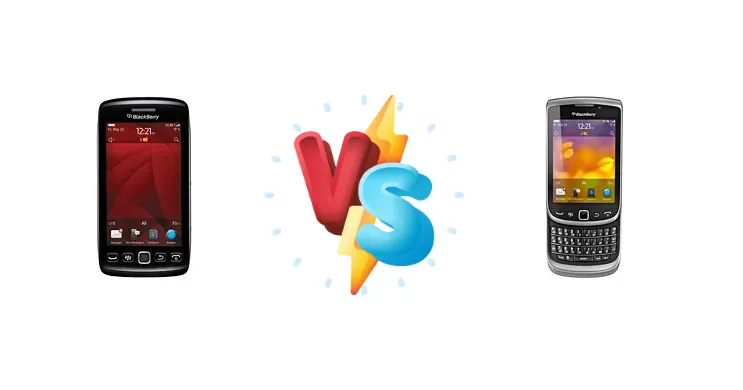
The BlackBerry Torch series represented a unique blend of touchscreen and physical keyboard, appealing to users who wanted the best of both worlds. But with two iterations – the 9850 and 9810 – which one offered the superior experience? This comprehensive comparison dives deep into their features and performance.
🏆 Quick Verdict
The BlackBerry Torch 9810 edges out the 9850 primarily due to its slightly improved display and overall refinement. While both offer the classic BlackBerry experience, the 9810's subtle upgrades make it the preferred choice for those seeking a polished device, assuming availability and price are comparable.
| Network |
|---|
| 2G bands | CDMA 800 / 1900 | GSM 850 / 900 / 1800 / 1900 |
| 3G bands | HSDPA 2100 | HSDPA 850 / 1900 / 2100 |
| Speed | HSPA 14.4/5.76 Mbps, EV-DO Rev A 3.1 Mbps | HSPA 14.4/5.76 Mbps |
| Technology | GSM / CDMA / HSPA / EVDO | GSM / HSPA |
| | CDMA2000 1xEV-DO | - |
| Launch |
|---|
| Announced | 2011, August. Released 2011, August | 2011, August. Released 2011, August |
| Status | Discontinued | Discontinued |
| Body |
|---|
| Dimensions | 120 x 62 x 11.5 mm (4.72 x 2.44 x 0.45 in) | 111 x 62 x 14.6 mm (4.37 x 2.44 x 0.57 in) |
| Keyboard | - | QWERTY |
| SIM | Mini-SIM | Mini-SIM |
| Weight | 135 g (4.76 oz) | 161 g (5.68 oz) |
| Display |
|---|
| Resolution | 480 x 800 pixels, 5:3 ratio (~252 ppi density) | 480 x 640 pixels, 4:3 ratio (~250 ppi density) |
| Size | 3.7 inches, 39.0 cm2 (~52.4% screen-to-body ratio) | 3.2 inches, 31.7 cm2 (~46.1% screen-to-body ratio) |
| Type | TFT | TFT |
| Platform |
|---|
| CPU | 1.2 GHz Scorpion | 1.2 GHz |
| Chipset | Qualcomm MSM8655 Snapdragon S2 | - |
| GPU | Adreno 205 | - |
| OS | BlackBerry OS 7 | BlackBerry OS 7.0 |
| Memory |
|---|
| Card slot | microSDHC (dedicated slot) | microSDHC (dedicated slot) |
| Internal | 4GB 768MB RAM | 8GB 768MB RAM |
| Main Camera |
|---|
| Features | LED flash | LED flash |
| Single | 5 MP, AF | 5 MP, AF |
| Video | 720p | 720p |
| Sound |
|---|
| 3.5mm jack | Yes | Yes |
| 35mm jack | Yes | Yes |
| Loudspeaker | Yes | Yes |
| Comms |
|---|
| Bluetooth | 2.1, A2DP, EDR | 2.1, A2DP |
| Positioning | GPS, A-GPS | GPS, A-GPS |
| Radio | No | No |
| USB | microUSB 2.0 | microUSB 2.0 |
| WLAN | Wi-Fi 802.11 b/g/n | Wi-Fi 802.11 b/g/n, UMA (carrier-dependent) |
| Features |
|---|
| Browser | - | HTML |
| Sensors | Accelerometer, proximity, compass | Proximity, compass |
| | Social feeds
BlackBerry maps
Document viewer
MP3/WMA/eAAC+/FlAC player
DivX/XviD/MP4/WMV/H.264
Organizer
Voice memo/dial
Predictive test input | Document viewer (Word, Excel, PowerPoint)
MP3/WMA/WAV/eAAC+ player
DivX/XviD/MP4/WMV/H.264 player
Organizer
Voice memo/dial
Predictive text input |
| Battery |
|---|
| Music play | Up to 50 h | Up to 54 h |
| Stand-by | Up to 320 h | Up to 308 h (2G) / Up to 300 h (3G) |
| Talk time | Up to 6 h 50 min | Up to 6 h 30 min (2G) / Up to 5 h 50 min (3G) |
| Type | Removable Li-Ion 1230 mAh battery | Removable Li-Ion 1270 mAh battery |
| Misc |
|---|
| Colors | Black | Black, Gray |
| Price | About 130 EUR | About 120 EUR |
| SAR | 0.90 W/kg (head) 0.66 W/kg (body) | 1.44 W/kg (head) 0.94 W/kg (body) |
| SAR EU | 0.76 W/kg (head) 0.43 W/kg (body) | 0.97 W/kg (head) 0.74 W/kg (body) |
| Tests |
|---|
| Audio quality | - |
Noise -85.7dB / Crosstalk -87.9dB |
| Camera | - |
Photo / Video |
| Display | - |
Contrast ratio: 1112:1 (nominal) |
| Loudspeaker | - |
Voice 67dB / Noise 65dB / Ring 66dB |
BlackBerry Torch 9850
- Slightly more powerful chipset
- Classic BlackBerry design
- Physical QWERTY keyboard
- Lower display contrast
- Older software
- Limited app ecosystem compared to Android/iOS
BlackBerry Torch 9810
- Superior display contrast
- Refined design
- Physical QWERTY keyboard
- Slightly more modern feel
- Older software
- Limited app ecosystem compared to Android/iOS
- Chipset details less clear
Display Comparison
Both the 9850 and 9810 feature a 3.7-inch capacitive touchscreen with a resolution of 800 x 480 pixels. However, the 9810 boasts a significantly higher contrast ratio of 1112:1 (nominal) compared to the 9850, resulting in deeper blacks and more vibrant colors. While both displays are adequate, the 9810 offers a noticeably better viewing experience, particularly in dimly lit environments.
Camera Comparison
Both devices feature a 5-megapixel camera capable of capturing photos and recording video. Image quality is comparable on both devices, with decent performance in good lighting conditions. Low-light performance is average for the era. Neither phone truly excelled in the camera department, but they were adequate for casual snapshots.
Performance
The 9850 is powered by a Qualcomm MSM8655 Snapdragon S2 chipset with a 1.2 GHz Scorpion CPU. The 9810 also features a 1.2 GHz CPU, but the underlying chipset details are less clear. While both offer acceptable performance for the BlackBerry OS 7, the 9850's Snapdragon chipset generally provided a slightly smoother multitasking experience. However, real-world performance differences are minimal.
Battery Life
Battery life on both devices was generally comparable, offering around 8-10 hours of moderate usage. The 9850's slightly more power-efficient chipset might have given it a marginal edge in some scenarios, but the difference is negligible. Battery performance was heavily influenced by usage patterns and network conditions.
Buying Guide
The BlackBerry Torch 9850 is a good choice for users who prioritize a slightly more powerful chipset and are comfortable with a potentially less vibrant display. The BlackBerry Torch 9810 is ideal for those who value a better display contrast and a more refined overall experience, especially if they appreciate a slightly more modern feel within the BlackBerry ecosystem.
Frequently Asked Questions
❓ What operating system did these devices run?
Both the BlackBerry Torch 9850 and 9810 ran BlackBerry OS 7. They were not significantly updated beyond that.
❓ Are these phones still worth buying today?
Given their age and limited software support, these phones are primarily of interest to collectors or those seeking a nostalgic BlackBerry experience. Modern smartphones offer significantly better performance, features, and security.