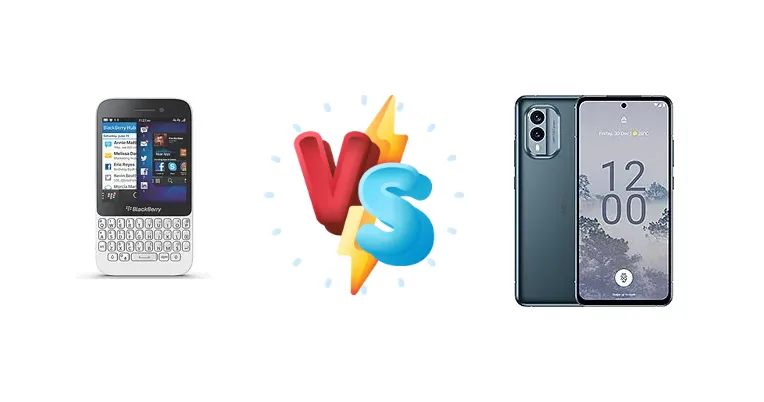
The BlackBerry Q5, a nostalgic reminder of a bygone era, faces off against the modern Nokia X30. This comparison dives deep into their specs, performance, and features to determine which phone reigns supreme in today's market. Can the Q5's legacy hold up against the X30's contemporary technology?
🏆 Quick Verdict
The Nokia X30 decisively wins this comparison. While the BlackBerry Q5 offers a physical keyboard and a unique design, the X30 boasts significantly better performance, a brighter display, a more modern chipset, and vastly superior battery life. The X30 is the clear choice for most users.
| Network |
|---|
| 2G bands | GSM 850 / 900 / 1800 / 1900 - all versions | GSM 850 / 900 / 1800 / 1900 |
| 3G bands | HSDPA 800 / 850 / 1700 / 1900 / 2100 - SQR100-1 | HSDPA 850 / 900 / 1700(AWS) / 1900 / 2100 |
| 4G bands | 2, 4, 5, 17 - SQR100-1 | 1, 2, 3, 4, 5, 7, 8, 12, 17, 20, 28, 32, 38, 39, 40, 41 |
| 5G bands | - | 1, 3, 5, 7, 8, 28, 38, 40, 41, 77, 78 SA/NSA/Sub6 |
| Speed | HSPA 42.2/5.76 Mbps, LTE Cat3 100/50 Mbps | HSPA, LTE, 5G |
| Technology | GSM / HSPA / LTE | GSM / HSPA / LTE / 5G |
| | 3, 7, 8, 20 - SQR100-2 | - |
| Launch |
|---|
| Announced | 2013, May. Released 2013, June | 2022, September 01 |
| Status | Discontinued | Available. Released 2022, September 21 |
| Body |
|---|
| Build | - | Glass front (Gorilla Glass Victus), aluminum frame, plastic back |
| Dimensions | 120 x 66 x 10.8 mm (4.72 x 2.60 x 0.43 in) | 158.9 x 73.9 x 8 mm (6.26 x 2.91 x 0.31 in) |
| Keyboard | QWERTY | - |
| SIM | Micro-SIM | · Nano-SIM + eSIM· Nano-SIM + Nano-SIM |
| Weight | 120 g (4.23 oz) | 185 g (6.53 oz) |
| | - | IP67 dust/water resistant (up to 1m for 30 min) |
| Display |
|---|
| Protection | - | Corning Gorilla Glass Victus |
| Resolution | 720 x 720 pixels, 1:1 ratio (~328 ppi density) | 1080 x 2400 pixels, 20:9 ratio (~409 ppi density) |
| Size | 3.1 inches, 31.0 cm2 (~39.1% screen-to-body ratio) | 6.43 inches, 99.8 cm2 (~85.0% screen-to-body ratio) |
| Type | IPS LCD | AMOLED, 90Hz, 450 nits (typ), 700 nits (peak) |
| Platform |
|---|
| CPU | Dual-core 1.2 GHz Krait | Octa-core (2x2.2 GHz Kryo 660 Gold & 6x1.7 GHz Kryo 660 Silver) |
| Chipset | Qualcomm MSM8960 Snapdragon S4 Plus | Qualcomm SM6375 Snapdragon 695 5G (6 nm) |
| GPU | Adreno 225 | Adreno 619 |
| OS | BlackBerry OS 10.2, upgradable to 10.3.1 | Android 12, upgradable to Android 13 |
| Memory |
|---|
| Card slot | microSDHC (dedicated slot) | No |
| Internal | 8GB 2GB RAM | 128GB 6GB RAM, 128GB 8GB RAM, 256GB 8GB RAM |
| | - | UFS 2.2 - 128GB
UFS 3.0 - 256GB |
| Main Camera |
|---|
| Dual | - | 50 MP, f/1.9, (wide), 1/1.56", 1.0µm, PDAF, OIS
13 MP, f/2.4, 123˚ (ultrawide), 1/3.06" |
| Features | LED flash, HDR, panorama | LED flash, HDR, panorama |
| Single | 5 MP, f/2.4, 30mm (standard), AF | 16 MP, f/2.4, (wide), 1/3.06", 1.0µm |
| Video | 1080p@30fps | 1080p@30/60fps |
| Selfie camera |
|---|
| Single | 2 MP | 16 MP, f/2.4, (wide), 1/3.06", 1.0µm |
| Video | 720p | 1080p@30fps |
| Sound |
|---|
| 3.5mm jack | Yes | No |
| 35mm jack | Yes | No |
| Loudspeaker | Yes | Yes |
| Comms |
|---|
| Bluetooth | 4.0, A2DP, LE | 5.1, A2DP, LE, aptX HD |
| NFC | Yes (market dependent) | Yes |
| Positioning | GPS | GPS, GLONASS, GALILEO, BDS |
| Radio | FM radio (after SW upgrade) | FM radio, RDS |
| USB | microUSB 2.0 | USB Type-C 2.0, OTG |
| WLAN | Wi-Fi 802.11 b/g/n, hotspot | Wi-Fi 802.11 a/b/g/n/ac/6, dual-band, Wi-Fi Direct |
| Features |
|---|
| Sensors | Accelerometer, gyro, proximity, compass | Fingerprint (under display, optical), accelerometer, gyro, proximity, compass |
| Battery |
|---|
| Charging | - | 33W wired, PD3.0 |
| Stand-by | Up to 336 h (3G) | - |
| Talk time | Up to 12 h 30 min (3G) | - |
| Type | Li-Ion 2180 mAh, non-removable | Li-Po 4200 mAh |
| Misc |
|---|
| Colors | Black, White, Red, Gray, Pink | Cloudy Blue, Ice White |
| Models | - | TA-1450, TA-1443 |
| Price | About 70 EUR | $ 399.00 |
| SAR | 1.33 W/kg (head) 0.85 W/kg (body) | - |
| SAR EU | 1.38 W/kg (head) 0.85 W/kg (body) | 0.79 W/kg (head) 1.37 W/kg (body) |
| Tests |
|---|
| Audio quality |
Noise -91.7dB / Crosstalk -90.7dB | - |
| Battery life |
Endurance rating 55h
|
Endurance rating 94h
|
| Camera |
Photo / Video |
Photo / Video |
| Display |
Contrast ratio: 1293:1 (nominal) / 1.682:1 (sunlight) |
Contrast ratio: Infinite (nominal) |
| Loudspeaker |
Voice 75dB / Noise 69dB / Ring 76dB
|
-27.5 LUFS (Good)
|
| Performance | - |
AnTuTu: 403732 (v9)
GeekBench: 1920 (v5.1)
GFXBench: 17fps (ES 3.1 onscreen) |
BlackBerry Q5
- Physical Keyboard
- Classic BlackBerry Design
- Decent Contrast Ratio (Nominal)
- Outdated Processor
- Poor Battery Life
- Low Brightness Display
- Limited App Support
Nokia X30
- Excellent Battery Life
- Bright Display
- Modern Chipset (5G)
- Fast Charging (33W)
- Good Performance
- No Physical Keyboard
- Design may not appeal to all
Display Comparison
The Nokia X30's display is a clear winner. Its 746 nits max brightness provides excellent visibility even in direct sunlight, a significant advantage over the Q5's contrast ratio-focused display. The 'infinite' contrast ratio claim on the X30 is likely a marketing term, but the measured brightness is the key differentiator. The Q5's 1293:1 contrast ratio is respectable, but doesn't compete with the X30's overall visual experience.
Camera Comparison
While specific camera specs are missing for both devices, the Nokia X30 is expected to have a superior camera system due to its modern hardware and image processing capabilities. The Q5's camera is likely outdated and produces lower-quality images. Nokia generally prioritizes camera quality in their devices.
Performance
The Nokia X30's Snapdragon 695 5G chipset and Octa-core CPU leave the BlackBerry Q5's Snapdragon S4 Plus and Dual-core Krait processor in the dust. The X30 offers significantly faster processing speeds, smoother multitasking, and better overall responsiveness. The Q5, while functional for basic tasks, will struggle with modern apps and demanding games.
Battery Life
The Nokia X30's 94h endurance rating is a massive improvement over the BlackBerry Q5's 55h. This translates to significantly longer battery life for the X30, allowing users to go days without needing to recharge. The X30 also benefits from 33W wired charging with PD3.0, offering faster charging speeds.
Buying Guide
Who should buy the BlackBerry Q5? Primarily those seeking a physical keyboard for enhanced typing and a retro BlackBerry experience. Who should buy the Nokia X30? Anyone looking for a reliable, modern smartphone with good performance, a decent camera, and excellent battery life, especially those valuing 5G connectivity.
Frequently Asked Questions
❓ Is the BlackBerry Q5 still worth buying?
Only if you specifically need a physical keyboard and appreciate the classic BlackBerry design. Otherwise, there are far better options available.
❓ Does the Nokia X30 support 5G?
Yes, the Nokia X30 features a Snapdragon 695 5G chipset, enabling 5G connectivity.