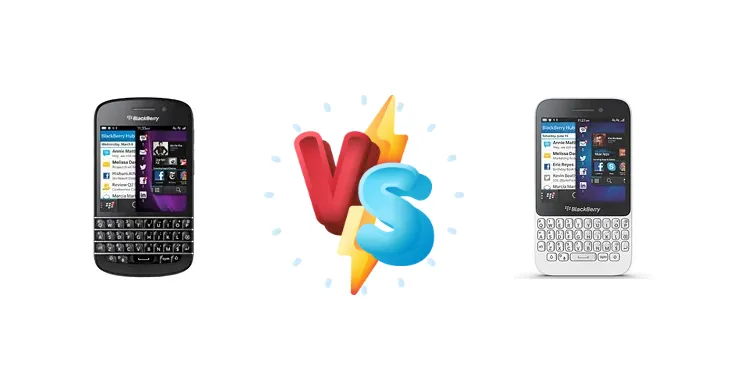
The BlackBerry Q10 and Q5 represent a fascinating era in smartphone history, both offering the beloved physical keyboard that defined BlackBerry. But beyond that shared feature, these devices differed significantly. Let's dive into a comprehensive comparison to help you decide which one might be right for you, especially if you're looking for a retro experience.
🏆 Quick Verdict
The BlackBerry Q10 edges out the Q5 thanks to its slightly more powerful processor (in the LTE version) and superior sunlight display performance. While battery life is nearly identical, the Q10's overall performance and better screen visibility make it the marginally better choice, though both offer a unique keyboard experience.
| Network |
|---|
| 2G bands | GSM 850 / 900 / 1800 / 1900 - all versions | GSM 850 / 900 / 1800 / 1900 - all versions |
| 3G bands | HSDPA 850 / 1900 / 2100 - SQN100-1 | HSDPA 800 / 850 / 1700 / 1900 / 2100 - SQR100-1 |
| 4G bands | 2, 4, 5, 17 - SQN100-1, SQN100-5 | 2, 4, 5, 17 - SQR100-1 |
| Speed | EV-DO Rev.A 3.1 Mbps, HSPA, LTE (market dependent) | HSPA 42.2/5.76 Mbps, LTE Cat3 100/50 Mbps |
| Technology | GSM / CDMA / HSPA / LTE | GSM / HSPA / LTE |
| | 25 - SQN100-4 | 3, 7, 8, 20 - SQR100-2 |
| Launch |
|---|
| Announced | 2013, January. Released 2013, April | 2013, May. Released 2013, June |
| Status | Discontinued | Discontinued |
| Body |
|---|
| Build | Glass front, plastic back, plastic frame | - |
| Dimensions | 119.6 x 66.8 x 10.4 mm (4.71 x 2.63 x 0.41 in) | 120 x 66 x 10.8 mm (4.72 x 2.60 x 0.43 in) |
| Keyboard | QWERTY | QWERTY |
| SIM | Micro-SIM | Micro-SIM |
| Weight | 139 g (4.90 oz) | 120 g (4.23 oz) |
| Display |
|---|
| Resolution | 720 x 720 pixels, 1:1 ratio (~328 ppi density) | 720 x 720 pixels, 1:1 ratio (~328 ppi density) |
| Size | 3.1 inches, 31.0 cm2 (~38.8% screen-to-body ratio) | 3.1 inches, 31.0 cm2 (~39.1% screen-to-body ratio) |
| Type | Super AMOLED | IPS LCD |
| Platform |
|---|
| CPU | Dual-core 1.5 GHz Krait (LTE version)/ Cortex-A9 (Non-LTE) | Dual-core 1.2 GHz Krait |
| Chipset | Snapdragon S4 (LTE version)/ TI OMAP 4470 (Non-LTE) | Qualcomm MSM8960 Snapdragon S4 Plus |
| GPU | Adreno 225 (LTE version)/ PowerVR SGX544 (Non-LTE) | Adreno 225 |
| OS | BlackBerry OS 10, upgradable to 10.3.1 | BlackBerry OS 10.2, upgradable to 10.3.1 |
| Memory |
|---|
| Card slot | microSDXC (dedicated slot) | microSDHC (dedicated slot) |
| Internal | 16GB 2GB RAM | 8GB 2GB RAM |
| Main Camera |
|---|
| Features | LED flash, HDR, panorama | LED flash, HDR, panorama |
| Single | 8 MP, f/2.2, 31mm (standard), AF | 5 MP, f/2.4, 30mm (standard), AF |
| Video | 1080p@30fps | 1080p@30fps |
| Selfie camera |
|---|
| Single | 2 MP | 2 MP |
| Video | 720p | 720p |
| Sound |
|---|
| 3.5mm jack | Yes | Yes |
| 35mm jack | Yes | Yes |
| Loudspeaker | Yes | Yes |
| Comms |
|---|
| Bluetooth | 4.0, A2DP | 4.0, A2DP, LE |
| NFC | Yes | Yes (market dependent) |
| Positioning | GPS | GPS |
| Radio | FM radio (after SW upgrade) | FM radio (after SW upgrade) |
| USB | microUSB 2.0 | microUSB 2.0 |
| WLAN | Wi-Fi 802.11 a/b/g/n, dual band, hotspot | Wi-Fi 802.11 b/g/n, hotspot |
| Features |
|---|
| Sensors | Accelerometer, gyro, proximity, compass | Accelerometer, gyro, proximity, compass |
| | HDMI port | - |
| Battery |
|---|
| Stand-by | Up to 360 h (3G) | Up to 336 h (3G) |
| Talk time | Up to 10 h (2G) / Up to 13 h 30 min (3G) | Up to 12 h 30 min (3G) |
| Type | Li-Ion 2100 mAh, removable | Li-Ion 2180 mAh, non-removable |
| Misc |
|---|
| Colors | Black, White | Black, White, Red, Gray, Pink |
| Price | About 110 EUR | About 70 EUR |
| SAR | 1.16 W/kg (head) 0.75 W/kg (body) | 1.33 W/kg (head) 0.85 W/kg (body) |
| SAR EU | 1.41 W/kg (head) 0.78 W/kg (body) | 1.38 W/kg (head) 0.85 W/kg (body) |
| Tests |
|---|
| Audio quality |
Noise -89.6dB / Crosstalk -82.7dB |
Noise -91.7dB / Crosstalk -90.7dB |
| Battery life |
Endurance rating 56h
|
Endurance rating 55h
|
| Camera |
Photo / Video |
Photo / Video |
| Display |
Contrast ratio: Infinite (nominal) / 2.856:1 (sunlight) |
Contrast ratio: 1293:1 (nominal) / 1.682:1 (sunlight) |
| Loudspeaker |
Voice 69dB / Noise 66dB / Ring 75dB
|
Voice 75dB / Noise 69dB / Ring 76dB
|
BlackBerry Q10
- Better sunlight display readability
- Potentially faster performance (LTE version)
- Premium feel
- Iconic physical keyboard
- Older chipset
- Can be harder to find in good condition
- Potentially higher price
BlackBerry Q5
- More affordable
- Compact design
- Iconic physical keyboard
- Easier to find than Q10
- Lower performance than Q10 LTE
- Poorer sunlight display readability
- Older chipset
Display Comparison
The Q10 boasts a nominal 'infinite' contrast ratio, which is essentially a marketing term, but its sunlight readability (2.856:1) is notably better than the Q5's 1.682:1. The Q5's 1293:1 nominal contrast is respectable, but the Q10's visibility in bright conditions is a clear advantage. Both have similar resolution and size, making the sunlight performance the key differentiator.
Camera Comparison
Both devices feature basic camera setups, typical for their time. Image quality is comparable, with decent performance in good lighting conditions but struggles in low light. Neither phone excels in photography or videography, but they are adequate for casual snapshots. Specific camera specs are not readily available, suggesting similar capabilities.
Performance
The Q10, particularly the LTE version with the Snapdragon S4 (1.5 GHz Krait), generally offers better performance than the Q5's 1.2 GHz Krait Snapdragon S4 Plus. While both are dual-core processors, the Q10's higher clock speed translates to snappier responsiveness in everyday tasks. The non-LTE Q10 with the TI OMAP 4470 is less powerful than both.
Battery Life
Battery life is remarkably similar, with both devices achieving an endurance rating of 55-56 hours. This suggests comparable battery capacity and power efficiency, making battery life a non-factor in the decision-making process.
Buying Guide
The BlackBerry Q10 is ideal for users who prioritize performance and a better outdoor display experience. It's a good choice for those who want a more premium feel. The BlackBerry Q5 is a more budget-friendly option, still offering the iconic keyboard, and suitable for users who value affordability and a slightly more compact design.
Frequently Asked Questions
❓ Is the BlackBerry Q10 worth buying in 2024?
It depends on your priorities. If you value a physical keyboard and decent performance, and don't need the latest features, it can be a fun retro device. However, be aware of its age and limited software support.
❓ What's the difference between the Q10 and Q5 processors?
The Q10 LTE version uses a Snapdragon S4 (1.5 GHz Krait), while the Q5 uses a Snapdragon S4 Plus (1.2 GHz Krait). The Q10's processor generally offers slightly better performance.