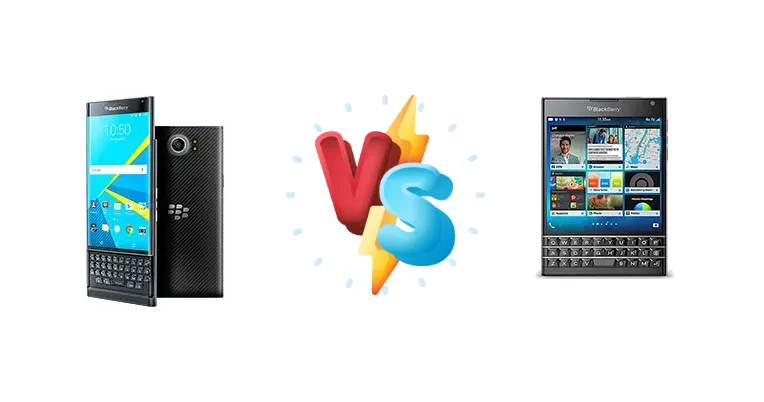
The BlackBerry Priv and Passport represent a fascinating chapter in smartphone history, attempting to blend BlackBerry's legacy with modern Android functionality. Both devices offered unique designs and features, but which one ultimately delivered a better experience? Let's dive into a comprehensive comparison.
🏆 Quick Verdict
The BlackBerry Passport edges out the Priv thanks to its superior battery life and exceptional sunlight readability. While the Priv boasts a more modern chipset, the Passport's unique square display and longer endurance make it the slightly better choice for those prioritizing longevity and outdoor visibility.
| Network |
|---|
| 2G bands | GSM 850 / 900 / 1800 / 1900 | GSM 850 / 900 / 1800 / 1900 |
| 3G bands | HSDPA 850 / 900 / 1700(AWS) / 1900 / 2100 - USA (STV100-1), Europe (STV100-4) | HSDPA 850 / 900 / 1900 / 2100 |
| 4G bands | 1, 2, 3, 4, 5, 7, 12, 17, 20, 29, 30 - USA (STV100-1) | 1, 3, 5, 7, 8 |
| Speed | HSPA 42.2/5.76 Mbps, LTE (3CA) Cat9 450/50 Mbps | HSPA, LTE |
| Technology | GSM / HSPA / LTE | GSM / HSPA / LTE |
| | 1, 2, 3, 4, 7, 8, 13, 17, 20, 28 - Europe (STV100-4) | 1, 2, 3, 4, 5, 7, 8, 13, 17, 20 |
| Launch |
|---|
| Announced | 2015, October. Released 2015, November | 2014, June. Released 2014, September |
| Status | Discontinued | Discontinued |
| Body |
|---|
| Build | Glass front (Gorilla Glass 4), plastic back, plastic frame | Glass front (Gorilla Glass 3), plastic back, aluminum frame |
| Dimensions | 147 x 77.2 x 9.4 mm (5.79 x 3.04 x 0.37 in) | 128 x 90.3 x 9.3 mm (5.04 x 3.56 x 0.37 in) |
| Keyboard | QWERTY | QWERTY |
| SIM | Nano-SIM | Nano-SIM |
| Weight | 192 g (6.77 oz) | 196 g (6.91 oz) |
| | Capacitive touch 4-row BlackBerry keyboard | Capacitive touch 3-row BlackBerry keyboard |
| Display |
|---|
| Protection | Corning Gorilla Glass 4 | Corning Gorilla Glass 3 |
| Resolution | 1440 x 2560 pixels, 16:9 ratio (~540 ppi density) | 1440 x 1440 pixels, 1:1 ratio (~453 ppi density) |
| Size | 5.4 inches, 81.6 cm2 (~71.9% screen-to-body ratio) | 4.5 inches, 65.3 cm2 (~56.5% screen-to-body ratio) |
| Type | AMOLED | IPS LCD |
| | Curved edge screen | - |
| Platform |
|---|
| CPU | Hexa-core (4x1.4 GHz Cortex-A53 & 2x1.8 GHz Cortex-A57) | Quad-core 2.26 GHz Krait 400 |
| Chipset | Qualcomm MSM8992 Snapdragon 808 (20 nm) | Qualcomm MSM8974AA Snapdragon 801 (28 nm) |
| GPU | Adreno 418 | Adreno 330 |
| OS | Android 5.1.1 (Lollipop), upgradable to 6.0.1 (Marshmallow) | BlackBerry OS 10.3, upgradable to 10.3.2 |
| Memory |
|---|
| Card slot | microSDXC (dedicated slot) | microSDXC (dedicated slot) |
| Internal | 32GB 3GB RAM | 32GB 3GB RAM |
| | eMMC 5.0 | eMMC 5.0 |
| Main Camera |
|---|
| Features | Schneider-Kreuznach optics, dual-LED dual-tone flash, HDR, panorama | LED flash, HDR, panorama |
| Single | 18 MP, f/2.2, 27mm (wide), 1/2.4", PDAF, OIS | 13 MP, f/2.0, 30mm (standard), AF, OIS |
| Video | 4K@30fps, 1080p@60fps | 1080p@60fps |
| Selfie camera |
|---|
| Single | 2 MP | 2 MP, f/2.8, 28mm (wide) |
| Video | 720p | 720p |
| Sound |
|---|
| 3.5mm jack | Yes | Yes |
| 35mm jack | Yes | Yes |
| Loudspeaker | Yes | Yes, with stereo speakers |
| Comms |
|---|
| Bluetooth | 4.1, A2DP, EDR, LE | 4.0, A2DP, LE |
| NFC | Yes | Yes |
| Positioning | GPS, GLONASS | GPS, GLONASS |
| Radio | No | FM radio, RDS |
| USB | microUSB 2.0 (SlimPort 4K) | microUSB 2.0 (SlimPort) |
| WLAN | Wi-Fi 802.11 a/b/g/n/ac, Wi-Fi Direct, hotspot | Wi-Fi 802.11 a/b/g/n/ac, dual-band, Wi-Fi Direct, DLNA, hotspot |
| Features |
|---|
| Sensors | Accelerometer, altimeter, gyro, ToF proximity, compass | Accelerometer, gyro, proximity, compass |
| Battery |
|---|
| Charging | 18W wired, QC2
Wireless (Qi) (market dependent) | - |
| Music play | Up to 73 h | Up to 84 h |
| Stand-by | Up to 420 h (3G) | Up to 432 h (2G) / Up to 444 h (3G) |
| Talk time | Up to 24 h (3G) | Up to 18 h (2G) / Up to 23 h (3G) |
| Type | Li-Ion 3410 mAh, non-removable | Li-Ion 3450 mAh, non-removable |
| Misc |
|---|
| Colors | Black | Black, White, Red, Black&Gold, Silver |
| Models | STV100-4, STV100-3, STV100-1, V100, STV100-2 | - |
| Price | About 270 EUR | About 170 EUR |
| Tests |
|---|
| Audio quality | - |
Noise -91.5dB / Crosstalk -92.5dB |
| Battery life |
Endurance rating 62h
|
Endurance rating 73h
|
| Camera |
Photo / Video |
Photo / Video |
| Display | - |
Contrast ratio: 1256 (nominal), 2.595 (sunlight) |
| Loudspeaker | - |
Voice 76dB / Noise 71dB / Ring 76dB
|
| Performance | - |
Basemark X: 10682 |
BlackBerry Priv
- Slider Keyboard
- Modern Android Experience
- Slightly Faster Processor
- Curved Display
- Shorter Battery Life
- Camera Performance
- Less Sunlight Readable Display
BlackBerry Passport
- Exceptional Battery Life
- Unique Square Display
- Excellent Sunlight Readability
- Productivity-Focused Design
- Older Processor
- Less Common Aspect Ratio
- Camera Performance
Display Comparison
The Passport's square 4.5-inch display is its defining feature, offering a unique aspect ratio perfect for reading and productivity. Its contrast ratio of 1256 (nominal) and 2.595 (sunlight) is outstanding, making it incredibly readable even in bright conditions. The Priv features a 5.4-inch curved display, offering a more standard smartphone experience, but lacks the Passport's exceptional sunlight performance.
Camera Comparison
Both phones feature decent cameras for their time, but neither excels. Image quality is acceptable in good lighting conditions, but low-light performance is underwhelming. The Priv's camera generally produces slightly more vibrant colors, but the Passport's image processing can sometimes appear more natural.
Performance
The Priv's Snapdragon 808 chipset provides a noticeable performance boost over the Passport's Snapdragon 801. Apps launch faster, and multitasking feels smoother on the Priv. However, the Passport's Krait 400 CPU still holds its own for everyday tasks.
Battery Life
The Passport's massive 3450 mAh battery provides significantly longer battery life than the Priv's 3400 mAh battery, as evidenced by the endurance rating (73h vs 62h). This difference translates to noticeably longer usage times on the Passport.
Buying Guide
The BlackBerry Priv is ideal for users who want a slider keyboard and a more contemporary Android experience with a slightly faster processor. The BlackBerry Passport is best suited for those who value a large, square display for productivity, excellent sunlight visibility, and extended battery life, even if it means sacrificing some processing power.
Frequently Asked Questions
❓ Which BlackBerry is better for productivity?
The BlackBerry Passport is generally considered better for productivity due to its square display, which is ideal for reading and multitasking, and its longer battery life.
❓ Is the Priv's slider keyboard worth it?
The Priv's slider keyboard is a significant selling point for those who prefer physical keyboards, but its quality is debated. Some find it cramped, while others appreciate the tactile feedback.
❓ Are these phones still usable today?
While both phones are aging, they can still be used for basic tasks. However, software updates are no longer available, so security risks are a concern. Performance may also be limited by older hardware.