
BlackBerry Priv vs. BlackBerry Motion: A Detailed Comparison
| Phones Images | |||||
|---|---|---|---|---|---|
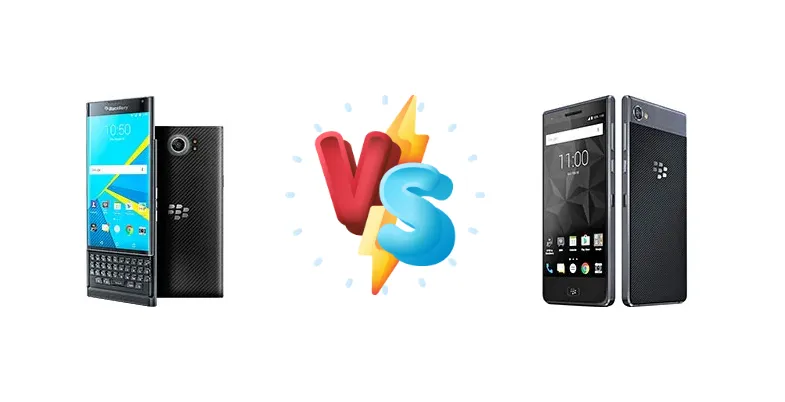
|
🏆 Quick Verdict
The BlackBerry Motion wins decisively thanks to its significantly longer battery life and more efficient Snapdragon 625 chipset. While the Priv boasts a more powerful processor, the Motion's endurance and QC3 charging make it the more practical choice for most users.
| PHONES | ||
|---|---|---|
| Phone Names | BlackBerry Priv | BlackBerry Motion |
| Network | ||
|---|---|---|
| 2G bands | GSM 850 / 900 / 1800 / 1900 | GSM 850 / 900 / 1800 / 1900 - SIM 1 & SIM 2 (dual-SIM model only) |
| 3G bands | HSDPA 850 / 900 / 1700(AWS) / 1900 / 2100 - USA (STV100-1), Europe (STV100-4) | HSDPA 850 / 900 / 1700(AWS) / 1900 / 2100 |
| 4G bands | 1, 2, 3, 4, 5, 7, 12, 17, 20, 29, 30 - USA (STV100-1) | 1, 2, 3, 4, 5, 7, 8, 12, 13, 17, 19, 20, 26, 28, 32, 38, 39, 40, 41 - BBD100-6 (EU, Global) |
| Speed | HSPA 42.2/5.76 Mbps, LTE (3CA) Cat9 450/50 Mbps | HSPA, LTE |
| Technology | GSM / HSPA / LTE | GSM / HSPA / LTE |
| 1, 2, 3, 4, 7, 8, 13, 17, 20, 28 - Europe (STV100-4) | 2, 4, 5, 7, 12, 13, 17, 29, 30, 66 - BBD100-2 (USA) | |
| Launch | ||
|---|---|---|
| Announced | 2015, October. Released 2015, November | 2017, October. Released 2017, December |
| Status | Discontinued | Discontinued |
| Body | ||
|---|---|---|
| Build | Glass front (Gorilla Glass 4), plastic back, plastic frame | Glass front, plastic back, aluminum frame |
| Dimensions | 147 x 77.2 x 9.4 mm (5.79 x 3.04 x 0.37 in) | 155.8 x 75.5 x 8.1 mm (6.13 x 2.97 x 0.32 in) |
| Keyboard | QWERTY | - |
| SIM | Nano-SIM | · Nano-SIM· Nano-SIM + Nano-SIM |
| Weight | 192 g (6.77 oz) | 167 g (5.89 oz) |
| Capacitive touch 4-row BlackBerry keyboard | IP67 dust/water resistant (up to 1m for 30 mins) | |
| Display | ||
|---|---|---|
| Protection | Corning Gorilla Glass 4 | Scratch-resistant glass |
| Resolution | 1440 x 2560 pixels, 16:9 ratio (~540 ppi density) | 1080 x 1920 pixels, 16:9 ratio (~403 ppi density) |
| Size | 5.4 inches, 81.6 cm2 (~71.9% screen-to-body ratio) | 5.5 inches, 82.6 cm2 (~70.2% screen-to-body ratio) |
| Type | AMOLED | IPS LCD |
| Curved edge screen | - | |
| Platform | ||
|---|---|---|
| CPU | Hexa-core (4x1.4 GHz Cortex-A53 & 2x1.8 GHz Cortex-A57) | Octa-core 2.0 GHz Cortex-A53 |
| Chipset | Qualcomm MSM8992 Snapdragon 808 (20 nm) | Qualcomm MSM8953 Snapdragon 625 (14 nm) |
| GPU | Adreno 418 | Adreno 506 |
| OS | Android 5.1.1 (Lollipop), upgradable to 6.0.1 (Marshmallow) | Android 7.1 (Nougat) |
| Memory | ||
|---|---|---|
| Card slot | microSDXC (dedicated slot) | microSDXC (uses shared SIM slot) |
| Internal | 32GB 3GB RAM | 32GB 4GB RAM |
| eMMC 5.0 | eMMC 5.1 | |
| Main Camera | ||
|---|---|---|
| Features | Schneider-Kreuznach optics, dual-LED dual-tone flash, HDR, panorama | Dual-LED dual-tone flash, HDR, panorama |
| Single | 18 MP, f/2.2, 27mm (wide), 1/2.4", PDAF, OIS | 12 MP, f/2.0, PDAF |
| Video | 4K@30fps, 1080p@60fps | 4K@30fps, 1080p@30fps |
| Selfie camera | ||
|---|---|---|
| Single | 2 MP | 8 MP, f/2.2, 1/4.0", 1.12µm |
| Video | 720p | 1080p@30fps |
| Sound | ||
|---|---|---|
| 3.5mm jack | Yes | Yes |
| 35mm jack | Yes | Yes |
| Loudspeaker | Yes | Yes |
| Comms | ||
|---|---|---|
| Bluetooth | 4.1, A2DP, EDR, LE | 4.2, A2DP, EDR, LE |
| NFC | Yes | Yes |
| Positioning | GPS, GLONASS | GPS, GLONASS, BDS2 |
| Radio | No | FM radio |
| USB | microUSB 2.0 (SlimPort 4K) | USB Type-C 2.0 |
| WLAN | Wi-Fi 802.11 a/b/g/n/ac, Wi-Fi Direct, hotspot | Wi-Fi 802.11 b/g/n/ac, Wi-Fi Direct |
| Features | ||
|---|---|---|
| Sensors | Accelerometer, altimeter, gyro, ToF proximity, compass | Fingerprint (front-mounted), accelerometer, gyro, proximity, compass |
| Battery | ||
|---|---|---|
| Charging | 18W wired, QC2 Wireless (Qi) (market dependent) | 18W wired, QC3 |
| Music play | Up to 73 h | - |
| Stand-by | Up to 420 h (3G) | - |
| Talk time | Up to 24 h (3G) | - |
| Type | Li-Ion 3410 mAh, non-removable | Li-Ion 4000 mAh, non-removable |
| Misc | ||
|---|---|---|
| Colors | Black | Black |
| Models | STV100-4, STV100-3, STV100-1, V100, STV100-2 | BBD100-1, BBD100-6, BBD100-2 |
| Price | About 270 EUR | About 390 EUR |
| Tests | ||
|---|---|---|
| Battery life | Endurance rating 62h | Endurance rating 94h |
| Camera | Photo / Video | Photo / Video |
| Loudspeaker | - | Voice 66dB / Noise 69dB / Ring 77dB |
| Performance | - | AnTuTu: 75057 (v7) GeekBench: 3567 (v4.4) GFXBench: 3.4fps (ES 3.1 onscreen) |
BlackBerry Priv
- Curved OLED display
- More powerful processor (Snapdragon 808)
- Physical keyboard
- Slightly better camera in good light
- Significantly shorter battery life
- Higher power consumption
- QC2 charging
- Curved screen can be awkward for some
BlackBerry Motion
- Exceptional battery life (94h endurance)
- Efficient Snapdragon 625 chipset
- Physical keyboard
- QC3 charging
- Larger screen size
- Less powerful processor than Priv
- IPS LCD display (less vibrant than OLED)
- Camera performance not top-tier
Display Comparison
The Priv features a 5.4-inch curved OLED display, offering vibrant colors and deep blacks. The Motion has a 5.5-inch IPS LCD display, which is generally accurate but lacks the OLED's contrast. The curved screen on the Priv is a unique feature, but the Motion's larger screen size might be preferable for some.
Camera Comparison
Both phones feature decent, but not exceptional, camera systems. The Priv's camera generally produces slightly better images in good lighting conditions, but both struggle in low light. Video quality is comparable on both devices. Expect around 13MP for both rear cameras and 8MP front cameras.
Performance
The Priv's Snapdragon 808 provides a noticeable performance boost over the Motion's Snapdragon 625, especially in demanding games and multitasking. However, the 808's higher power consumption impacts battery life. The Motion's Snapdragon 625 offers smooth everyday performance and excellent efficiency.
Battery Life
This is where the Motion truly shines. Its 4000mAh battery provides an impressive 94-hour endurance rating, significantly outperforming the Priv's 3400mAh battery (62h rating). The Motion also supports QC3 charging, offering faster charging speeds than the Priv's QC2.
Buying Guide
The BlackBerry Priv is for those who prioritize performance and a curved display, and don't mind sacrificing battery life. The BlackBerry Motion is ideal for users who value all-day (or multi-day) battery life and a physical keyboard, even if it means a slight performance trade-off.