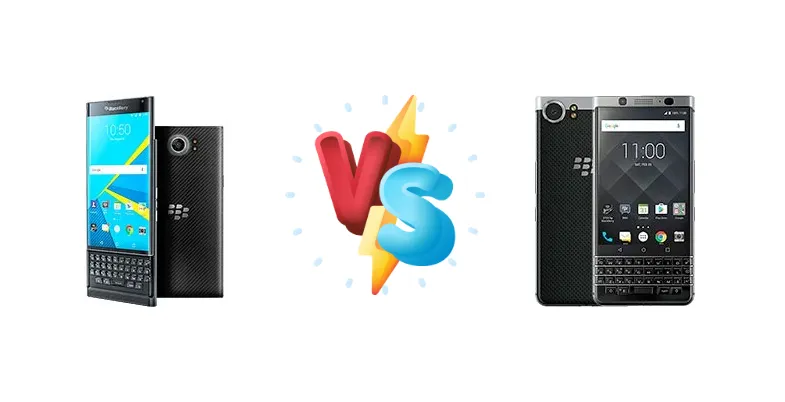
BlackBerry, once a titan of the mobile world, attempted a comeback with the Priv and Keyone. Both offered a unique blend of security, productivity features, and physical keyboards, but catered to slightly different audiences. Let's dive into a detailed comparison to see which device ultimately holds up better today.
🏆 Quick Verdict
The BlackBerry Keyone emerges as the clear winner. While the Priv boasted a Snapdragon 808, the Keyone's superior battery life (81h vs 62h), faster charging (QC3), and generally more refined software experience make it the better choice, especially considering their age.
| Network |
|---|
| 2G bands | GSM 850 / 900 / 1800 / 1900 | GSM 850 / 900 / 1800 / 1900 - SIM 1 & SIM 2 (BBB100-4 only) |
| 3G bands | HSDPA 850 / 900 / 1700(AWS) / 1900 / 2100 - USA (STV100-1), Europe (STV100-4) | HSDPA 850 / 900 / 1700(AWS) / 1900 / 2100 |
| 4G bands | 1, 2, 3, 4, 5, 7, 12, 17, 20, 29, 30 - USA (STV100-1) | 1, 2, 3, 4, 5, 7, 8, 13, 17, 20, 28, 38, 40 |
| Speed | HSPA 42.2/5.76 Mbps, LTE (3CA) Cat9 450/50 Mbps | HSPA 42.2/5.76 Mbps, LTE Cat9 450/50 Mbps |
| Technology | GSM / HSPA / LTE | GSM / HSPA / LTE |
| | 1, 2, 3, 4, 7, 8, 13, 17, 20, 28 - Europe (STV100-4) | - |
| Launch |
|---|
| Announced | 2015, October. Released 2015, November | 2017, February. Released 2017, April |
| Status | Discontinued | Discontinued |
| Body |
|---|
| Build | Glass front (Gorilla Glass 4), plastic back, plastic frame | Glass front (Gorilla Glass 4), plastic back, aluminum frame |
| Dimensions | 147 x 77.2 x 9.4 mm (5.79 x 3.04 x 0.37 in) | 149.1 x 72.4 x 9.4 mm (5.87 x 2.85 x 0.37 in) |
| Keyboard | QWERTY | QWERTY |
| SIM | Nano-SIM | · Nano-SIM· Nano-SIM + Nano-SIM - BBB100-4 only |
| Weight | 192 g (6.77 oz) | 180 g (6.35 oz) |
| | Capacitive touch 4-row BlackBerry keyboard | Capacitive touch 4-row BlackBerry keyboard |
| Display |
|---|
| Protection | Corning Gorilla Glass 4 | Corning Gorilla Glass 4 |
| Resolution | 1440 x 2560 pixels, 16:9 ratio (~540 ppi density) | 1080 x 1620 pixels, 3:2 ratio (~434 ppi density) |
| Size | 5.4 inches, 81.6 cm2 (~71.9% screen-to-body ratio) | 4.5 inches, 60.0 cm2 (~55.6% screen-to-body ratio) |
| Type | AMOLED | IPS LCD |
| | Curved edge screen | - |
| Platform |
|---|
| CPU | Hexa-core (4x1.4 GHz Cortex-A53 & 2x1.8 GHz Cortex-A57) | Octa-core 2.0 GHz Cortex-A53 |
| Chipset | Qualcomm MSM8992 Snapdragon 808 (20 nm) | Qualcomm MSM8953 Snapdragon 625 (14 nm) |
| GPU | Adreno 418 | Adreno 506 |
| OS | Android 5.1.1 (Lollipop), upgradable to 6.0.1 (Marshmallow) | Android 7.1 (Nougat), upgradable to Android 8.1 (Oreo) |
| Memory |
|---|
| Card slot | microSDXC (dedicated slot) | microSDXC (uses shared SIM slot) |
| Internal | 32GB 3GB RAM | 32GB 3GB RAM, 64GB 4GB RAM |
| | eMMC 5.0 | eMMC 5.1 |
| Main Camera |
|---|
| Features | Schneider-Kreuznach optics, dual-LED dual-tone flash, HDR, panorama | Dual-LED dual-tone flash, HDR, panorama |
| Single | 18 MP, f/2.2, 27mm (wide), 1/2.4", PDAF, OIS | 12 MP, f/2.0, 1/2.3", 1.55µm, PDAF |
| Video | 4K@30fps, 1080p@60fps | 4K@30fps |
| Selfie camera |
|---|
| Single | 2 MP | 8 MP, f/2.2, 1/4.0", 1.12µm |
| Video | 720p | 1080p@30fps |
| Sound |
|---|
| 3.5mm jack | Yes | Yes |
| 35mm jack | Yes | Yes |
| Loudspeaker | Yes | Yes |
| Comms |
|---|
| Bluetooth | 4.1, A2DP, EDR, LE | 4.2, A2DP, LE, EDR |
| NFC | Yes | Yes |
| Positioning | GPS, GLONASS | GPS, GLONASS, BDS2 |
| Radio | No | FM radio |
| USB | microUSB 2.0 (SlimPort 4K) | USB Type-C 3.1, OTG |
| WLAN | Wi-Fi 802.11 a/b/g/n/ac, Wi-Fi Direct, hotspot | Wi-Fi 802.11 a/b/g/n/ac, dual-band, Wi-Fi Direct |
| Features |
|---|
| Sensors | Accelerometer, altimeter, gyro, ToF proximity, compass | Fingerprint (front-mounted), accelerometer, gyro, proximity, compass |
| Battery |
|---|
| Charging | 18W wired, QC2
Wireless (Qi) (market dependent) | 18W wired, QC3, 50% in 36 min |
| Music play | Up to 73 h | - |
| Stand-by | Up to 420 h (3G) | - |
| Talk time | Up to 24 h (3G) | - |
| Type | Li-Ion 3410 mAh, non-removable | Li-Ion 3500 mAh, non-removable |
| Misc |
|---|
| Colors | Black | Black/Silver, Black, Bronze |
| Models | STV100-4, STV100-3, STV100-1, V100, STV100-2 | BBB100-2, BBB100-7, BBB100-1, BBB100-5, BBB100-3, BBB100-4 |
| Price | About 270 EUR | About 290 EUR |
| Tests |
|---|
| Audio quality | - |
Noise -92.2dB / Crosstalk -96.4dB |
| Battery life |
Endurance rating 62h
| Endurance rating 81h |
| Camera |
Photo / Video |
Photo / Video |
| Display | - |
Contrast ratio: 1756:1 (nominal) |
| Loudspeaker | - |
Voice 62dB / Noise 66dB / Ring 67dB |
| Performance | - |
GFXBench: 4.1fps (ES 3.1 onscreen) |
BlackBerry Priv
- Sleeker design
- Initially faster processor
- Curved display (aesthetic)
- Shorter battery life
- Older software support
- Potential for thermal throttling
- Less refined keyboard
BlackBerry Keyone
- Exceptional battery life
- Faster charging (QC3)
- Robust physical keyboard
- Optimized software
- Better value (historically)
- Less powerful processor (compared to initial Priv launch)
- Slightly less modern design
- Camera not top-tier
Display Comparison
Both devices feature a 4.5-inch display with a 1756:1 contrast ratio. However, the Keyone's display is generally considered to be slightly brighter and more color accurate. The Priv's curved display, while visually appealing, doesn't offer significant functional benefits.
Camera Comparison
Camera performance is comparable, with both offering decent image quality for their time. Low-light performance is a weakness for both. The Keyone's camera software received some updates that slightly improved image processing.
Performance
The Priv's Snapdragon 808 offered a performance edge initially, but the Keyone's Snapdragon 625, coupled with optimized software, provides surprisingly smooth performance for everyday tasks. The 808's age shows more, with potential for thermal throttling under sustained load.
Battery Life
This is where the Keyone truly shines. Its 3500mAh battery provides significantly longer battery life than the Priv's 3400mAh battery, achieving an endurance rating of 81 hours compared to the Priv's 62 hours. The Keyone also supports QC3 fast charging, offering a 50% charge in just 36 minutes.
Buying Guide
The BlackBerry Priv is for those who prioritize raw processing power and a sleeker, more modern design (though dated now). The Keyone is ideal for users who value exceptional battery life, a robust physical keyboard, and a more practical, productivity-focused experience. Both are niche devices for those seeking a BlackBerry experience.
Frequently Asked Questions
❓ Which BlackBerry has better software support?
Neither device receives active software updates anymore. However, the Keyone's software was generally considered more stable and optimized for its hardware.
❓ Is it worth buying a BlackBerry Priv or Keyone in 2024?
Only if you're a dedicated BlackBerry enthusiast seeking a physical keyboard and are comfortable with the limitations of older hardware and lack of software updates. The Keyone is the slightly better option due to its superior battery life.