
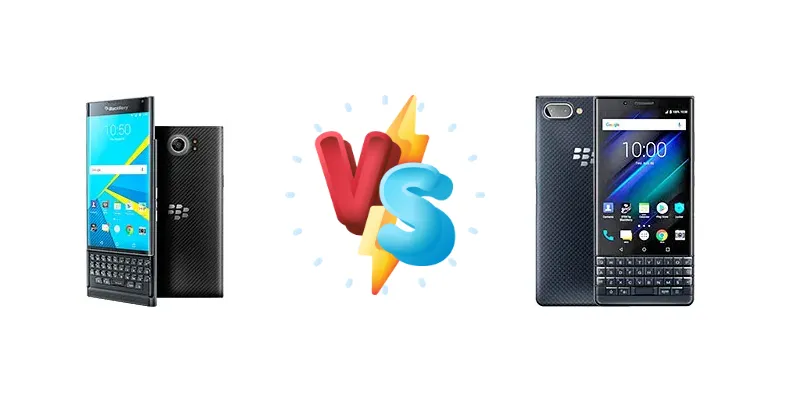
BlackBerry Priv vs. KEY2 LE: A Detailed Comparison
| Phones Images | |||||
|---|---|---|---|---|---|
|
🏆 Quick Verdict
The KEY2 LE offers a more modern chipset and improved efficiency, resulting in better overall performance and potentially longer real-world battery life despite similar endurance ratings. While the Priv boasts a more powerful processor, the KEY2 LE's Snapdragon 636 provides a smoother experience for most users.
| PHONES | ||
|---|---|---|
| Phone Names | BlackBerry Priv | BlackBerry KEY2 LE |
| Network | ||
|---|---|---|
| 2G bands | GSM 850 / 900 / 1800 / 1900 | GSM 850 / 900 / 1800 / 1900 |
| 3G bands | HSDPA 850 / 900 / 1700(AWS) / 1900 / 2100 - USA (STV100-1), Europe (STV100-4) | HSDPA 850 / 900 / 1700(AWS) / 1900 / 2100 |
| 4G bands | 1, 2, 3, 4, 5, 7, 12, 17, 20, 29, 30 - USA (STV100-1) | 1, 2, 3, 4, 5, 7, 8, 12, 17, 19, 20, 26, 28, 32, 38, 40, 41 - BBE100-1, BBE100-4 DS (EU, Africa, AU) |
| Speed | HSPA 42.2/5.76 Mbps, LTE (3CA) Cat9 450/50 Mbps | HSPA, LTE |
| Technology | GSM / HSPA / LTE | GSM / HSPA / LTE |
| 1, 2, 3, 4, 7, 8, 13, 17, 20, 28 - Europe (STV100-4) | 1, 2, 3, 4, 5, 7, 8, 12, 13, 17, 20, 28, 29, 66, 38, 39, 40, 41 - BBE100-2, BBE100-5 DS (NA, LATAM) | |
| Launch | ||
|---|---|---|
| Announced | 2015, October. Released 2015, November | 2018, August. Released 2018, October |
| Status | Discontinued | Discontinued |
| Body | ||
|---|---|---|
| Build | Glass front (Gorilla Glass 4), plastic back, plastic frame | Glass front (Gorilla Glass), plastic back, aluminum frame |
| Dimensions | 147 x 77.2 x 9.4 mm (5.79 x 3.04 x 0.37 in) | 150.3 x 71.8 x 8.4 mm (5.92 x 2.83 x 0.33 in) |
| Keyboard | QWERTY | QWERTY |
| SIM | Nano-SIM | · Nano-SIM· Nano-SIM + Nano-SIM |
| Weight | 192 g (6.77 oz) | 156 g (5.50 oz) |
| Capacitive touch 4-row BlackBerry keyboard | - | |
| Display | ||
|---|---|---|
| Protection | Corning Gorilla Glass 4 | Corning Gorilla Glass (unspecified version) |
| Resolution | 1440 x 2560 pixels, 16:9 ratio (~540 ppi density) | 1080 x 1620 pixels, 3:2 ratio (~434 ppi density) |
| Size | 5.4 inches, 81.6 cm2 (~71.9% screen-to-body ratio) | 4.5 inches, 60.0 cm2 (~55.6% screen-to-body ratio) |
| Type | AMOLED | IPS LCD |
| Curved edge screen | - | |
| Platform | ||
|---|---|---|
| CPU | Hexa-core (4x1.4 GHz Cortex-A53 & 2x1.8 GHz Cortex-A57) | Octa-core (4x1.8 GHz Kryo 260 Gold & 4x1.6 GHz Kryo 260 Silver) |
| Chipset | Qualcomm MSM8992 Snapdragon 808 (20 nm) | Qualcomm SDM636 Snapdragon 636 (14 nm) |
| GPU | Adreno 418 | Adreno 509 |
| OS | Android 5.1.1 (Lollipop), upgradable to 6.0.1 (Marshmallow) | Android 8.1 (Oreo) |
| Memory | ||
|---|---|---|
| Card slot | microSDXC (dedicated slot) | microSDXC (uses shared SIM slot) |
| Internal | 32GB 3GB RAM | 32GB 4GB RAM, 64GB 4GB RAM |
| eMMC 5.0 | eMMC 5.1 | |
| Main Camera | ||
|---|---|---|
| Dual | - | 13 MP, f/2.2, 1/3.1", 1.12µm, PDAF Auxiliary lens |
| Features | Schneider-Kreuznach optics, dual-LED dual-tone flash, HDR, panorama | Dual-LED dual-tone flash, HDR, panorama |
| Single | 18 MP, f/2.2, 27mm (wide), 1/2.4", PDAF, OIS | - |
| Video | 4K@30fps, 1080p@60fps | 4K@30fps, 1080p@30fps |
| Selfie camera | ||
|---|---|---|
| Single | 2 MP | 8 MP |
| Video | 720p | 1080p@30fps |
| Sound | ||
|---|---|---|
| 3.5mm jack | Yes | Yes |
| 35mm jack | Yes | Yes |
| Loudspeaker | Yes | Yes |
| Comms | ||
|---|---|---|
| Bluetooth | 4.1, A2DP, EDR, LE | 5.0, A2DP, LE, EDR |
| NFC | Yes | Yes |
| Positioning | GPS, GLONASS | GPS, GLONASS |
| Radio | No | FM radio |
| USB | microUSB 2.0 (SlimPort 4K) | USB Type-C 2.0, OTG |
| WLAN | Wi-Fi 802.11 a/b/g/n/ac, Wi-Fi Direct, hotspot | Wi-Fi 802.11 а/b/g/n/ac, dual-band, Wi-Fi Direct |
| Features | ||
|---|---|---|
| Sensors | Accelerometer, altimeter, gyro, ToF proximity, compass | Fingerprint (front-mounted), accelerometer, proximity, compass |
| Battery | ||
|---|---|---|
| Charging | 18W wired, QC2 Wireless (Qi) (market dependent) | - |
| Music play | Up to 73 h | - |
| Stand-by | Up to 420 h (3G) | - |
| Talk time | Up to 24 h (3G) | - |
| Type | Li-Ion 3410 mAh, non-removable | Li-Ion 3000 mAh, non-removable |
| Misc | ||
|---|---|---|
| Colors | Black | Slate, Champagne, Atomic |
| Models | STV100-4, STV100-3, STV100-1, V100, STV100-2 | BBE100-4, BBE100-5, BBE100-1, BBE100-2 |
| Price | About 270 EUR | About 440 EUR |
| SAR | - | 1.01 W/kg (head) 1.17 W/kg (body) |
| SAR EU | - | 0.78 W/kg (head) 1.61 W/kg (body) |
| Tests | ||
|---|---|---|
| Battery life | Endurance rating 62h | - |
| Camera | Photo / Video | - |
| Performance | - | AnTuTu: 116764 (v7) GeekBench: 4965 (v4.4) |
BlackBerry Priv
- Slider Keyboard
- QHD Display
- Flagship Processor (at launch)
- Older Chipset
- Potential Battery Drain
- Outdated Software Support
BlackBerry KEY2 LE
- More Efficient Processor
- Improved Battery Life (potentially)
- More Modern Design
- Better Software Support
- Lower Resolution Display
- Less Powerful Processor than Priv (on paper)
Display Comparison
The Priv features a 5.4-inch IPS LCD display with a resolution of 2560 x 1440 (QHD). The KEY2 LE has a 5.5-inch IPS LCD display with a resolution of 2160 x 1080 (FHD+). While the Priv has a higher resolution, the KEY2 LE's smaller resolution can contribute to slightly better battery efficiency. Both offer decent viewing angles and color reproduction, but the Priv's QHD resolution provides a sharper image.
Camera Comparison
Camera details are limited in the provided data. However, generally, the Priv's camera was considered decent for its time, offering good image quality in well-lit conditions. The KEY2 LE's camera, while not exceptional, benefits from software improvements and generally produces acceptable photos. Both likely struggle in low-light conditions.
Performance
The Priv's Snapdragon 808 chipset, while once flagship-level, is now showing its age. The KEY2 LE's Snapdragon 636 offers a more balanced and efficient performance, handling everyday tasks and multitasking with ease. The KEY2 LE's octa-core Kryo processor generally provides a smoother and more responsive user experience.
Battery Life
Both devices are reported with an endurance rating of 62h. However, the KEY2 LE's more efficient Snapdragon 636 chipset likely translates to better real-world battery life, as the Priv's older chipset consumes more power.
Buying Guide
The BlackBerry Priv is for those seeking a premium, albeit older, BlackBerry experience with flagship-level processing power and a slider keyboard. The KEY2 LE is ideal for users prioritizing productivity, a comfortable physical keyboard, and a more modern, efficient device at a more accessible price point.