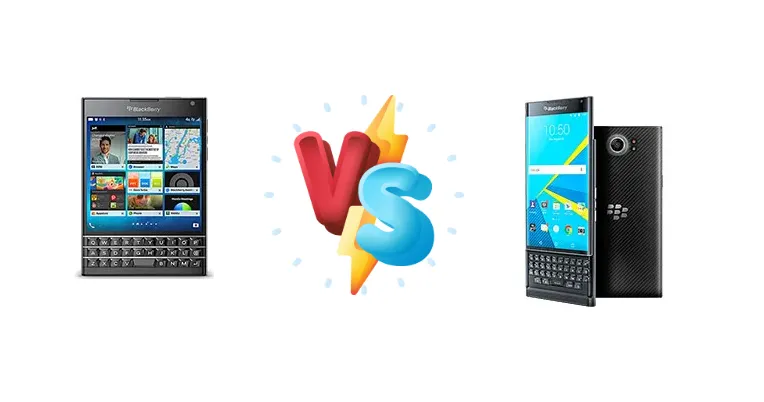
BlackBerry enthusiasts remember a time when physical keyboards ruled the smartphone world. The Passport and Priv were BlackBerry's attempts to blend that legacy with modern features. But which device ultimately delivers a better experience? Let's dive into a head-to-head comparison.
🏆 Quick Verdict
The BlackBerry Passport boasts superior battery life and a unique, large display, appealing to productivity-focused users. However, the Priv’s slider keyboard, Snapdragon 808, and wireless charging offer a more modern and versatile experience, making it the slightly better overall choice for most.
| Network |
|---|
| 2G bands | GSM 850 / 900 / 1800 / 1900 | GSM 850 / 900 / 1800 / 1900 |
| 3G bands | HSDPA 850 / 900 / 1900 / 2100 | HSDPA 850 / 900 / 1700(AWS) / 1900 / 2100 - USA (STV100-1), Europe (STV100-4) |
| 4G bands | 1, 3, 5, 7, 8 | 1, 2, 3, 4, 5, 7, 12, 17, 20, 29, 30 - USA (STV100-1) |
| Speed | HSPA, LTE | HSPA 42.2/5.76 Mbps, LTE (3CA) Cat9 450/50 Mbps |
| Technology | GSM / HSPA / LTE | GSM / HSPA / LTE |
| | 1, 2, 3, 4, 5, 7, 8, 13, 17, 20 | 1, 2, 3, 4, 7, 8, 13, 17, 20, 28 - Europe (STV100-4) |
| Launch |
|---|
| Announced | 2014, June. Released 2014, September | 2015, October. Released 2015, November |
| Status | Discontinued | Discontinued |
| Body |
|---|
| Build | Glass front (Gorilla Glass 3), plastic back, aluminum frame | Glass front (Gorilla Glass 4), plastic back, plastic frame |
| Dimensions | 128 x 90.3 x 9.3 mm (5.04 x 3.56 x 0.37 in) | 147 x 77.2 x 9.4 mm (5.79 x 3.04 x 0.37 in) |
| Keyboard | QWERTY | QWERTY |
| SIM | Nano-SIM | Nano-SIM |
| Weight | 196 g (6.91 oz) | 192 g (6.77 oz) |
| | Capacitive touch 3-row BlackBerry keyboard | Capacitive touch 4-row BlackBerry keyboard |
| Display |
|---|
| Protection | Corning Gorilla Glass 3 | Corning Gorilla Glass 4 |
| Resolution | 1440 x 1440 pixels, 1:1 ratio (~453 ppi density) | 1440 x 2560 pixels, 16:9 ratio (~540 ppi density) |
| Size | 4.5 inches, 65.3 cm2 (~56.5% screen-to-body ratio) | 5.4 inches, 81.6 cm2 (~71.9% screen-to-body ratio) |
| Type | IPS LCD | AMOLED |
| | - | Curved edge screen |
| Platform |
|---|
| CPU | Quad-core 2.26 GHz Krait 400 | Hexa-core (4x1.4 GHz Cortex-A53 & 2x1.8 GHz Cortex-A57) |
| Chipset | Qualcomm MSM8974AA Snapdragon 801 (28 nm) | Qualcomm MSM8992 Snapdragon 808 (20 nm) |
| GPU | Adreno 330 | Adreno 418 |
| OS | BlackBerry OS 10.3, upgradable to 10.3.2 | Android 5.1.1 (Lollipop), upgradable to 6.0.1 (Marshmallow) |
| Memory |
|---|
| Card slot | microSDXC (dedicated slot) | microSDXC (dedicated slot) |
| Internal | 32GB 3GB RAM | 32GB 3GB RAM |
| | eMMC 5.0 | eMMC 5.0 |
| Main Camera |
|---|
| Features | LED flash, HDR, panorama | Schneider-Kreuznach optics, dual-LED dual-tone flash, HDR, panorama |
| Single | 13 MP, f/2.0, 30mm (standard), AF, OIS | 18 MP, f/2.2, 27mm (wide), 1/2.4", PDAF, OIS |
| Video | 1080p@60fps | 4K@30fps, 1080p@60fps |
| Selfie camera |
|---|
| Single | 2 MP, f/2.8, 28mm (wide) | 2 MP |
| Video | 720p | 720p |
| Sound |
|---|
| 3.5mm jack | Yes | Yes |
| 35mm jack | Yes | Yes |
| Loudspeaker | Yes, with stereo speakers | Yes |
| Comms |
|---|
| Bluetooth | 4.0, A2DP, LE | 4.1, A2DP, EDR, LE |
| NFC | Yes | Yes |
| Positioning | GPS, GLONASS | GPS, GLONASS |
| Radio | FM radio, RDS | No |
| USB | microUSB 2.0 (SlimPort) | microUSB 2.0 (SlimPort 4K) |
| WLAN | Wi-Fi 802.11 a/b/g/n/ac, dual-band, Wi-Fi Direct, DLNA, hotspot | Wi-Fi 802.11 a/b/g/n/ac, Wi-Fi Direct, hotspot |
| Features |
|---|
| Sensors | Accelerometer, gyro, proximity, compass | Accelerometer, altimeter, gyro, ToF proximity, compass |
| Battery |
|---|
| Charging | - | 18W wired, QC2
Wireless (Qi) (market dependent) |
| Music play | Up to 84 h | Up to 73 h |
| Stand-by | Up to 432 h (2G) / Up to 444 h (3G) | Up to 420 h (3G) |
| Talk time | Up to 18 h (2G) / Up to 23 h (3G) | Up to 24 h (3G) |
| Type | Li-Ion 3450 mAh, non-removable | Li-Ion 3410 mAh, non-removable |
| Misc |
|---|
| Colors | Black, White, Red, Black&Gold, Silver | Black |
| Models | - | STV100-4, STV100-3, STV100-1, V100, STV100-2 |
| Price | About 170 EUR | About 270 EUR |
| Tests |
|---|
| Audio quality |
Noise -91.5dB / Crosstalk -92.5dB | - |
| Battery life |
Endurance rating 73h
|
Endurance rating 62h
|
| Camera |
Photo / Video |
Photo / Video |
| Display |
Contrast ratio: 1256 (nominal), 2.595 (sunlight) | - |
| Loudspeaker |
Voice 76dB / Noise 71dB / Ring 76dB
| - |
| Performance |
Basemark X: 10682 | - |
BlackBerry Passport
- Exceptional battery life
- Unique square display
- Excellent physical keyboard
- Durable build quality
- Outdated chipset
- Less conventional design
- Camera performance is average
- Limited app support compared to modern devices
BlackBerry Priv
- Slide-out keyboard
- Wireless charging (market dependent)
- More modern chipset (Snapdragon 808)
- Larger display for media consumption
- Shorter battery life than Passport
- Keyboard mechanism can be prone to issues
- Camera still not top-tier
- App support limitations
Display Comparison
The Passport's 4.5-inch square display is its defining feature, offering ample screen real estate for multitasking and document viewing. Its contrast ratio of 1256 (nominal) and 2.595 (sunlight) is impressive. The Priv features a 5.4-inch display, offering a more standard smartphone experience with better media consumption. While the Passport's unique aspect ratio is a productivity boon, the Priv's larger size is generally more appealing.
Camera Comparison
Both devices feature decent cameras for their time, but neither excels. Image quality is acceptable in good lighting conditions, but low-light performance is lacking. The Priv generally produces slightly better images due to its more modern image processing capabilities. Video recording is standard for the era.
Performance
The Passport's Snapdragon 801, while capable, is showing its age. The Priv's Snapdragon 808, with its hexa-core architecture, provides a noticeable performance boost, especially in multitasking and demanding applications. The Priv's Cortex-A53 and A57 cores offer a more balanced approach to power efficiency and performance.
Battery Life
The Passport's battery life is its standout feature, offering an incredible endurance rating of 73 hours. This is significantly better than the Priv's 62 hours. This difference is a major factor for users who prioritize longevity.
Buying Guide
The BlackBerry Passport is ideal for users who prioritize exceptional battery life, a large, square display for productivity, and a robust physical keyboard. The BlackBerry Priv is better suited for those seeking a more conventional smartphone experience with a slide-out keyboard, wireless charging, and a slightly more modern chipset.
Frequently Asked Questions
❓ Is the BlackBerry Passport worth buying in 2024?
If you prioritize battery life and a unique productivity-focused display, and don't mind an older chipset, the Passport can still be a viable option. However, app support and overall performance will be limitations.
❓ Which BlackBerry has the better keyboard?
While subjective, the Priv's slide-out keyboard offers a more modern and versatile experience, while the Passport's physical keyboard is robust and well-suited for extensive typing.
❓ Are there still apps available for these devices?
App support is limited for both devices. While some apps may still function, many modern apps are not compatible. Expect to rely on older versions of apps or web-based alternatives.