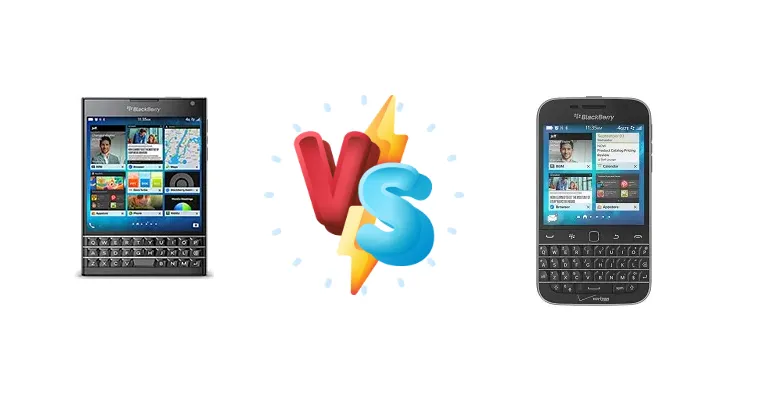
Nostalgia for BlackBerry devices is real. The Passport and Classic represent different approaches to reviving the brand's legacy. But which one offers the better experience for the modern user seeking a taste of the past?
🏆 Quick Verdict
The BlackBerry Passport wins overall due to its superior Snapdragon 801 processor, significantly better battery life, and impressive sunlight readability. While the Classic offers a familiar physical keyboard, the Passport's performance and display make it the more compelling choice.
| Network |
|---|
| 2G bands | GSM 850 / 900 / 1800 / 1900 | GSM 850 / 900 / 1800 / 1900 |
| 3G bands | HSDPA 850 / 900 / 1900 / 2100 | HSDPA 850 / 900 / 1900 / 2100 |
| 4G bands | 1, 3, 5, 7, 8 | 4, 13 |
| Speed | HSPA, LTE | HSPA 42.2/5.76 Mbps, LTE Cat4 150/50 Mbps, EV-DO Rev.A 3.1 Mbps |
| Technology | GSM / HSPA / LTE | GSM / CDMA / HSPA / EVDO / LTE |
| | 1, 2, 3, 4, 5, 7, 8, 13, 17, 20 | CDMA2000 1xEV-DO |
| Launch |
|---|
| Announced | 2014, June. Released 2014, September | 2015, February. Released 2015, March |
| Status | Discontinued | Discontinued |
| Body |
|---|
| Build | Glass front (Gorilla Glass 3), plastic back, aluminum frame | - |
| Dimensions | 128 x 90.3 x 9.3 mm (5.04 x 3.56 x 0.37 in) | 131 x 72.4 x 10.2 mm (5.16 x 2.85 x 0.40 in) |
| Keyboard | QWERTY | QWERTY |
| SIM | Nano-SIM | Nano-SIM |
| Weight | 196 g (6.91 oz) | 178 g (6.28 oz) |
| | Capacitive touch 3-row BlackBerry keyboard | Optical trackpad |
| Display |
|---|
| Protection | Corning Gorilla Glass 3 | Corning Gorilla Glass 3 |
| Resolution | 1440 x 1440 pixels, 1:1 ratio (~453 ppi density) | 720 x 720 pixels, 1:1 ratio (~291 ppi density) |
| Size | 4.5 inches, 65.3 cm2 (~56.5% screen-to-body ratio) | 3.5 inches, 39.5 cm2 (~41.7% screen-to-body ratio) |
| Type | IPS LCD | IPS LCD, |
| Platform |
|---|
| CPU | Quad-core 2.26 GHz Krait 400 | Dual-core 1.5 GHz Krait |
| Chipset | Qualcomm MSM8974AA Snapdragon 801 (28 nm) | - |
| GPU | Adreno 330 | - |
| OS | BlackBerry OS 10.3, upgradable to 10.3.2 | BlackBerry OS 10.3.1 |
| Memory |
|---|
| Card slot | microSDXC (dedicated slot) | microSDXC (dedicated slot) |
| Internal | 32GB 3GB RAM | 16GB 2GB RAM |
| | eMMC 5.0 | - |
| Main Camera |
|---|
| Features | LED flash, HDR, panorama | - |
| Single | 13 MP, f/2.0, 30mm (standard), AF, OIS | - |
| Video | 1080p@60fps | - |
| Selfie camera |
|---|
| Single | 2 MP, f/2.8, 28mm (wide) | - |
| Video | 720p | - |
| Sound |
|---|
| 3.5mm jack | Yes | Yes |
| 35mm jack | Yes | Yes |
| Loudspeaker | Yes, with stereo speakers | Yes |
| Comms |
|---|
| Bluetooth | 4.0, A2DP, LE | 4.0, A2DP, EDR, LE |
| NFC | Yes | Yes |
| Positioning | GPS, GLONASS | GPS |
| Radio | FM radio, RDS | FM radio |
| USB | microUSB 2.0 (SlimPort) | microUSB 2.0 (SlimPort) |
| WLAN | Wi-Fi 802.11 a/b/g/n/ac, dual-band, Wi-Fi Direct, DLNA, hotspot | Wi-Fi 802.11 a/b/g/n, dual-band, hotspot |
| Features |
|---|
| Sensors | Accelerometer, gyro, proximity, compass | Accelerometer, gyro, proximity, compass |
| | - | MP3/WMA/WAV/eAAC+/FlAC player
DivX/XviD/MP4/WMV/H.264 player
Photo/video editor
Document viewer |
| Battery |
|---|
| Music play | Up to 84 h | - |
| Stand-by | Up to 432 h (2G) / Up to 444 h (3G) | Up to 384 h (3G) |
| Talk time | Up to 18 h (2G) / Up to 23 h (3G) | Up to 22 h (3G) |
| Type | Li-Ion 3450 mAh, non-removable | Li-Ion 2500 mAh, non-removable |
| Misc |
|---|
| Colors | Black, White, Red, Black&Gold, Silver | Black |
| Price | About 170 EUR | About 180 EUR |
| SAR | - | 1.41 W/kg (head) 0.78 W/kg (body) |
| Tests |
|---|
| Audio quality |
Noise -91.5dB / Crosstalk -92.5dB | - |
| Battery life |
Endurance rating 73h
| - |
| Camera |
Photo / Video | - |
| Display |
Contrast ratio: 1256 (nominal), 2.595 (sunlight) | - |
| Loudspeaker |
Voice 76dB / Noise 71dB / Ring 76dB
| - |
| Performance |
Basemark X: 10682 | - |
BlackBerry Passport
- Superior Performance
- Exceptional Battery Life
- Excellent Sunlight Readability
- Unique Design
- Large Size May Not Suit Everyone
- Camera Quality is Dated
BlackBerry Classic Non Camera
- Classic BlackBerry Keyboard
- Compact Size
- Familiar BlackBerry OS Experience
- Slower Performance
- Poor Battery Life
- No Camera
- Smaller Display
Display Comparison
The Passport boasts a 4.5-inch square display with a 1256:1 contrast ratio and exceptional 2.595 contrast in sunlight, making it easily viewable outdoors. The Classic has a smaller, more standard 3.5-inch display, offering decent clarity but lacking the Passport's sunlight performance and overall screen real estate.
Camera Comparison
The Passport includes a camera (specs not provided in the data, but generally considered adequate for its time), while the Classic notably lacks a camera entirely. This is a significant difference for users who value mobile photography.
Performance
The Passport's Qualcomm Snapdragon 801 chipset and quad-core 2.26 GHz Krait 400 CPU provide a noticeable performance advantage over the Classic's dual-core 1.5 GHz Krait processor. Apps launch faster, multitasking is smoother, and the Passport handles demanding tasks with greater ease.
Battery Life
The Passport's endurance rating of 73 hours is a standout feature, offering exceptional battery life. The Classic's battery life is considerably shorter, typical of devices from that era, though specific figures are unavailable.
Buying Guide
The BlackBerry Passport is ideal for users prioritizing performance, battery life, and a unique, large display. The BlackBerry Classic is best suited for those who absolutely crave the physical QWERTY keyboard and a more traditional BlackBerry experience, accepting compromises in speed and battery.
Frequently Asked Questions
❓ Is the BlackBerry Passport worth buying in 2024?
It depends on your priorities. If you value performance and battery life over modern features, and appreciate a unique design, it can be a fun retro device. However, be aware of its age and limited software support.
❓ Why does the Classic have no camera?
BlackBerry aimed for a more traditional, business-focused experience with the Classic, and omitting the camera was a deliberate design choice to simplify the device and appeal to users who didn't prioritize photography.