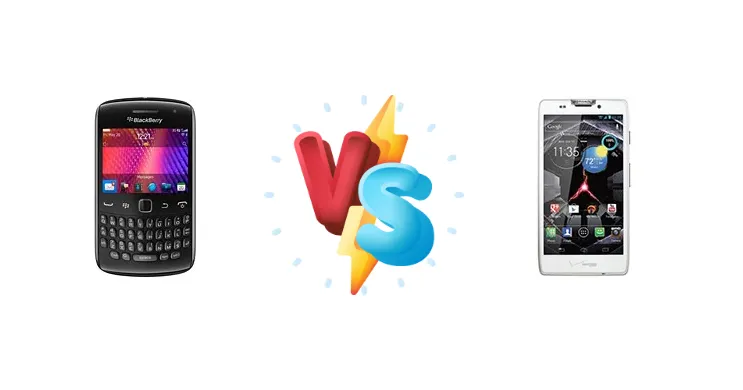
The BlackBerry Curve 9360 and Motorola DROID RAZR HD represent distinct eras in smartphone development. The Curve, released in 2010, embodies the last gasp of BlackBerry’s physical keyboard dominance, while the RAZR HD, from 2012, showcases the burgeoning power of Android and larger, high-resolution displays. This comparison highlights the dramatic technological advancements made in just two years.
🏆 Quick Verdict
For the average user in 2024, the Motorola DROID RAZR HD is the clear winner. Its Qualcomm Snapdragon S4 Plus chipset delivers significantly faster performance and a more modern software experience. While the Curve 9360’s keyboard is a draw for some, the RAZR HD’s overall capabilities far outweigh this advantage.
| Network |
|---|
| 2G bands | GSM 850 / 900 / 1800 / 1900 | CDMA 800 / 1900 |
| 3G bands | HSDPA 850 / 1900 / 2100 | CDMA2000 1xEV-DO |
| 4G bands | - | 13 |
| Speed | HSPA 7.2/2 Mbps | HSPA 21.1/5.76 Mbps, LTE, EV-DO Rev.A 3.1 Mbps |
| Technology | GSM / HSPA | GSM / CDMA / HSPA / EVDO / LTE |
| | HSDPA 900 / 1700 / 2100 | HSDPA 850 / 900 / 1900 / 2100 |
| Launch |
|---|
| Announced | 2011, August. Released 2011, August | 2012, September. Released 2012, October |
| Status | Discontinued | Discontinued |
| Body |
|---|
| Dimensions | 109 x 60 x 11 mm (4.29 x 2.36 x 0.43 in) | 131.9 x 67.9 x 8.4 mm (5.19 x 2.67 x 0.33 in) |
| Keyboard | QWERTY | - |
| SIM | Mini-SIM | Micro-SIM |
| Weight | 99 g (3.49 oz) | 146 g (5.15 oz) |
| | Optical trackpad | Splash resistant |
| Display |
|---|
| Protection | - | Corning Gorilla Glass |
| Resolution | 480 x 360 pixels, 4:3 ratio (~246 ppi density) | 720 x 1280 pixels, 16:9 ratio (~312 ppi density) |
| Size | 2.44 inches, 18.4 cm2 (~28.2% screen-to-body ratio) | 4.7 inches, 60.9 cm2 (~68.0% screen-to-body ratio) |
| Type | TFT | Super AMOLED |
| Platform |
|---|
| CPU | 800MHz | Dual-core 1.5 GHz Krait |
| Chipset | - | Qualcomm MSM8960 Snapdragon S4 Plus |
| GPU | - | Adreno 225 |
| OS | BlackBerry OS 7.0 | Android 4.0.4 (Ice Cream Sandwich), upgradable to 4.4 (KitKat) |
| Memory |
|---|
| Card slot | microSDHC (dedicated slot) | microSDHC (dedicated slot) |
| Internal | 512MB 512MB RAM | 16GB (12GB user available), 1GB RAM |
| Main Camera |
|---|
| Features | LED flash | LED flash |
| Single | 5 MP | 8 MP, AF |
| Video | 480p | 1080p@30fps |
| Selfie camera |
|---|
| Single | - | 1.3 MP |
| | No | - |
| Sound |
|---|
| 3.5mm jack | Yes | Yes |
| 35mm jack | Yes | Yes |
| Loudspeaker | Yes | Yes |
| Comms |
|---|
| Bluetooth | 2.1, A2DP | 4.0, A2DP, EDR, LE, aptX |
| NFC | Yes | Yes |
| Positioning | GPS, A-GPS | GPS, A-GPS, S-GPS, GLONASS |
| Radio | No | No |
| USB | microUSB 2.0 | microUSB 2.0 |
| WLAN | Wi-Fi 802.11 b/g/n, UMA (carrier-dependent) | Wi-Fi 802.11 a/b/g/n, dual-band, hotspot |
| Features |
|---|
| Browser | HTML | - |
| Sensors | - | Accelerometer, proximity, compass, barometer |
| | MP3/eAAC+/WMA/WAV/FLAC player
MP4/H.264/WMV player
Organizer
Document viewer
Voice memo/dial
Predictive text input | HDMI port
MP3/AAC+/WAV/WMA player
MP4/H.264/WMV player
Organizer
Document viewer/editor
Voice memo/dial/commands
Predictive text input |
| Battery |
|---|
| Music play | Up to 25 h | - |
| Stand-by | Up to 336 h (2G) / Up to 288 h (3G) | Up to 286 h |
| Talk time | Up to 5 h (2G) / Up to 5 h (3G) | Up to 24 h |
| Type | Removable Li-Ion 1000 mAh battery | Non-removable Li-Po 2530 mAh battery |
| Misc |
|---|
| Colors | Black, Purple, Pink | Black, White |
| Models | - | XT926 |
| Price | About 90 EUR | About 250 EUR |
| SAR | 1.42 W/kg (head) 1.06 W/kg (body) | 0.97 W/kg (head) 0.46 W/kg (body) |
| SAR EU | 1.22 W/kg (head) 0.62 W/kg (body) | - |
| Tests |
|---|
| Audio quality |
Noise -85.9dB / Crosstalk -82.1dB | - |
| Camera |
Photo | - |
| Display |
Contrast ratio: 1054:1 (nominal) | - |
| Loudspeaker |
Voice 69dB / Noise 65dB / Ring 71dB
| - |
BlackBerry Curve 9360
- Excellent physical keyboard for fast typing
- Long battery life due to efficient hardware and OS
- Compact and pocketable design
- Slow processor compared to modern smartphones
- Limited app ecosystem and outdated OS
- Low-resolution display
Motorola DROID RAZR HD
- Significantly faster processor and performance
- Larger, higher-resolution display
- Access to the Android app ecosystem
- Lacks a physical keyboard
- Potentially shorter battery life under heavy use (though mitigated by efficient chipset)
- Larger size compared to the Curve 9360
Display Comparison
The BlackBerry Curve 9360 features a smaller display with a contrast ratio of 1054:1 (nominal). While respectable for its time, this pales in comparison to the DROID RAZR HD’s larger, higher-resolution display. The RAZR HD’s display, though lacking specific specs in the provided data, benefited from Motorola’s color-boosting technology, offering a more immersive viewing experience. The Curve’s smaller screen size is geared towards efficient text input, while the RAZR HD’s larger screen is better suited for media consumption and web browsing.
Camera Comparison
Both devices feature cameras capable of taking photos, but details are limited for the Curve 9360. The RAZR HD, benefiting from the advancements in mobile imaging during that period, likely featured a more capable sensor and image processing pipeline. While neither phone is expected to compete with modern smartphone cameras, the RAZR HD’s hardware and software would provide a noticeably better photography experience. The lack of specific camera specs for the Curve makes a detailed comparison impossible, but it’s safe to assume the RAZR HD offered superior image quality.
Performance
The core difference lies in the processing power. The BlackBerry Curve 9360 is equipped with an 800MHz CPU, a significant limitation compared to the Motorola DROID RAZR HD’s Qualcomm MSM8960 Snapdragon S4 Plus, featuring a dual-core 1.5 GHz Krait architecture. The Snapdragon S4 Plus, built on a 28nm process, offered a substantial leap in performance and efficiency. This translates to faster app loading times, smoother multitasking, and the ability to run more demanding applications on the RAZR HD. The Krait cores also provided better sustained performance due to improved thermal management.
Battery Life
The BlackBerry Curve 9360 was known for its excellent battery life, a hallmark of BlackBerry devices. However, the DROID RAZR HD, despite potentially having a similar or slightly larger battery capacity (data unavailable), benefits from the power efficiency of the Snapdragon S4 Plus chipset. While the Curve might offer longer standby time, the RAZR HD’s efficient processor allows for more active usage without significant battery drain. The RAZR HD also likely supported faster charging technologies, reducing downtime.
Buying Guide
Buy the BlackBerry Curve 9360 if you absolutely require a physical QWERTY keyboard for extensive messaging and prioritize battery life over app performance. This phone is ideal for users deeply embedded in the BlackBerry ecosystem and resistant to change. Buy the Motorola DROID RAZR HD if you prioritize speed, a larger and more vibrant display, and access to the vast Android app ecosystem. This is the choice for users who want a more versatile and future-proof smartphone experience.
Frequently Asked Questions
❓ Is the BlackBerry Curve 9360 still usable as a daily driver in 2024?
While technically functional, the BlackBerry Curve 9360 is severely limited by its outdated hardware and software. App compatibility is a major issue, and the slow processor makes even basic tasks frustrating. It's best suited for collectors or those with a specific need for a physical keyboard and BlackBerry services.
❓ Does the Motorola DROID RAZR HD support modern Android updates?
No, the Motorola DROID RAZR HD has reached its end-of-life in terms of software updates. It is likely running an older version of Android, and security updates are no longer available. This is a significant security risk and limits the functionality of the device.
❓ What kind of apps can I realistically run on the BlackBerry Curve 9360?
The BlackBerry App World (now defunct) offered a limited selection of apps, and many modern apps are incompatible with the Curve 9360’s older operating system and processor. You’ll be restricted to basic apps for communication, productivity, and a few older games.