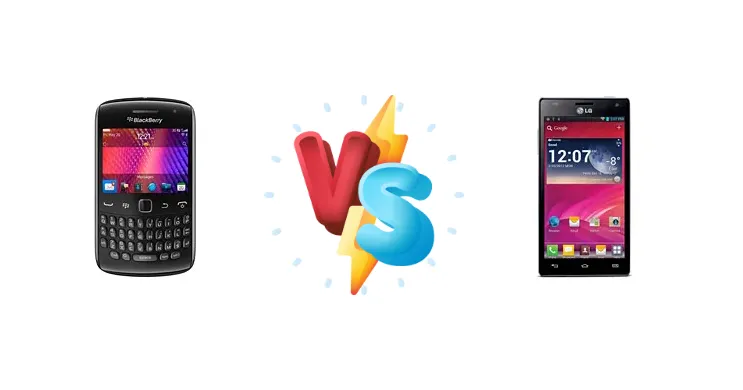
The BlackBerry Curve 9360 and the LG Optimus 4X HD P880 represent distinct turning points in smartphone history. The 9360, a late-era BlackBerry, prioritizes secure communication and physical keyboard usability, while the Optimus 4X HD, powered by Nvidia’s Tegra 3, signaled Android’s push into more demanding multimedia and gaming experiences. This comparison dissects their strengths and weaknesses, revealing which device holds up better in retrospect.
🏆 Quick Verdict
For the average user today, the LG Optimus 4X HD P880 is the more capable device. Its Nvidia Tegra 3 chipset offers significantly more processing power for modern apps and media consumption, despite its age. While the BlackBerry excels at secure messaging, its limited capabilities make it a niche choice.
| Network |
|---|
| 2G bands | GSM 850 / 900 / 1800 / 1900 | GSM 850 / 900 / 1800 / 1900 |
| 3G bands | HSDPA 850 / 1900 / 2100 | HSDPA 850 / 900 / 1900 / 2100 |
| Speed | HSPA 7.2/2 Mbps | HSPA 21.1/5.76 Mbps |
| Technology | GSM / HSPA | GSM / HSPA |
| | HSDPA 900 / 1700 / 2100 | - |
| Launch |
|---|
| Announced | 2011, August. Released 2011, August | 2012, February. Released 2012, June |
| Status | Discontinued | Discontinued |
| Body |
|---|
| Dimensions | 109 x 60 x 11 mm (4.29 x 2.36 x 0.43 in) | 132.4 x 68.1 x 8.9 mm (5.21 x 2.68 x 0.35 in) |
| Keyboard | QWERTY | - |
| SIM | Mini-SIM | Mini-SIM |
| Weight | 99 g (3.49 oz) | 133 g (4.69 oz) |
| | Optical trackpad | - |
| Display |
|---|
| Protection | - | Corning Gorilla Glass |
| Resolution | 480 x 360 pixels, 4:3 ratio (~246 ppi density) | 720 x 1280 pixels, 16:9 ratio (~312 ppi density) |
| Size | 2.44 inches, 18.4 cm2 (~28.2% screen-to-body ratio) | 4.7 inches, 60.9 cm2 (~67.5% screen-to-body ratio) |
| Type | TFT | True HD-IPS LCD |
| | - | Optimus UI v3.0 |
| Platform |
|---|
| CPU | 800MHz | Quad-core 1.5 GHz Cortex-A9 |
| Chipset | - | Nvidia Tegra 3 |
| GPU | - | ULP GeForce |
| OS | BlackBerry OS 7.0 | Android 4.0 (Ice Cream Sandwich), upgradable to 4.1 (Jelly Bean) |
| Memory |
|---|
| Card slot | microSDHC (dedicated slot) | microSDXC (dedicated slot) |
| Internal | 512MB 512MB RAM | 16GB (12GB user available), 1GB RAM |
| Main Camera |
|---|
| Features | LED flash | LED flash |
| Single | 5 MP | 8 MP, AF |
| Video | 480p | 1080p@30fps |
| Selfie camera |
|---|
| Single | - | 1.3 MP |
| | No | - |
| Sound |
|---|
| 3.5mm jack | Yes | Yes |
| 35mm jack | Yes | Yes |
| Loudspeaker | Yes | Yes |
| Comms |
|---|
| Bluetooth | 2.1, A2DP | 4.0, A2DP, LE |
| NFC | Yes | Yes |
| Positioning | GPS, A-GPS | GPS, A-GPS |
| Radio | No | Stereo FM |
| USB | microUSB 2.0 | microUSB 2.0 (MHL TV-out) |
| WLAN | Wi-Fi 802.11 b/g/n, UMA (carrier-dependent) | Wi-Fi 802.11 a/b/g/n, dual-band, Wi-Fi Direct, DLNA, hotspot |
| Features |
|---|
| Browser | HTML | - |
| Sensors | - | Accelerometer, gyro, proximity, compass |
| | MP3/eAAC+/WMA/WAV/FLAC player
MP4/H.264/WMV player
Organizer
Document viewer
Voice memo/dial
Predictive text input | DivX/Xvid/MP4/H.264/WMV player
MP3/WAV/WMA/eAAC+ player
Document editor
Organizer
Voice memo/dial/commands
Predictive text input |
| Battery |
|---|
| Music play | Up to 25 h | - |
| Stand-by | Up to 336 h (2G) / Up to 288 h (3G) | Up to 730 h (2G) / Up to 686 h (3G) |
| Talk time | Up to 5 h (2G) / Up to 5 h (3G) | Up to 9 h 20 min (2G) / Up to 10 h 50 min (3G) |
| Type | Removable Li-Ion 1000 mAh battery | Removable Li-Ion 2150 mAh battery |
| Misc |
|---|
| Colors | Black, Purple, Pink | Black, White |
| Models | - | P880 |
| Price | About 90 EUR | About 220 EUR |
| SAR | 1.42 W/kg (head) 1.06 W/kg (body) | 0.51 W/kg (head) 0.74 W/kg (body) |
| SAR EU | 1.22 W/kg (head) 0.62 W/kg (body) | 0.62 W/kg (head) 0.37 W/kg (body) |
| Tests |
|---|
| Audio quality |
Noise -85.9dB / Crosstalk -82.1dB |
Noise -74.8dB / Crosstalk -81.6dB |
| Battery life | - | Endurance rating 40h |
| Camera |
Photo |
Photo / Video |
| Display |
Contrast ratio: 1054:1 (nominal) |
Contrast ratio: 1102:1 (nominal) / 1.691:1 (sunlight) |
| Loudspeaker |
Voice 69dB / Noise 65dB / Ring 71dB
| - |
BlackBerry Curve 9360
- Excellent physical keyboard for fast typing
- Secure BlackBerry messaging platform
- Compact and pocketable design
- Limited app ecosystem compared to Android
- Slow processor and limited multitasking capabilities
- No video recording
LG Optimus 4X HD P880
- Powerful Nvidia Tegra 3 processor for gaming and multimedia
- Larger display for better viewing experience
- Android OS with access to a vast app library
- Larger size and less pocketable than the BlackBerry
- Battery life may be impacted by demanding apps
- Android OS security concerns (relative to BlackBerry)
Display Comparison
Both devices feature nominal contrast ratios around 1054:1 (BlackBerry) and 1102:1 (LG), suggesting similar black levels and color depth for their time. However, the LG Optimus 4X HD boasts a larger display, crucial for media consumption. The LG’s contrast ratio of 1.691:1 in sunlight indicates better outdoor visibility than the BlackBerry, which lacks a specified sunlight contrast ratio. The BlackBerry’s smaller screen is optimized for text, while the LG aims for a more immersive visual experience.
Camera Comparison
Both phones offer photo capabilities, but the LG Optimus 4X HD extends this to include video recording, a feature absent on the BlackBerry. While neither device boasts a cutting-edge camera by today’s standards, the LG’s ability to capture video adds a layer of versatility. Without specific sensor size or aperture information, it’s difficult to assess image quality beyond the basic functionality offered by both.
Performance
The performance gap is substantial. The BlackBerry Curve 9360’s 800MHz CPU is dwarfed by the LG Optimus 4X HD’s quad-core 1.5 GHz Cortex-A9 processor, powered by the Nvidia Tegra 3 chipset. This translates to significantly faster app loading times, smoother multitasking, and the ability to run more demanding games on the LG. The Tegra 3’s GPU provides a level of graphical performance the BlackBerry simply cannot match. While the BlackBerry was efficient for its time, the LG’s processing power offers a far more future-proof experience, even considering its age.
Battery Life
The LG Optimus 4X HD’s endurance rating of 40 hours suggests a reasonable battery life, especially considering the power of the Tegra 3 chipset. This rating implies a balance between performance and power consumption. The BlackBerry, while likely efficient due to its less demanding hardware, lacks a comparable endurance rating. The LG’s 40-hour rating suggests it could comfortably last a full day of moderate use, while the BlackBerry’s battery life would likely be more dependent on messaging activity.
Buying Guide
Buy the BlackBerry Curve 9360 if you absolutely require a physical QWERTY keyboard for rapid text input and prioritize secure, encrypted communication above all else. Its simplicity and focus on messaging are its core strengths. Buy the LG Optimus 4X HD P880 if you prefer a larger display, want to experience early Android gaming with the Tegra 3, and need a more versatile smartphone capable of handling a wider range of applications, even if it's showing its age.
Frequently Asked Questions
❓ Is the Nvidia Tegra 3 in the LG Optimus 4X HD still capable of running modern Android apps?
While the Tegra 3 was powerful for its time, many modern Android apps are optimized for newer processors and may experience performance issues or be incompatible with the LG Optimus 4X HD. Basic apps and older games should run adequately, but demanding titles will likely struggle.
❓ How secure is the BlackBerry Curve 9360's messaging platform compared to modern messaging apps?
The BlackBerry's messaging platform was renowned for its security, utilizing end-to-end encryption. However, the infrastructure supporting this security is now largely outdated and potentially vulnerable. Modern messaging apps offer comparable or superior security features with ongoing updates and support.
❓ Can I still find replacement batteries for either of these phones?
Finding replacement batteries for both phones is becoming increasingly difficult. While some third-party options may be available, their quality and reliability can vary significantly. Battery health is a major concern for both devices given their age.