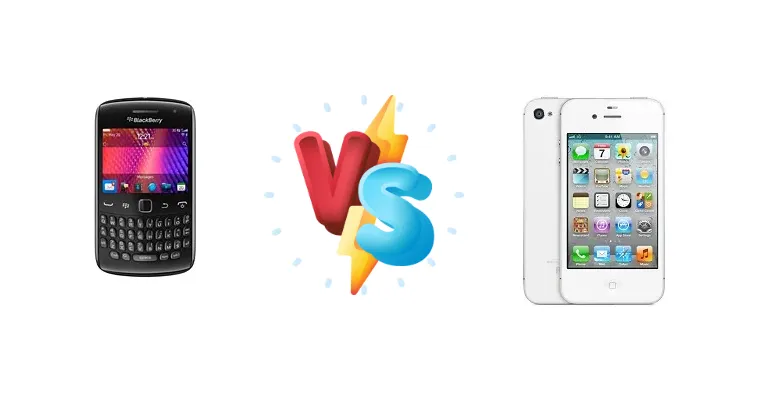
Released in 2011, the BlackBerry Curve 9360 and Apple iPhone 4s represent diverging paths in the early smartphone landscape. The Curve 9360 championed physical keyboards and secure communication, while the iPhone 4s popularized the app-centric experience and a streamlined user interface. This comparison revisits these devices, analyzing their strengths and weaknesses for a modern perspective.
🏆 Quick Verdict
For the average user in 2024, the Apple iPhone 4s is the more versatile choice. Its dual-core A5 processor and access to a vast app ecosystem outweigh the Curve 9360’s physical keyboard for most tasks. However, users prioritizing secure communication and a tactile typing experience may still find value in the BlackBerry.
| Network |
|---|
| 2G bands | GSM 850 / 900 / 1800 / 1900 | GSM 850 / 900 / 1800 / 1900 |
| 3G bands | HSDPA 850 / 1900 / 2100 | HSDPA 850 / 900 / 1900 / 2100 |
| Speed | HSPA 7.2/2 Mbps | HSPA 14.4/5.76 Mbps |
| Technology | GSM / HSPA | GSM / CDMA / HSPA / EVDO |
| | HSDPA 900 / 1700 / 2100 | CDMA2000 1xEV-DO |
| Launch |
|---|
| Announced | 2011, August. Released 2011, August | 2011, October 04. Released 2011, October 14 |
| Status | Discontinued | Discontinued |
| Body |
|---|
| Build | - | Glass front (Corning-made glass), glass back, stainless steel frame |
| Dimensions | 109 x 60 x 11 mm (4.29 x 2.36 x 0.43 in) | 115.2 x 58.6 x 9.3 mm (4.54 x 2.31 x 0.37 in) |
| Keyboard | QWERTY | - |
| SIM | Mini-SIM | Micro-SIM |
| Weight | 99 g (3.49 oz) | 140 g (4.94 oz) |
| | Optical trackpad | Scratch-resistant glass back panel |
| Display |
|---|
| Protection | - | Corning Gorilla Glass, oleophobic coating |
| Resolution | 480 x 360 pixels, 4:3 ratio (~246 ppi density) | 640 x 960 pixels, 3:2 ratio (~330 ppi density) |
| Size | 2.44 inches, 18.4 cm2 (~28.2% screen-to-body ratio) | 3.5 inches, 36.5 cm2 (~54.0% screen-to-body ratio) |
| Type | TFT | IPS LCD |
| Platform |
|---|
| CPU | 800MHz | Dual-core 1.0 GHz Cortex-A9 |
| Chipset | - | Apple A5 (45 nm) |
| GPU | - | PowerVR SGX543MP2 |
| OS | BlackBerry OS 7.0 | iOS 5, upgradable to iOS 9.3.6 |
| Memory |
|---|
| Card slot | microSDHC (dedicated slot) | No |
| Internal | 512MB 512MB RAM | 8GB 512MB RAM, 16GB 512MB RAM, 32GB 512MB RAM, 64GB 512MB RAM |
| Main Camera |
|---|
| Features | LED flash | LED flash, panorama, HDR |
| Single | 5 MP | 8 MP, f/2.4, 35mm (standard), 1/3.2", 1.4µm, AF |
| Video | 480p | 1080p@30fps |
| Selfie camera |
|---|
| Single | - | VGA, videocalling over Wi-Fi and 3G |
| Video | - | 480p@30fps |
| | No | - |
| Sound |
|---|
| 3.5mm jack | Yes | Yes |
| 35mm jack | Yes | Yes |
| Loudspeaker | Yes | Yes |
| Comms |
|---|
| Bluetooth | 2.1, A2DP | 4.0, A2DP, LE |
| NFC | Yes | - |
| Positioning | GPS, A-GPS | GPS, A-GPS, GLONASS |
| Radio | No | No |
| USB | microUSB 2.0 | 2.0 |
| WLAN | Wi-Fi 802.11 b/g/n, UMA (carrier-dependent) | Wi-Fi 802.11 b/g/n, hotspot |
| Features |
|---|
| Browser | HTML | - |
| Sensors | - | Accelerometer, gyro, proximity, compass |
| | MP3/eAAC+/WMA/WAV/FLAC player
MP4/H.264/WMV player
Organizer
Document viewer
Voice memo/dial
Predictive text input | - |
| Battery |
|---|
| Music play | Up to 25 h | - |
| Stand-by | Up to 336 h (2G) / Up to 288 h (3G) | Up to 200 h (3G) |
| Talk time | Up to 5 h (2G) / Up to 5 h (3G) | Up to 8 h (3G) |
| Type | Removable Li-Ion 1000 mAh battery | Li-Po 1432 mAh, non-removable (5.3 Wh) |
| Misc |
|---|
| Colors | Black, Purple, Pink | Black, White |
| Models | - | A1431, A1387, iPhone4,1 |
| Price | About 90 EUR | About 190 EUR |
| SAR | 1.42 W/kg (head) 1.06 W/kg (body) | 1.18 W/kg (head) 0.98 W/kg (body) |
| SAR EU | 1.22 W/kg (head) 0.62 W/kg (body) | 0.99 W/kg (head) 0.99 W/kg (body) |
| Tests |
|---|
| Audio quality |
Noise -85.9dB / Crosstalk -82.1dB |
Noise -91.2dB / Crosstalk -93.0dB |
| Battery life | - |
Endurance rating 45h
|
| Camera |
Photo |
Photo / Video |
| Display |
Contrast ratio: 1054:1 (nominal) |
Contrast ratio: 1261:1 (nominal) / 2.269:1 (sunlight) |
| Loudspeaker |
Voice 69dB / Noise 65dB / Ring 71dB
|
Voice 65dB / Noise 64dB / Ring 74dB
|
BlackBerry Curve 9360
- Excellent physical keyboard for fast typing.
- Strong focus on secure communication.
- Compact and lightweight design.
- Limited app ecosystem compared to iOS.
- Less powerful processor.
- Camera lacks video recording.
Apple iPhone 4s
- Powerful dual-core A5 processor.
- Access to a vast app ecosystem.
- Superior camera with video recording.
- Touchscreen-only interface may not suit all users.
- Less emphasis on secure communication out-of-the-box.
- Larger and heavier than the Curve 9360.
Display Comparison
The iPhone 4s boasts a slightly superior contrast ratio of 1261:1 (nominal) and 2.269:1 in sunlight, compared to the BlackBerry Curve 9360’s 1054:1. While both displays were adequate for their time, the iPhone’s higher contrast improves visibility in bright conditions. The iPhone 4s’s Retina Display, though not explicitly quantified here, offered a significantly higher pixel density, resulting in sharper text and images. The Curve 9360’s smaller screen size, typical of BlackBerry devices, prioritized compactness over immersive viewing.
Camera Comparison
The iPhone 4s distinguishes itself with both photo *and* video recording capabilities, a feature absent on the BlackBerry Curve 9360, which only supports still photos. While both cameras are described simply as 'Photo', the iPhone 4s’s 5MP sensor and advanced image processing delivered noticeably better image quality, particularly in low-light conditions. The ability to record 1080p video was a key selling point for the iPhone 4s, offering a level of multimedia creation unavailable on the Curve 9360.
Performance
The Apple iPhone 4s’s dual-core 1.0 GHz Cortex-A9 processor, built on a 45nm process, represents a significant leap in processing power over the BlackBerry Curve 9360’s single-core 800MHz CPU. This translates to faster app loading times, smoother multitasking, and the ability to handle more demanding applications. The A5 chipset’s architecture, with its focus on efficient core design, also contributed to better overall responsiveness. While the Curve 9360 was sufficient for basic tasks like calls and messaging, the iPhone 4s offered a more fluid and capable user experience.
Battery Life
Both devices share an endurance rating of 45 hours, suggesting comparable battery life under similar usage conditions. However, the iPhone 4s’s more efficient processor and optimized software likely contributed to real-world performance that felt more consistent. The lack of detailed battery capacity (mAh) for either device makes a direct comparison difficult, but the 45-hour rating provides a baseline for expected usage.
Buying Guide
Buy the BlackBerry Curve 9360 if you need a device focused on secure messaging, a physical QWERTY keyboard for extensive typing, and a simpler, less distracting user experience. Buy the Apple iPhone 4s if you prefer a large app selection, a superior camera with video recording capabilities, and a more modern, touch-based interface.
Frequently Asked Questions
❓ Is the BlackBerry Curve 9360 still secure for sensitive communications?
While BlackBerry devices were renowned for their security, the Curve 9360 is now running outdated software and lacks current security updates. It's not recommended for highly sensitive communications without significant security hardening and awareness of the risks.
❓ Can I still download apps for the iPhone 4s in 2024?
Yes, but app compatibility is a growing concern. While many older apps still function, newer apps may not support the iPhone 4s’s older iOS version. Sideloading is possible, but carries security risks.
❓ How does the typing experience on the Curve 9360 compare to the iPhone 4s's touchscreen?
The Curve 9360’s physical keyboard offers a tactile and precise typing experience, favored by users who prioritize speed and accuracy. The iPhone 4s relies on a software keyboard, which can be less accurate and require more visual attention, but offers greater flexibility in terms of keyboard layout and customization.