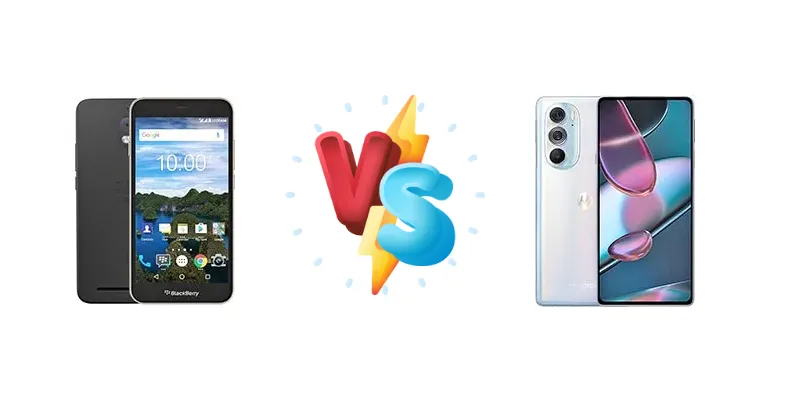
The BlackBerry Aurora represents a bygone era of secure, physical keyboard smartphones, while the Motorola Edge X30 embodies modern flagship performance. This comparison pits a budget-friendly legacy device against a powerhouse, exploring which offers the best value and features for today's user.
🏆 Quick Verdict
The Motorola Edge X30 utterly dominates the BlackBerry Aurora in nearly every category. Its Snapdragon 8 Gen 1 chipset, stunning display, and rapid charging make it a clear winner for users prioritizing performance and modern features. The Aurora's appeal lies solely in its BlackBerry heritage and physical keyboard for a niche audience.
| Network |
|---|
| 2G bands | GSM 850 / 900 / 1800 / 1900 - SIM 1 & SIM 2 | GSM 850 / 900 / 1800 / 1900 |
| 3G bands | HSDPA 850 / 900 / 1900 / 2100 | HSDPA 850 / 900 / 1800 / 1900 / 2100 |
| 4G bands | LTE | 1, 2, 3, 4, 5, 7, 8, 12, 17, 34, 38, 39, 40, 41 |
| 5G bands | - | 1, 3, 5, 7, 8, 20, 28, 38, 41, 78 SA/NSA/Sub6 |
| Speed | HSPA, LTE | HSPA, LTE, 5G |
| Technology | GSM / HSPA / LTE | GSM / HSPA / LTE / 5G |
| Launch |
|---|
| Announced | 2017, March. Released 2017, March | 2021, December 09 |
| Status | Discontinued | Available. Released 2021, December 15 |
| Body |
|---|
| Build | Glass front, plastic back, plastic frame | Glass front, glass back (Gorilla Glass 5) |
| Dimensions | 152 x 76.8 x 8.5 mm (5.98 x 3.02 x 0.33 in) | 163.6 x 75.6 x 8.5 mm (6.44 x 2.98 x 0.33 in) |
| SIM | Dual SIM (Micro-SIM, dual stand-by) | Nano-SIM + Nano-SIM |
| Weight | 178 g (6.28 oz) | 194 g (6.84 oz) |
| | - | Water-repellent design |
| Display |
|---|
| Resolution | 720 x 1280 pixels, 16:9 ratio (~267 ppi density) | 1080 x 2400 pixels, 20:9 ratio (~393 ppi density) |
| Size | 5.5 inches, 83.4 cm2 (~71.4% screen-to-body ratio) | 6.7 inches, 108.4 cm2 (~87.6% screen-to-body ratio) |
| Type | IPS LCD | OLED, 1B colors, 144Hz, HDR10+, 500 nits (typ), 700 nits (HBM) |
| Platform |
|---|
| CPU | Quad-core 1.4 GHz Cortex-A53 | Octa-core (1x3.00 GHz Cortex-X2 & 3x2.50 GHz Cortex-A710 & 4x1.80 GHz Cortex-A510) |
| Chipset | Qualcomm MSM8917 Snapdragon 425 (28 nm) | Qualcomm SM8450 Snapdragon 8 Gen 1 (4 nm) |
| GPU | Adreno 308 | Adreno 730 |
| OS | Android 7.0 (Nougat) | Android 12, MYUI 3.0 |
| Memory |
|---|
| Card slot | microSDXC (dedicated slot) | No |
| Internal | 32GB 4GB RAM | 128GB 8GB RAM, 256GB 8GB RAM, 256GB 12GB RAM |
| | eMMC 5.1 | UFS 3.1 |
| Main Camera |
|---|
| Features | Dual-LED flash, HDR, panorama | Dual-LED flash, panorama, HDR |
| Single | 13 MP, AF | - |
| Triple | - | 50 MP, f/1.9, (wide), 1/1.55", 1.0µm, dual pixel PDAF, OIS
50 MP, f/2.2, 114˚ (ultrawide), 1/2.76", 0.64µm
Auxiliary lens |
| Video | 1080p@30fps | 4K@30fps, 1080p@30/60/120/240fps, 720p@960fps, 10-bit HDR10+, gyro-EIS |
| Selfie camera |
|---|
| Features | - | HDR |
| Single | 8 MP | 60 MP, f/2.2, (wide), 1/2.8", 0.61µm
or
60 MP, f/2.2, (wide), 1/2.8", 0.61µm, under display |
| Video | - | 4K@30fps, 1080p@30/120fps |
| Sound |
|---|
| 3.5mm jack | Yes | No |
| 35mm jack | Yes | No |
| Loudspeaker | Yes | Yes, with stereo speakers |
| Comms |
|---|
| Bluetooth | 4.0, A2DP, EDR, LE | 5.2, A2DP, LE, aptX HD, aptX Adaptive |
| NFC | No | Yes |
| Positioning | GPS, GLONASS, BDS | GPS (L1+L5), GLONASS, BDS, GALILEO |
| Radio | No | No |
| USB | microUSB 2.0 | USB Type-C |
| WLAN | Wi-Fi 802.11 b/g/n, Wi-Fi Direct | Wi-Fi 802.11 a/b/g/n/ac/6e, dual-band, Wi-Fi Direct |
| Features |
|---|
| Sensors | Accelerometer, proximity, compass | Fingerprint (side-mounted), accelerometer, gyro, proximity, compass |
| | - | Ready For support |
| Battery |
|---|
| Charging | - | 68W wired, 100% in 35 min |
| Type | Li-Ion 3000 mAh, non-removable | Market-dependent versions:· Li-Po 5000 mAh (regular version)· Li-Po 4800 mAh (under screen camera version) |
| Misc |
|---|
| Colors | Black, Silver, Gold | White, Black |
| Models | BBC100-1 | XT2201-2, XT2201-6 |
| Price | About 200 EUR | About 420 EUR |
BlackBerry Aurora
- Physical Keyboard
- BlackBerry Security Features (potentially)
- Compact Size
- Outdated Processor
- Low-Resolution Display
- Poor Camera
- Slow Charging
- Limited Software Updates
Motorola Edge X30
- Flagship Performance
- Stunning Display
- Fast Charging
- Excellent Camera
- Modern Design
- Good Value
- No Headphone Jack
- Potential for Software Bugs (common with new phones)
Display Comparison
The Motorola Edge X30 boasts a 6.7-inch OLED display with a 144Hz refresh rate, offering vibrant colors, deep blacks, and incredibly smooth scrolling. The Aurora has a smaller 5.5-inch IPS LCD display with a standard 60Hz refresh rate. The difference in visual quality and responsiveness is substantial.
Camera Comparison
The Edge X30 features a triple-camera system (50MP main, 13MP ultrawide, 2MP depth) capable of capturing detailed photos and videos. The Aurora has a basic 8MP main camera. Image quality, low-light performance, and video recording are vastly superior on the Edge X30.
Performance
The Snapdragon 8 Gen 1 in the Edge X30 provides significantly faster processing speeds and graphics performance compared to the Aurora's Snapdragon 425. Expect seamless multitasking, demanding games running smoothly, and quicker app loading times on the Edge X30. The Aurora struggles with modern apps and heavier workloads.
Battery Life
The Edge X30's 4500mAh battery, coupled with 68W fast charging, provides all-day battery life and can be fully charged in around 35 minutes. The Aurora has a smaller battery (likely around 2500-3000mAh) and lacks fast charging, resulting in shorter battery life and slower charging times.
Buying Guide
The BlackBerry Aurora is for die-hard BlackBerry fans nostalgic for the physical keyboard and secure operating system (though it runs Android). The Motorola Edge X30 is for users seeking a high-performance Android phone with a premium display, fast charging, and a competitive camera system at a reasonable price.
Frequently Asked Questions
❓ Is the BlackBerry Aurora still worth buying?
Only if you're a dedicated BlackBerry enthusiast who values the physical keyboard and are willing to accept its limitations in performance and features. Otherwise, there are far better options available.
❓ What are the key differences between the Snapdragon 8 Gen 1 and Snapdragon 425?
The Snapdragon 8 Gen 1 is a flagship-level processor offering significantly faster performance, improved graphics, and better power efficiency compared to the Snapdragon 425, which is a budget-friendly processor.