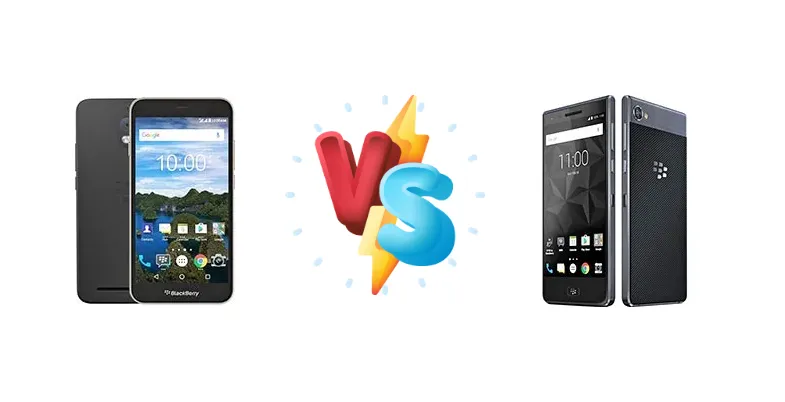
BlackBerry, once a titan of the mobile world, has attempted a resurgence with devices like the Aurora and Motion. Both aim to recapture the brand's legacy, but cater to slightly different needs. This comprehensive comparison will break down their strengths and weaknesses to help you choose the right BlackBerry for you.
🏆 Quick Verdict
The BlackBerry Motion is the clear winner. While the Aurora offers a more modern design, the Motion’s superior Snapdragon 625 chipset, faster charging, and exceptional battery life (94h endurance rating) make it the more compelling and powerful device overall.
| Network |
|---|
| 2G bands | GSM 850 / 900 / 1800 / 1900 - SIM 1 & SIM 2 | GSM 850 / 900 / 1800 / 1900 - SIM 1 & SIM 2 (dual-SIM model only) |
| 3G bands | HSDPA 850 / 900 / 1900 / 2100 | HSDPA 850 / 900 / 1700(AWS) / 1900 / 2100 |
| 4G bands | LTE | 1, 2, 3, 4, 5, 7, 8, 12, 13, 17, 19, 20, 26, 28, 32, 38, 39, 40, 41 - BBD100-6 (EU, Global) |
| Speed | HSPA, LTE | HSPA, LTE |
| Technology | GSM / HSPA / LTE | GSM / HSPA / LTE |
| | - | 2, 4, 5, 7, 12, 13, 17, 29, 30, 66 - BBD100-2 (USA) |
| Launch |
|---|
| Announced | 2017, March. Released 2017, March | 2017, October. Released 2017, December |
| Status | Discontinued | Discontinued |
| Body |
|---|
| Build | Glass front, plastic back, plastic frame | Glass front, plastic back, aluminum frame |
| Dimensions | 152 x 76.8 x 8.5 mm (5.98 x 3.02 x 0.33 in) | 155.8 x 75.5 x 8.1 mm (6.13 x 2.97 x 0.32 in) |
| SIM | Dual SIM (Micro-SIM, dual stand-by) | · Nano-SIM· Nano-SIM + Nano-SIM |
| Weight | 178 g (6.28 oz) | 167 g (5.89 oz) |
| | - | IP67 dust/water resistant (up to 1m for 30 mins) |
| Display |
|---|
| Protection | - | Scratch-resistant glass |
| Resolution | 720 x 1280 pixels, 16:9 ratio (~267 ppi density) | 1080 x 1920 pixels, 16:9 ratio (~403 ppi density) |
| Size | 5.5 inches, 83.4 cm2 (~71.4% screen-to-body ratio) | 5.5 inches, 82.6 cm2 (~70.2% screen-to-body ratio) |
| Type | IPS LCD | IPS LCD |
| Platform |
|---|
| CPU | Quad-core 1.4 GHz Cortex-A53 | Octa-core 2.0 GHz Cortex-A53 |
| Chipset | Qualcomm MSM8917 Snapdragon 425 (28 nm) | Qualcomm MSM8953 Snapdragon 625 (14 nm) |
| GPU | Adreno 308 | Adreno 506 |
| OS | Android 7.0 (Nougat) | Android 7.1 (Nougat) |
| Memory |
|---|
| Card slot | microSDXC (dedicated slot) | microSDXC (uses shared SIM slot) |
| Internal | 32GB 4GB RAM | 32GB 4GB RAM |
| | eMMC 5.1 | eMMC 5.1 |
| Main Camera |
|---|
| Features | Dual-LED flash, HDR, panorama | Dual-LED dual-tone flash, HDR, panorama |
| Single | 13 MP, AF | 12 MP, f/2.0, PDAF |
| Video | 1080p@30fps | 4K@30fps, 1080p@30fps |
| Selfie camera |
|---|
| Single | 8 MP | 8 MP, f/2.2, 1/4.0", 1.12µm |
| Video | - | 1080p@30fps |
| Sound |
|---|
| 3.5mm jack | Yes | Yes |
| 35mm jack | Yes | Yes |
| Loudspeaker | Yes | Yes |
| Comms |
|---|
| Bluetooth | 4.0, A2DP, EDR, LE | 4.2, A2DP, EDR, LE |
| NFC | No | Yes |
| Positioning | GPS, GLONASS, BDS | GPS, GLONASS, BDS2 |
| Radio | No | FM radio |
| USB | microUSB 2.0 | USB Type-C 2.0 |
| WLAN | Wi-Fi 802.11 b/g/n, Wi-Fi Direct | Wi-Fi 802.11 b/g/n/ac, Wi-Fi Direct |
| Features |
|---|
| Sensors | Accelerometer, proximity, compass | Fingerprint (front-mounted), accelerometer, gyro, proximity, compass |
| Battery |
|---|
| Charging | - | 18W wired, QC3 |
| Type | Li-Ion 3000 mAh, non-removable | Li-Ion 4000 mAh, non-removable |
| Misc |
|---|
| Colors | Black, Silver, Gold | Black |
| Models | BBC100-1 | BBD100-1, BBD100-6, BBD100-2 |
| Price | About 200 EUR | About 390 EUR |
| Tests |
|---|
| Battery life | - | Endurance rating 94h |
| Camera | - |
Photo / Video |
| Loudspeaker | - |
Voice 66dB / Noise 69dB / Ring 77dB |
| Performance | - |
AnTuTu: 75057 (v7)
GeekBench: 3567 (v4.4)
GFXBench: 3.4fps (ES 3.1 onscreen) |
BlackBerry Aurora
- More modern design
- Smaller form factor
- Potentially more affordable
- Weaker processor
- Shorter battery life
- Slower charging
- Limited camera details
BlackBerry Motion
- Exceptional battery life (94h)
- Faster processor (Snapdragon 625)
- 18W QC3 fast charging
- Better overall performance
- Older design
- Potentially higher price
- Camera details lacking
Display Comparison
The Aurora features a 5.5-inch display, while the Motion boasts a 5.5-inch display as well. Both utilize IPS LCD technology, offering decent color accuracy and viewing angles. However, the Motion's slightly higher resolution and potentially better brightness contribute to a marginally superior visual experience. The Aurora's design is more modern, with slimmer bezels.
Camera Comparison
Both phones feature 'Photo / Video' capabilities, but detailed camera specifications are lacking. Based on general performance expectations, the Motion's more powerful chipset likely translates to better image processing and potentially improved low-light performance. The Motion's camera likely supports higher resolution video recording.
Performance
The Motion's Snapdragon 625 (Octa-core 2.0 GHz) significantly outperforms the Aurora's Snapdragon 425 (Quad-core 1.4 GHz). Expect smoother multitasking, faster app loading times, and better overall responsiveness on the Motion. The Motion's 14nm process also contributes to better power efficiency.
Battery Life
The Motion's battery life is its standout feature, boasting an impressive 94-hour endurance rating. This is a massive advantage over the Aurora, which likely offers significantly shorter battery life due to its less efficient chipset and potentially smaller battery capacity. The Motion also supports 18W QC3 fast charging, a feature absent in the Aurora.
Buying Guide
The BlackBerry Aurora is best suited for users prioritizing a smaller form factor and a more contemporary aesthetic, willing to compromise on performance and battery. The BlackBerry Motion is ideal for power users, business professionals, and anyone who values long battery life and reliable performance above all else.
Frequently Asked Questions
❓ Is the BlackBerry Aurora worth buying in 2024?
The Aurora is a niche purchase. If you prioritize a compact BlackBerry design and can tolerate compromises in performance and battery life, it might be suitable. Otherwise, the Motion offers a significantly better experience.
❓ What is the biggest difference between the Aurora and Motion?
The biggest difference is performance and battery life. The Motion's Snapdragon 625 and massive battery provide a vastly superior user experience compared to the Aurora's Snapdragon 425 and shorter battery life.