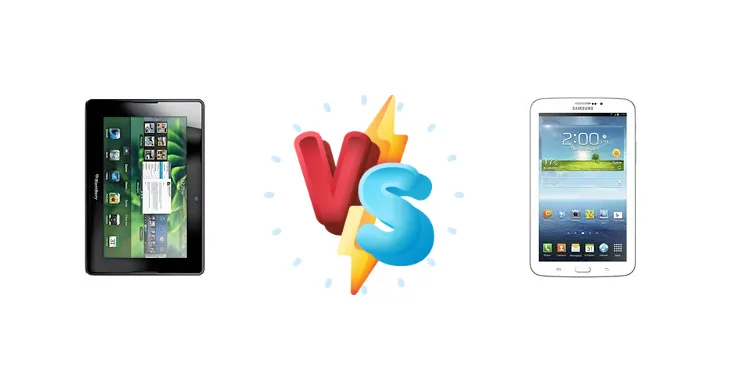
The BlackBerry Playbook and Samsung Galaxy Tab 3 7.0 represent distinct approaches to the early tablet landscape. The Playbook, aiming for a professional user, prioritized security and multitasking, while the Tab 3 7.0 targeted a broader consumer base with a focus on media consumption. This comparison revisits these devices, analyzing their strengths and weaknesses in a modern context.
🏆 Quick Verdict
For the average user seeking a functional, albeit dated, tablet experience, the Samsung Galaxy Tab 3 7.0 edges out the BlackBerry Playbook HSPA+. While the Playbook’s unique OS and security features were ambitious, the Tab 3’s more conventional Android experience and slightly faster processor offer greater app compatibility and overall usability.
| Network |
|---|
| 2G bands | GSM 850 / 900 / 1800 / 1900 | GSM 850 / 900 / 1800 / 1900 - SM-T211, SM-T215 |
| 3G bands | HSDPA 900 / 1900 / 2100 | HSDPA 850 / 900 / 1900 / 2100 - SM-T211, SM-T215 |
| 4G bands | - | 3, 7 - SM-T215 |
| Speed | HSPA 21.1/5.76 Mbps | HSPA 21.1/5.76 Mbps, LTE Cat3 100/50 Mbps (SM-T215) |
| Technology | GSM / HSPA | GSM / HSPA / LTE |
| Launch |
|---|
| Announced | 2011, February | 2013, April. Released 2013, July |
| Status | Discontinued | Discontinued |
| Body |
|---|
| Dimensions | 194 x 130 x 10 mm (7.64 x 5.12 x 0.39 in) | 188 x 111.1 x 9.9 mm (7.40 x 4.37 x 0.39 in) |
| SIM | Mini-SIM | Micro-SIM |
| Weight | 425 g (14.99 oz) | 306 g (10.79 oz) |
| Display |
|---|
| Resolution | 600 x 1024 pixels, 16:9 ratio (~170 ppi density) | 600 x 1024 pixels, 16:9 ratio (~170 ppi density) |
| Size | 7.0 inches, 137.9 cm2 (~54.7% screen-to-body ratio) | 7.0 inches, 137.9 cm2 (~66.0% screen-to-body ratio) |
| Type | TFT | TFT |
| Platform |
|---|
| CPU | Dual-core 1.0 GHz Cortex-A9 | Dual-core 1.2 GHz Cortex-A9 |
| Chipset | TI OMAP 4430 | Marvell PXA986 |
| GPU | PowerVR SGX540 | PowerVR SGX540 |
| OS | BlackBerry Tablet OS | Android 4.1.2 (Jelly Bean), TouchWiz UX UI |
| Memory |
|---|
| Card slot | No | microSDXC (dedicated slot) |
| Internal | 16GB 1GB RAM, 32GB 1GB RAM, 64GB 1GB RAM | 8GB 1GB RAM, 16GB 1GB RAM |
| Main Camera |
|---|
| Single | 5 MP, AF | 3.15 MP |
| Video | 1080p@30fps | 720p@30fps |
| Selfie camera |
|---|
| Single | 3 MP | 1.3 MP |
| Sound |
|---|
| 3.5mm jack | - | Yes |
| 35mm jack | Yes | Yes |
| Loudspeaker | Yes, with stereo speakers | Yes |
| Comms |
|---|
| Bluetooth | 2.1, A2DP, EDR | 3.0, A2DP |
| Infrared port | - | Yes |
| NFC | - | No |
| Positioning | No | GPS, GLONASS |
| Radio | No | No |
| USB | microUSB 2.0 | 2.0 (TV-out) |
| WLAN | Wi-Fi 802.11 a/b/g/n, dual-band | Wi-Fi 802.11 a/b/g/n, dual-band, Wi-Fi Direct, DLNA, hotspot |
| Features |
|---|
| Browser | HTML, Adobe Flash | - |
| Sensors | Accelerometer | Accelerometer, gyro, proximity, compass |
| Battery |
|---|
| Music play | - | Up to 108 h |
| Talk time | - | Up to 8 h (multimedia) |
| Type | Non-removable Li-Po 5300 mAh battery | Li-Ion 4000 mAh, non-removable |
| Misc |
|---|
| Colors | Black | White |
| Models | - | GT-P3200, SM-T211, SM-T215, SM-T217S, SM-T217T |
| Price | - | About 150 EUR |
| SAR | - | 0.63 W/kg (head) 1.59 W/kg (body) |
| SAR EU | - | 0.71 W/kg (head) 0.98 W/kg (body) |
| Tests |
|---|
| Display | - |
Contrast ratio: 1098 (nominal) |
BlackBerry 4G Playbook HSPA+
- Unique BlackBerry OS with focus on security
- Potential for legacy application support
- Compact and relatively lightweight design
- Limited app ecosystem compared to Android
- Slower processor than the Tab 3
- Outdated operating system and security vulnerabilities
Samsung Galaxy Tab 3 7.0
- Familiar Android operating system
- Wider app compatibility
- Slightly faster processor
- Generic Android experience
- Limited storage options
- Outdated hardware and software
Display Comparison
Both tablets share a nominal contrast ratio of 1098, suggesting similar display quality in terms of black levels and color depth. However, the lack of detailed display specifications like brightness (nits) and color gamut coverage for both devices makes a definitive comparison difficult. The Tab 3’s 7.0-inch size is likely more comfortable for extended reading and portability, while the Playbook’s 7-inch display, though similar in size, was integrated into a different form factor. The absence of information regarding panel technology (IPS, TFT) prevents a deeper analysis of viewing angles and color accuracy.
Camera Comparison
Neither device was designed with photography as a primary focus. Detailed camera specifications are scarce, but it’s safe to assume both feature basic cameras suitable for occasional snapshots. Without information on sensor size, aperture, or image processing capabilities, a meaningful comparison is impossible. The emphasis on video conferencing on the Playbook might suggest a slightly better front-facing camera, but this remains speculative.
Performance
The Samsung Galaxy Tab 3 7.0 boasts a slightly faster dual-core 1.2 GHz Cortex-A9 processor compared to the BlackBerry Playbook’s 1.0 GHz Cortex-A9. While both utilize the same ARM architecture, the clock speed difference suggests a marginal performance advantage for the Tab 3 in everyday tasks. The Tab 3’s Marvell PXA986 chipset versus the Playbook’s TI OMAP 4430 also implies different GPU capabilities, potentially favoring the Tab 3 in graphics-intensive applications. However, the limited RAM specifications for both devices (likely 1GB in both cases) will constrain multitasking performance.
Battery Life
Battery capacity information is unavailable for both devices. However, given their similar screen sizes and processor power, battery life is likely comparable. The Playbook’s HSPA+ connectivity could potentially drain the battery faster during data-intensive tasks compared to the Tab 3’s Wi-Fi-only configuration (assuming the Tab 3 is used primarily on Wi-Fi). Charging times are also unknown, but given the age of these devices, they would likely be significantly slower than modern tablets.
Buying Guide
Buy the BlackBerry 4G Playbook HSPA+ if you are a collector of vintage technology, specifically interested in BlackBerry’s unique OS and security features, or require a device for specific legacy applications. Buy the Samsung Galaxy Tab 3 7.0 if you prefer a more familiar Android experience, broader app compatibility, and a device better suited for basic media consumption and light productivity tasks.
Frequently Asked Questions
❓ Is the BlackBerry Playbook still secure enough to use for sensitive data?
While the Playbook was initially lauded for its security features, the operating system is no longer actively supported by BlackBerry. This means it’s vulnerable to unpatched security exploits and is not recommended for handling sensitive data. The lack of security updates poses a significant risk.
❓ Can I install modern Android apps on the BlackBerry Playbook?
No, the BlackBerry Playbook runs its own proprietary operating system (BlackBerry Tablet OS) which is not compatible with Android apps. While there were attempts to sideload Android apps, they were largely unsuccessful and unstable. The Tab 3, running Android, has access to a vast app ecosystem.
❓ What kind of storage options did the Samsung Galaxy Tab 3 7.0 offer?
The Samsung Galaxy Tab 3 7.0 typically came with 8GB or 16GB of internal storage, expandable via a microSD card slot. This was a significant advantage over the Playbook, which had limited internal storage options and no microSD card support.
❓ Is the performance of either tablet sufficient for modern web browsing?
Both tablets will struggle with modern, complex websites due to their limited processing power and RAM. Basic web browsing is possible, but expect slow loading times and rendering issues. Modern web technologies and heavier JavaScript are likely to cause performance bottlenecks.