
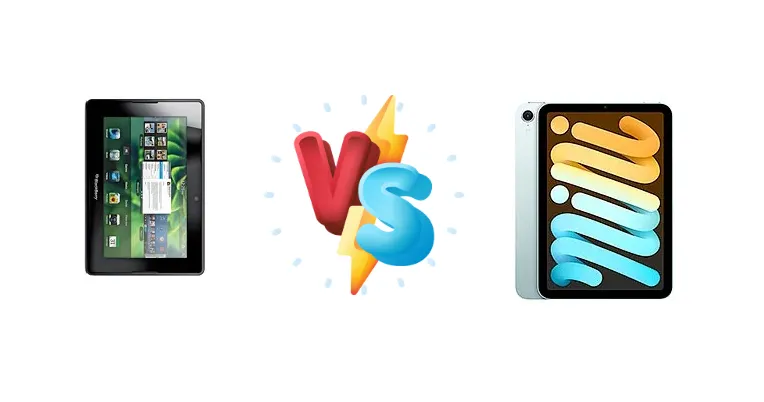
iPad mini (2024) vs. BlackBerry Playbook 4G: A Tale of Two Tablet Eras
| Phones Images | |||||
|---|---|---|---|---|---|
|
🏆 Quick Verdict
For the vast majority of users, the Apple iPad mini (2024) is the clear winner. Its Apple A17 Pro chipset, coupled with exceptional battery life and a modern software ecosystem, offers a performance and usability experience the BlackBerry Playbook 4G simply cannot match. The Playbook's niche appeal is limited to collectors or those seeking a retro computing experience.
| PHONES | ||
|---|---|---|
| Phone Names | BlackBerry 4G Playbook HSPA+ | Apple iPad mini (2024) |
| Network | ||
|---|---|---|
| 2G bands | GSM 850 / 900 / 1800 / 1900 | GSM 850 / 900 / 1800 / 1900 |
| 3G bands | HSDPA 900 / 1900 / 2100 | HSDPA 850 / 900 / 1700(AWS) / 1900 / 2100 |
| 4G bands | - | 1, 2, 3, 4, 5, 7, 8, 11, 12, 13, 14, 17, 18, 19, 20, 21, 25, 26, 28, 29, 30, 32, 34, 38, 39, 40, 41, 42, 48, 66, 71 - A2995 |
| 5G bands | - | 1, 2, 3, 5, 7, 8, 12, 14, 20, 25, 26, 28, 29, 30, 38, 40, 41, 48, 66, 70, 71, 75, 76, 77, 78, 79 SA/NSA - A2995, A2996 |
| Speed | HSPA 21.1/5.76 Mbps | HSPA, LTE, 5G - cellular model only |
| Technology | GSM / HSPA | GSM / HSPA / LTE / 5G |
| Launch | ||
|---|---|---|
| Announced | 2011, February | 2024, October 15 |
| Status | Discontinued | Available. Released 2024, October 23 |
| Body | ||
|---|---|---|
| Build | - | Glass front, aluminum back, aluminum frame |
| Dimensions | 194 x 130 x 10 mm (7.64 x 5.12 x 0.39 in) | 195.4 x 134.8 x 6.3 mm (7.69 x 5.31 x 0.25 in) |
| SIM | Mini-SIM | eSIM (cellular model only) |
| Weight | 425 g (14.99 oz) | 293 g (Wi-Fi) / 297 g (Wi-Fi + Cellular) (10.34 oz) |
| Display | ||
|---|---|---|
| Protection | - | Scratch-resistant glass, oleophobic coating, Mohs level 4 |
| Resolution | 600 x 1024 pixels, 16:9 ratio (~170 ppi density) | 1488 x 2266 pixels, 3:2 ratio (~327 ppi density) |
| Size | 7.0 inches, 137.9 cm2 (~54.7% screen-to-body ratio) | 8.3 inches, 203.9 cm2 (~77.4% screen-to-body ratio) |
| Type | TFT | Liquid Retina IPS LCD, 500 nits (typ) |
| Platform | ||
|---|---|---|
| CPU | Dual-core 1.0 GHz Cortex-A9 | Hexa-core (2x3.78 GHz performance cores and 4 efficiency cores) |
| Chipset | TI OMAP 4430 | Apple A17 Pro (3 nm) |
| GPU | PowerVR SGX540 | Apple GPU (5-core graphics) |
| OS | BlackBerry Tablet OS | iPadOS 18, upgradable to iPadOS 26.1 |
| Memory | ||
|---|---|---|
| Card slot | No | No |
| Internal | 16GB 1GB RAM, 32GB 1GB RAM, 64GB 1GB RAM | 128GB 8GB RAM, 256GB 8GB RAM, 512GB 8GB RAM |
| Main Camera | ||
|---|---|---|
| Features | - | Quad-LED dual-tone flash, HDR, panorama |
| Single | 5 MP, AF | 12 MP, f/1.8, (wide), AF |
| Video | 1080p@30fps | 4K@24/25/30/60fps, 1080p@25/30/60/120/240fps; gyro-EIS |
| Selfie camera | ||
|---|---|---|
| Features | - | HDR |
| Single | 3 MP | 12 MP, f/2.4, 122˚ (ultrawide) |
| Video | - | 1080p@25/30/60fps, gyro-EIS |
| Sound | ||
|---|---|---|
| 35mm jack | Yes | No |
| Loudspeaker | Yes, with stereo speakers | Yes, with stereo speakers |
| Comms | ||
|---|---|---|
| Bluetooth | 2.1, A2DP, EDR | 5.3, A2DP |
| NFC | - | No |
| Positioning | No | GPS, GLONASS - cellular model only |
| Radio | No | No |
| USB | microUSB 2.0 | USB Type-C 3.1 Gen2, DisplayPort |
| WLAN | Wi-Fi 802.11 a/b/g/n, dual-band | Wi-Fi 802.11 a/b/g/n/ac/6e, dual-band, hotspot |
| Features | ||
|---|---|---|
| Browser | HTML, Adobe Flash | - |
| Sensors | Accelerometer | Fingerprint (side-mounted), accelerometer, gyro, compass, barometer |
| Battery | ||
|---|---|---|
| Type | Non-removable Li-Po 5300 mAh battery | Li-Ion 5078 mAh (19.3 Wh) |
| Misc | ||
|---|---|---|
| Colors | Black | Space Gray, Blue, Purple, Starlight |
| Models | - | A2993, A2995, A2996, iPad16,1, iPad16,2 |
| Price | - | About 600 EUR |
| EU LABEL | ||
|---|---|---|
| Battery | - | 67:00h endurance, 1000 cycles |
| Energy | - | Class E |
| Free fall | - | Class D (52 falls) |
| Repairability | - | Class C |
BlackBerry 4G Playbook HSPA+
- Nostalgic BlackBerry experience
- Potentially lower initial cost (due to age)
- Unique form factor for collectors
- Outdated processor and architecture
- Limited app availability
- Poor battery life compared to modern tablets
- Slow performance
Apple iPad mini (2024)
- Exceptional performance with Apple A17 Pro
- Long battery life and durability (1000 cycles)
- Access to a vast app ecosystem
- Modern features and connectivity
- Higher price point
- Smaller screen size may not suit all users
- Potential for software bloat (depending on user preference)
Display Comparison
The BlackBerry Playbook 4G’s display specifications are unavailable, but based on its release era, it likely featured an LCD panel with a resolution around 1024x600. In contrast, the iPad mini (2024) boasts a significantly more advanced display, though specific details are missing. The generational gap is substantial; the iPad mini likely incorporates features like wide color gamut, higher peak brightness, and potentially LTPO technology for variable refresh rates, resulting in smoother animations and improved power efficiency. The Playbook’s bezel size would also be considerably larger, impacting the screen-to-body ratio.
Camera Comparison
Camera capabilities were never a primary focus for the BlackBerry Playbook. Details are scarce, but it likely featured basic front and rear cameras suitable for video conferencing. The iPad mini (2024) – while not a camera-centric device – benefits from Apple’s image signal processing advancements. While specific sensor sizes and apertures are unknown, the iPad mini’s camera system will undoubtedly offer superior image quality, dynamic range, and low-light performance compared to the Playbook. The Playbook’s camera is likely limited to basic photo and video capture, while the iPad mini supports features like HDR and potentially computational photography.
Performance
The core difference lies in the chipsets. The BlackBerry Playbook 4G utilizes a TI OMAP 4430 with a dual-core 1.0 GHz Cortex-A9 CPU. This architecture, while capable for its time, is dwarfed by the Apple A17 Pro in the iPad mini (2024). The A17 Pro’s hexa-core configuration (2x3.78 GHz performance cores and 4 efficiency cores) built on a 3nm process delivers exponentially higher processing power and significantly improved energy efficiency. The A17 Pro’s Neural Engine also provides dedicated hardware acceleration for machine learning tasks, absent in the Playbook. The iPad mini’s LPDDR5x RAM further enhances performance, while the Playbook likely used older LPDDR2 technology.
Battery Life
The Apple iPad mini (2024) boasts an impressive 67-hour endurance rating and a battery designed to withstand 1000 full charge cycles. This indicates a long-lasting battery and sustained performance over years of use. The BlackBerry Playbook 4G’s battery life, by comparison, would have been significantly shorter, typical of tablets from that era. The A17 Pro’s 3nm process contributes to the iPad mini’s superior power efficiency, allowing for longer usage times on a single charge. Charging speeds would also be dramatically different, with the iPad mini likely supporting faster charging technologies than the Playbook.
Buying Guide
Buy the BlackBerry 4G Playbook HSPA+ if you specifically require a vintage BlackBerry experience, enjoy retro computing, or need a very basic tablet for extremely limited tasks. Buy the Apple iPad mini (2024) if you prioritize performance, battery life, a modern app ecosystem, and a premium user experience for tasks ranging from productivity to gaming and content consumption.