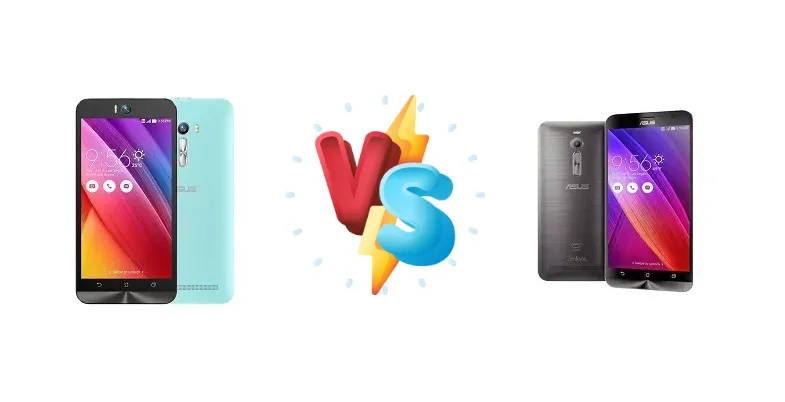
The Asus Zenfone Selfie and Zenfone 2 were popular mid-range phones, each boasting unique strengths. The Selfie prioritized camera capabilities, while the Zenfone 2 offered a more powerful processor and faster charging. Let's dive into a comprehensive comparison to help you decide which one holds up best today.
🏆 Quick Verdict
The Zenfone Selfie ZD551KL edges out the Zenfone 2 due to its significantly better sunlight display contrast and longer battery life. However, the Zenfone 2's faster charging and potentially more responsive performance (depending on RAM configuration) are compelling factors. It's a close call, leaning towards the Selfie for overall usability.
| Network |
|---|
| 2G bands | GSM 850 / 900 / 1800 / 1900 - SIM 1 & SIM 2 | GSM 850 / 900 / 1800 / 1900 - SIM 1 & SIM 2 |
| 3G bands | HSDPA 850 / 900 / 1900 / 2100 | HSDPA 850 / 900 / 1900 / 2100 |
| 4G bands | 1, 2, 3, 5, 7, 8, 20 - Global | 1, 2, 3, 4, 5, 8, 9, 18, 19, 28 - Taiwan |
| Speed | HSPA 42.2/5.76 Mbps, LTE Cat4 150/50 Mbps | HSPA 42.2/5.76 Mbps, LTE Cat4 150/50 Mbps |
| Technology | GSM / HSPA / LTE | GSM / HSPA / LTE |
| | 1, 3 - India | - |
| Launch |
|---|
| Announced | 2015, June. Released 2015, August | 2015, January. Released 2015, March |
| Status | Discontinued | Discontinued |
| Body |
|---|
| Build | Glass front (Gorilla Glass 4), plastic back, plastic frame | Glass front (Gorilla Glass 3), plastic back, plastic frame |
| Dimensions | 156.5 x 77.2 x 10.8 mm (6.16 x 3.04 x 0.43 in) | 152.5 x 77.2 x 10.9 mm (6.00 x 3.04 x 0.43 in) |
| SIM | Dual SIM (Micro-SIM, dual stand-by) | Dual SIM (Micro-SIM, dual stand-by) |
| Weight | 170 g (6.00 oz) | 170 g (6.00 oz) |
| Display |
|---|
| Protection | Corning Gorilla Glass 4, oleophobic coating | Corning Gorilla Glass 3 |
| Resolution | 1080 x 1920 pixels, 16:9 ratio (~403 ppi density) | 1080 x 1920 pixels, 16:9 ratio (~401 ppi density) |
| Size | 5.5 inches, 82.6 cm2 (~68.3% screen-to-body ratio) | 5.5 inches, 83.4 cm2 (~70.8% screen-to-body ratio) |
| Type | IPS LCD | IPS LCD |
| Platform |
|---|
| CPU | Octa-core (4x1.7 GHz Cortex-A53 & 4x1.0 GHz Cortex-A53) | Quad-core 2.3 GHz (4 GB RAM model)Quad-core 1.8 GHz (2 GB RAM model) |
| Chipset | Qualcomm MSM8939 Snapdragon 615 (28 nm) | Intel Atom Z3580 (4 GB RAM model)Intel Atom Z3560 (2 GB RAM model) |
| GPU | Adreno 405 | PowerVR G6430 |
| OS | Android 5.0 (Lollipop), upgradable to 6.0 (Marshmallow), ZenUI | Android 5.0 (Lollipop), upgradable to 6.0 (Marshmallow) |
| Memory |
|---|
| Card slot | microSDXC (dedicated slot) | microSDXC (dedicated slot) |
| Internal | 16GB 2GB RAM, 32GB 3GB RAM | 16GB 2GB RAM, 32GB 2GB RAM, 32GB 4GB RAM, 64GB 4GB RAM, 128GB 4GB RAM |
| | eMMC 4.5 | - |
| Main Camera |
|---|
| Features | Laser AF, Dual-LED dual-tone flash, panorama, HDR | Dual-LED dual-tone flash, panorama, HDR |
| Single | 13 MP, f/2.0, 28mm (wide), 1/3.0" | 13 MP, f/2.0, AF |
| Video | 1080p@30fps | 1080p@30fps |
| Selfie camera |
|---|
| Features | Dual-LED dual-tone flash | - |
| Single | 13 MP, f/2.2, 1/3.1", 1.12µm, AF | 5 MP, f/2.0 |
| Video | 1080p@30fps | - |
| Sound |
|---|
| 3.5mm jack | Yes | Yes |
| 35mm jack | Yes | Yes |
| Loudspeaker | Yes | Yes |
| Comms |
|---|
| Bluetooth | 4.0, A2DP, EDR | 4.0, A2DP, EDR |
| NFC | No | Yes |
| Positioning | GPS, GLONASS, BDS | GPS, GLONASS |
| Radio | FM radio, RDS | FM radio, RDS |
| USB | microUSB 2.0, OTG | microUSB 2.0, OTG |
| WLAN | Wi-Fi 802.11 a/b/g/n/ac, Wi-Fi Direct, hotspot | Wi-Fi 802.11 a/b/g/n/ac, Wi-Fi Direct, hotspot |
| Features |
|---|
| Sensors | Accelerometer, gyro, proximity, compass | Accelerometer, gyro, proximity, compass |
| Battery |
|---|
| Charging | - | 18W wired, 60% in 40 min |
| Type | Li-Po 3000 mAh, removable | Li-Po 3000 mAh, non-removable |
| Misc |
|---|
| Colors | Pure White, Chic Pink, Aqua Blue | Osmium Black, Sheer Gold, Glacier Gray, Glamor Red, Ceramic White |
| Models | Z00UD, Z00UDH, Z00UDC, Z00UDB | Z00AD, Z00A |
| Price | About 280 EUR | About 300 EUR |
| SAR EU | - | 0.35 W/kg (head) |
| Tests |
|---|
| Audio quality |
Noise -92.1dB / Crosstalk -92.5dB | - |
| Battery life |
Endurance rating 63h
| Endurance rating 59h |
| Camera |
Photo / Video |
Photo / Video |
| Display |
Contrast ratio: 928:1 (nominal), 1.680 (sunlight) | - |
| Loudspeaker |
Voice 65dB / Noise 66dB / Ring 75dB
|
Voice 62dB / Noise 61dB / Ring 67dB |
| Performance |
Basemark OS II 2.0: 883Basemark X: 4915 |
Basemark OS II 2.0: 1090Basemark X: 12565 |
Asus Zenfone Selfie ZD551KL
- Excellent sunlight display contrast
- Longer battery life (63h)
- Camera-focused design
- Older chipset (Snapdragon 615)
- Potentially slower performance compared to Zenfone 2 (4GB RAM model)
Asus Zenfone 2 ZE551ML
- Faster charging (18W)
- Potentially faster performance (4GB RAM model with Intel Atom Z3580)
- Multiple RAM options (2GB/4GB)
- Shorter battery life (59h)
- Less impressive display contrast
- Intel Atom processor can be less efficient
Display Comparison
The Zenfone Selfie boasts an impressive contrast ratio of 928:1 (nominal) and a remarkable 1680:1 in sunlight, making it exceptionally viewable outdoors. The Zenfone 2's display, while decent, doesn't match this level of sunlight visibility. Both phones feature similar screen sizes and resolutions, but the Selfie's display is the clear winner.
Camera Comparison
The Zenfone Selfie, as its name suggests, heavily emphasized camera capabilities. While specific camera specs aren't detailed, it likely offered improved features and image processing compared to the Zenfone 2. Both phones featured Photo/Video capabilities, but the Selfie was marketed as a camera-centric device.
Performance
The Zenfone 2 has a potential performance advantage. The 4GB RAM model with the Intel Atom Z3580 offers a more modern architecture and potentially faster speeds than the Zenfone Selfie's Snapdragon 615. However, the 2GB RAM model's performance is more comparable. Real-world performance will depend heavily on RAM and software optimization.
Battery Life
The Zenfone Selfie shines in battery life, achieving an endurance rating of 63 hours, significantly surpassing the Zenfone 2's 59 hours. This difference translates to noticeably longer usage between charges. The Zenfone 2 does offer 18W fast charging, allowing it to reach 60% charge in just 40 minutes, mitigating the battery life disadvantage somewhat.
Buying Guide
The Asus Zenfone Selfie ZD551KL is ideal for users who prioritize camera quality, especially in bright conditions, and value extended battery life. The Asus Zenfone 2 ZE551ML is a better choice for those seeking a slightly faster processor and quicker charging, particularly if opting for the 4GB RAM model.
Frequently Asked Questions
❓ Is the Asus Zenfone Selfie good for photography?
Yes, the Zenfone Selfie was specifically designed with photography in mind, likely offering improved camera features and image processing compared to other phones of its time.
❓ Which Zenfone has better performance?
The Zenfone 2 with the 4GB RAM model and Intel Atom Z3580 generally offers better performance, but the 2GB RAM model is more comparable to the Zenfone Selfie.