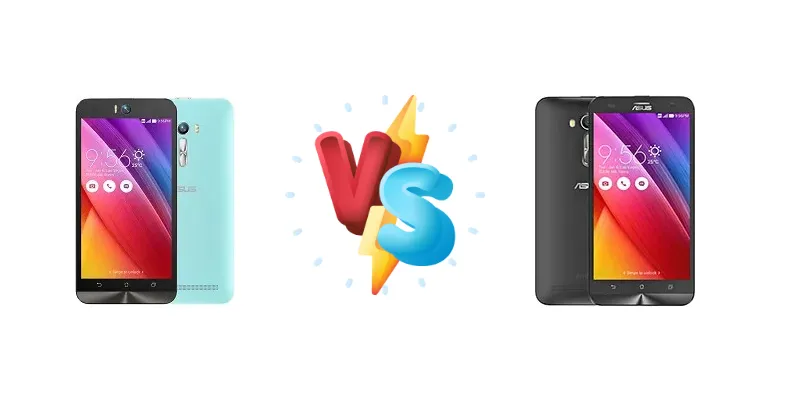
The Asus Zenfone series offered compelling mid-range smartphones, and the Selfie ZD551KL and Zenfone 2 Laser ZE550KL were popular choices. Both aimed to deliver value, but with different strengths. This comparison dives deep into their features to help you decide which one was the better pick.
🏆 Quick Verdict
The Zenfone Selfie ZD551KL edges out the Zenfone 2 Laser due to its significantly better battery life and superior sunlight display performance. While the Zenfone 2 Laser offered a slightly more powerful CPU configuration, the Selfie's overall package is more appealing, especially for users prioritizing longevity and outdoor visibility.
| Network |
|---|
| 2G bands | GSM 850 / 900 / 1800 / 1900 - SIM 1 & SIM 2 | GSM 850 / 900 / 1800 / 1900 - SIM 1 & SIM 2 |
| 3G bands | HSDPA 850 / 900 / 1900 / 2100 | HSDPA 850 / 900 / 1900 / 2100 - Global |
| 4G bands | 1, 2, 3, 5, 7, 8, 20 - Global | 1, 2, 3, 5, 7, 8, 20 - Global |
| Speed | HSPA 42.2/5.76 Mbps, LTE Cat4 150/50 Mbps | HSPA 42.2/5.76 Mbps, LTE Cat4 150/50 Mbps |
| Technology | GSM / HSPA / LTE | GSM / HSPA / LTE |
| | 1, 3 - India | 1, 3, 38, 40, 41 - India |
| Launch |
|---|
| Announced | 2015, June. Released 2015, August | 2015, August. Released 2015, September |
| Status | Discontinued | Discontinued |
| Body |
|---|
| Build | Glass front (Gorilla Glass 4), plastic back, plastic frame | - |
| Dimensions | 156.5 x 77.2 x 10.8 mm (6.16 x 3.04 x 0.43 in) | 152.5 x 77.2 x 10.8 mm (6.00 x 3.04 x 0.43 in) |
| SIM | Dual SIM (Micro-SIM, dual stand-by) | Dual SIM (Micro-SIM, dual stand-by) |
| Weight | 170 g (6.00 oz) | 170 g (6.00 oz) |
| Display |
|---|
| Protection | Corning Gorilla Glass 4, oleophobic coating | Corning Gorilla Glass 4 |
| Resolution | 1080 x 1920 pixels, 16:9 ratio (~403 ppi density) | 720 x 1280 pixels, 16:9 ratio (~267 ppi density) |
| Size | 5.5 inches, 82.6 cm2 (~68.3% screen-to-body ratio) | 5.5 inches, 83.4 cm2 (~70.8% screen-to-body ratio) |
| Type | IPS LCD | IPS LCD |
| Platform |
|---|
| CPU | Octa-core (4x1.7 GHz Cortex-A53 & 4x1.0 GHz Cortex-A53) | Quad-core 1.2 GHz Cortex-A53Octa-core (4x1.5 GHz Cortex-A53 & 4x1.0 GHz Cortex-A53) |
| Chipset | Qualcomm MSM8939 Snapdragon 615 (28 nm) | Qualcomm MSM8916 Snapdragon 410 (28 nm)Qualcomm MSM8939 Snapdragon 615 (28 nm) |
| GPU | Adreno 405 | Adreno 306Adreno 405 |
| OS | Android 5.0 (Lollipop), upgradable to 6.0 (Marshmallow), ZenUI | Android 5.0 (Lollipop), upgradable to 6.0 (Marshmallow), ZenUI |
| Memory |
|---|
| Card slot | microSDXC (dedicated slot) | microSDXC (dedicated slot) |
| Internal | 16GB 2GB RAM, 32GB 3GB RAM | 16GB 2GB RAM, 32GB 3GB RAM |
| | eMMC 4.5 | eMMC 4.5 |
| Main Camera |
|---|
| Features | Laser AF, Dual-LED dual-tone flash, panorama, HDR | Laser AF, Dual-LED dual-tone flash, panorama, HDR |
| Single | 13 MP, f/2.0, 28mm (wide), 1/3.0" | 13 MP, f/2.0 |
| Video | 1080p@30fps | 1080p@30fps |
| Selfie camera |
|---|
| Features | Dual-LED dual-tone flash | - |
| Single | 13 MP, f/2.2, 1/3.1", 1.12µm, AF | 5 MP, f/2.0, AF |
| Video | 1080p@30fps | - |
| Sound |
|---|
| 3.5mm jack | Yes | Yes |
| 35mm jack | Yes | Yes |
| Loudspeaker | Yes | Yes |
| Comms |
|---|
| Bluetooth | 4.0, A2DP, EDR | 4.0, A2DP, EDR |
| NFC | No | No |
| Positioning | GPS, GLONASS, BDS | GPS, GLONASS |
| Radio | FM radio, RDS | FM radio |
| USB | microUSB 2.0, OTG | microUSB 2.0, OTG |
| WLAN | Wi-Fi 802.11 a/b/g/n/ac, Wi-Fi Direct, hotspot | Wi-Fi 802.11 b/g/n, Wi-Fi Direct, hotspot |
| Features |
|---|
| Sensors | Accelerometer, gyro, proximity, compass | Accelerometer, gyro, proximity, compass |
| Battery |
|---|
| Type | Li-Po 3000 mAh, removable | Li-Po 3000 mAh, removable |
| Misc |
|---|
| Colors | Pure White, Chic Pink, Aqua Blue | Black, White, Red, Silver, Gold |
| Models | Z00UD, Z00UDH, Z00UDC, Z00UDB | Z00LD, Z00LDD |
| Price | About 280 EUR | About 220 EUR |
| Tests |
|---|
| Audio quality |
Noise -92.1dB / Crosstalk -92.5dB | - |
| Battery life |
Endurance rating 63h
| - |
| Camera |
Photo / Video | - |
| Display |
Contrast ratio: 928:1 (nominal), 1.680 (sunlight) | - |
| Loudspeaker |
Voice 65dB / Noise 66dB / Ring 75dB
| - |
| Performance |
Basemark OS II 2.0: 883Basemark X: 4915 | - |
Asus Zenfone Selfie ZD551KL
- Exceptional battery life (63h endurance)
- Excellent sunlight display visibility
- Potentially better front-facing camera
- Slightly less powerful CPU configuration compared to some Zenfone 2 Laser variants
- Camera specs are not fully detailed
Asus Zenfone 2 Laser ZE550KL
- Potentially faster CPU performance in specific tasks
- Decent display quality
- Significantly shorter battery life
- Less visible display in sunlight
- Camera specs are not fully detailed
Display Comparison
Both phones featured 5.5-inch displays, but the Zenfone Selfie shines with a reported contrast ratio of 928:1 (nominal) and an impressive 1680:1 in sunlight. This suggests significantly better outdoor visibility compared to the Zenfone 2 Laser, which lacked specific contrast ratio data but generally had a decent, though not exceptional, display. The Selfie's display was likely brighter and more vibrant.
Camera Comparison
Both phones were marketed with a focus on photography, but specific camera specs are missing. The Selfie's name suggests a stronger emphasis on front-facing camera capabilities, potentially offering better selfies and video calls. The Zenfone 2 Laser likely had a decent rear camera, but without detailed specifications, a direct comparison is difficult.
Performance
The Zenfone 2 Laser had a more complex CPU configuration, featuring both Quad-core 1.2 GHz Cortex-A53 and Octa-core (4x1.5 GHz Cortex-A53 & 4x1.0 GHz Cortex-A53) options. The Selfie used a Qualcomm MSM8939 Snapdragon 615 (Octa-core (4x1.7 GHz Cortex-A53 & 4x1.0 GHz Cortex-A53)). While the Laser's higher clock speeds on some cores *could* translate to slightly faster performance in certain scenarios, the Snapdragon 615 in the Selfie is generally considered a more efficient and capable chipset for everyday use. Real-world performance differences would likely be minimal.
Battery Life
This is where the Zenfone Selfie truly excels. It boasts an endurance rating of 63 hours, a remarkable figure that significantly surpasses the Zenfone 2 Laser. This indicates substantially longer battery life for the Selfie, allowing for extended usage without frequent charging.
Buying Guide
The Asus Zenfone Selfie ZD551KL is ideal for users who prioritize long battery life and a bright, easily viewable display, even in direct sunlight. The Zenfone 2 Laser ZE550KL might appeal to those seeking a slightly faster processor for basic tasks, but the trade-off in battery and display isn't worth it for most.
Frequently Asked Questions
❓ Which phone is better for taking selfies?
The Asus Zenfone Selfie ZD551KL is likely the better choice for selfies, given its name and presumed focus on front-facing camera capabilities.
❓ Which phone will last longer on a single charge?
The Asus Zenfone Selfie ZD551KL offers significantly longer battery life with an endurance rating of 63 hours compared to the Zenfone 2 Laser.