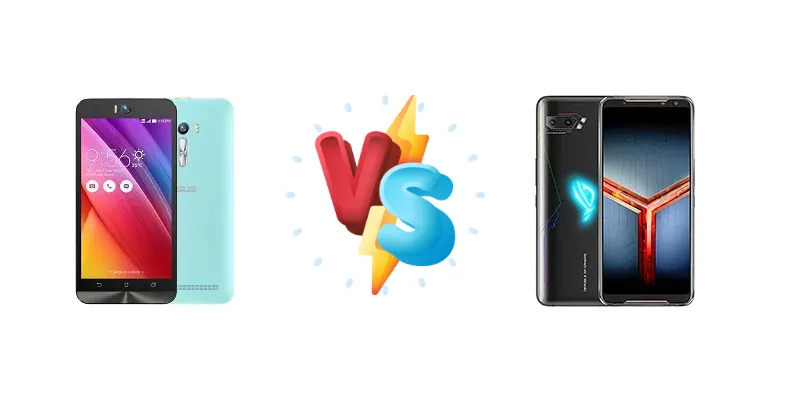
Asus has a history of producing compelling smartphones, catering to different needs. The Zenfone Selfie ZD551KL was a selfie-focused mid-ranger, while the ROG Phone II targeted hardcore mobile gamers. Let's dive into a detailed comparison to see how these devices stack up today.
🏆 Quick Verdict
The ROG Phone II utterly dominates the Zenfone Selfie. Its superior Snapdragon 855+ chipset, massive battery, and stunning display offer a vastly improved experience. The Zenfone Selfie's strengths are largely overshadowed by the ROG Phone II's advancements, making it the clear winner for most users.
| Network |
|---|
| 2G bands | GSM 850 / 900 / 1800 / 1900 - SIM 1 & SIM 2 | GSM 850 / 900 / 1800 / 1900 |
| 3G bands | HSDPA 850 / 900 / 1900 / 2100 | HSDPA 850 / 900 / 1900 / 2100 |
| 4G bands | 1, 2, 3, 5, 7, 8, 20 - Global | 1, 2, 3, 4, 5, 7, 8, 12, 13, 17, 18, 19, 20, 28, 29, 32, 34, 38, 39, 40, 41, 46 |
| Speed | HSPA 42.2/5.76 Mbps, LTE Cat4 150/50 Mbps | HSPA 42.2/5.76 Mbps, LTE (5CA) Cat18 (Cat20 Ultimate edition) 1200/150 Mbps |
| Technology | GSM / HSPA / LTE | GSM / HSPA / LTE |
| | 1, 3 - India | - |
| Launch |
|---|
| Announced | 2015, June. Released 2015, August | 2019, July 22. Released 2019, September |
| Status | Discontinued | Discontinued |
| Body |
|---|
| Build | Glass front (Gorilla Glass 4), plastic back, plastic frame | Glass front (Gorilla Glass 6), glass back (Gorilla Glass 3), aluminum frame |
| Dimensions | 156.5 x 77.2 x 10.8 mm (6.16 x 3.04 x 0.43 in) | 171 x 77.6 x 9.5 mm (6.73 x 3.06 x 0.37 in) |
| SIM | Dual SIM (Micro-SIM, dual stand-by) | Nano-SIM + Nano-SIM |
| Weight | 170 g (6.00 oz) | 240 g (8.47 oz) |
| | - | RGB light panel (on the back) |
| Display |
|---|
| Protection | Corning Gorilla Glass 4, oleophobic coating | Corning Gorilla Glass 6 |
| Resolution | 1080 x 1920 pixels, 16:9 ratio (~403 ppi density) | 1080 x 2340 pixels, 19.5:9 ratio (~391 ppi density) |
| Size | 5.5 inches, 82.6 cm2 (~68.3% screen-to-body ratio) | 6.59 inches, 106.6 cm2 (~80.3% screen-to-body ratio) |
| Type | IPS LCD | AMOLED, 1B colors, 120Hz, HDR10 |
| Platform |
|---|
| CPU | Octa-core (4x1.7 GHz Cortex-A53 & 4x1.0 GHz Cortex-A53) | Octa-core (1x2.96 GHz Kryo 485 & 3x2.42 GHz Kryo 485 & 4x1.78 GHz Kryo 485) |
| Chipset | Qualcomm MSM8939 Snapdragon 615 (28 nm) | Qualcomm SM8150 Snapdragon 855+ (7 nm) |
| GPU | Adreno 405 | Adreno 640 (700 MHz) |
| OS | Android 5.0 (Lollipop), upgradable to 6.0 (Marshmallow), ZenUI | Android 9.0 (Pie), ROG UI |
| Memory |
|---|
| Card slot | microSDXC (dedicated slot) | No |
| Internal | 16GB 2GB RAM, 32GB 3GB RAM | 128GB 8GB RAM, 256GB 12GB RAM, 512GB 12GB RAM, 1TB 12GB RAM |
| | eMMC 4.5 | UFS 3.0 |
| Main Camera |
|---|
| Dual | - | 48 MP, f/1.8, 26mm (wide), 1/2.0", 0.8µm, PDAF
13 MP, f/2.4, 11mm (ultrawide) |
| Features | Laser AF, Dual-LED dual-tone flash, panorama, HDR | Laser AF, LED flash, HDR, panorama |
| Single | 13 MP, f/2.0, 28mm (wide), 1/3.0" | 5 MP |
| Video | 1080p@30fps | 4K@30/60fps, 1080p@30/60/240fps, 720p@480fps; gyro-EIS (except @240/480fps) |
| Selfie camera |
|---|
| Features | Dual-LED dual-tone flash | Panorama, HDR |
| Single | 13 MP, f/2.2, 1/3.1", 1.12µm, AF | 24MP, f/2.2, 0.9µm |
| Video | 1080p@30fps | 1080p@30fps |
| Sound |
|---|
| 3.5mm jack | Yes | Yes |
| 35mm jack | Yes | Yes |
| Loudspeaker | Yes | Yes, with DTS:X stereo speakers (2 dedicated amplifiers) |
| | - | 24-bit/192kHz audio |
| Comms |
|---|
| Bluetooth | 4.0, A2DP, EDR | 5.0, A2DP, LE, aptX HD |
| NFC | No | Yes |
| Positioning | GPS, GLONASS, BDS | GPS (L1+L5), GLONASS, BDS, GALILEO, QZSS |
| Radio | FM radio, RDS | FM radio |
| USB | microUSB 2.0, OTG | USB Type-C 3.1, accessory connector, OTG |
| WLAN | Wi-Fi 802.11 a/b/g/n/ac, Wi-Fi Direct, hotspot | Wi-Fi 802.11 a/b/g/n/ac/ad, dual-band, Wi-Fi Direct |
| Features |
|---|
| Sensors | Accelerometer, gyro, proximity, compass | Fingerprint (under display, optical), accelerometer, gyro, proximity, compass |
| Battery |
|---|
| Charging | - | 30W wired
10W reverse wired, QC4 |
| Stand-by | - | Up to 150 h (3G) |
| Talk time | - | Up to 5 h (3G) |
| Type | Li-Po 3000 mAh, removable | Li-Po 6000 mAh, non-removable |
| Misc |
|---|
| Colors | Pure White, Chic Pink, Aqua Blue | Matte Black, Glossy Black |
| Models | Z00UD, Z00UDH, Z00UDC, Z00UDB | ASUS_I001D, I001DA, I001DE, I001DC, I001DB, I001D, I001DD |
| Price | About 280 EUR | About 1070 EUR |
| Tests |
|---|
| Audio quality |
Noise -92.1dB / Crosstalk -92.5dB | - |
| Battery life |
Endurance rating 63h
|
Endurance rating 114h
|
| Camera |
Photo / Video |
Photo / Video |
| Display |
Contrast ratio: 928:1 (nominal), 1.680 (sunlight) |
Contrast ratio: Infinite (nominal) |
| Loudspeaker |
Voice 65dB / Noise 66dB / Ring 75dB
|
-19.5 LUFS (Excellent)
|
| Performance |
Basemark OS II 2.0: 883Basemark X: 4915 |
AnTuTu: 398935 (v7), 483239 (v8)
GeekBench: 10923 (v4.4)
GFXBench: 40fps (ES 3.1 onscreen) |
Asus Zenfone Selfie ZD551KL
- Long battery life (63h)
- Good sunlight visibility (1680 contrast)
- Affordable (historically)
- Outdated chipset
- Lower performance
- Limited features
- Lower quality display compared to modern phones
Asus ROG Phone II ZS660KL
- Exceptional performance (Snapdragon 855+)
- Massive battery life (114h)
- Bright and vibrant display
- Fast charging (30W)
- Gaming-focused features
- Larger size and weight
- Potentially higher price (historically)
- May be overkill for basic users
Display Comparison
The ROG Phone II boasts a significantly superior display. Its 626 nits of brightness ensures excellent visibility even in direct sunlight, a stark contrast to the Zenfone Selfie. The ROG Phone II's 'infinite' contrast ratio (likely a marketing term, but indicative of excellent blacks) further enhances the viewing experience. The Zenfone Selfie's 928:1 contrast ratio is respectable, but simply can't compete.
Camera Comparison
While both phones offer 'Photo / Video' capabilities, the ROG Phone II likely has a more advanced camera system, though specific details are missing. The Zenfone Selfie was known for its front-facing camera, but the ROG Phone II's overall camera performance is expected to be better due to its more powerful processor and likely improved sensors. Image quality, dynamic range, and low-light performance would all be significantly better on the ROG Phone II.
Performance
The performance gap is massive. The ROG Phone II's Snapdragon 855+ is a flagship-level chipset, offering significantly faster processing speeds and smoother multitasking than the Zenfone Selfie's Snapdragon 615. Gaming on the ROG Phone II is a vastly superior experience, with higher frame rates and less lag. The Zenfone Selfie struggles with demanding apps and games.
Battery Life
The ROG Phone II's battery life is exceptional, boasting an endurance rating of 114 hours, compared to the Zenfone Selfie's 63 hours. This difference is largely due to the ROG Phone II's larger battery capacity and more efficient chipset. The ROG Phone II also supports 30W fast charging, further enhancing its usability.
Buying Guide
The Asus Zenfone Selfie ZD551KL is suitable for users on a very tight budget who prioritize a decent camera and long battery life, but are willing to compromise on performance. The Asus ROG Phone II is ideal for mobile gamers, power users, and anyone who demands top-tier performance, a large, vibrant display, and exceptional battery life.
Frequently Asked Questions
❓ Is the Zenfone Selfie still worth buying?
Only if you're on an extremely tight budget and primarily need a phone for basic tasks and long battery life. Otherwise, there are better options available.
❓ What makes the ROG Phone II a good gaming phone?
Its powerful Snapdragon 855+ chipset, high refresh rate display (likely 120Hz, though not explicitly stated), large battery, and gaming-specific features like AirTriggers make it ideal for mobile gaming.