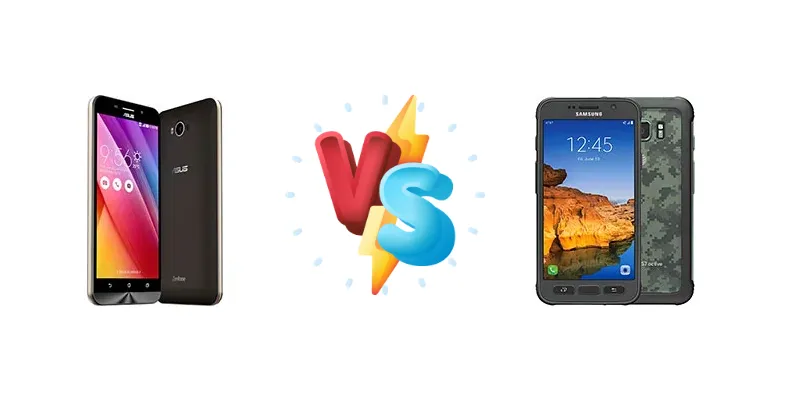
Choosing a new Android phone can be overwhelming, especially when balancing price and performance. Today, we're pitting the budget-friendly Asus Zenfone Max ZC550KL (2016) against the rugged and powerful Samsung Galaxy S7 Active. Let's see which one comes out on top.
🏆 Quick Verdict
The Samsung Galaxy S7 Active is the clear winner, boasting a significantly faster processor, superior camera, and wireless charging. While the Zenfone Max offers incredible battery life, the S7 Active's overall performance and durability make it the better choice for most users, despite its age.
| Network |
|---|
| 2G bands | GSM 850 / 900 / 1800 / 1900 - SIM 1 & SIM 2 | GSM 850 / 900 / 1800 / 1900 |
| 3G bands | HSDPA 850 / 900 / 1900 / 2100 - India | HSDPA 850 / 1900 / 2100 |
| 4G bands | 1, 3, 5, 38, 39, 40, 41 - India | 1, 2, 3, 4, 5, 7, 8, 12, 20, 29, 30, 38, 39, 40, 41 |
| Speed | HSPA 42.2/5.76 Mbps, LTE Cat4 150/50 Mbps | HSPA 42.2/5.76 Mbps, LTE (3CA) Cat9 450/50 Mbps |
| Technology | GSM / HSPA / LTE | GSM / HSPA / LTE |
| Launch |
|---|
| Announced | 2016, May. Released 2016, May | 2016, June. Released 2016, June |
| Status | Discontinued | Discontinued |
| Body |
|---|
| Build | - | Glass front (Gorilla Glass 4), plastic back, aluminum frame |
| Dimensions | 156 x 77.5 x 10.6 mm (6.14 x 3.05 x 0.42 in) | 148.8 x 74.9 x 9.9 mm (5.86 x 2.95 x 0.39 in) |
| SIM | Dual SIM (Micro-SIM, dual stand-by) | Nano-SIM |
| Weight | 202 g (7.13 oz) | 184.8 g (6.53 oz) |
| | - | IP68 dust/water resistant (up to 1.5m for 30 mins)
MIL-STD-810G compliant |
| Display |
|---|
| Protection | Corning Gorilla Glass 4 | Corning Gorilla Glass 4 |
| Resolution | 720 x 1280 pixels, 16:9 ratio (~267 ppi density) | 1440 x 2560 pixels, 16:9 ratio (~576 ppi density) |
| Size | 5.5 inches, 83.4 cm2 (~69.0% screen-to-body ratio) | 5.1 inches, 71.7 cm2 (~64.3% screen-to-body ratio) |
| Type | IPS LCD | Super AMOLED |
| | - | Always-on display |
| Platform |
|---|
| CPU | Octa-core (4x1.5 GHz Cortex-A53 & 4x1.0 GHz Cortex-A53) | Quad-core (2x2.15 GHz Kryo & 2x1.6 GHz Kryo) |
| Chipset | Qualcomm MSM8939 Snapdragon 615 (28 nm) | Qualcomm MSM8996 Snapdragon 820 (14 nm) |
| GPU | Adreno 405 | Adreno 530 |
| OS | Android 6.0.1 (Marshmallow), ZenUI | Android 6.0 (Marshmallow), upgradable to 7.0 (Nougat), TouchWiz UI |
| Memory |
|---|
| Card slot | microSDXC (dedicated slot) | microSDXC (dedicated slot) |
| Internal | 32GB 2GB RAM, 32GB 3GB RAM | 32GB 4GB RAM |
| | eMMC 4.5 | - |
| Main Camera |
|---|
| Features | Laser AF, Dual-LED dual-tone flash, panorama, HDR | LED flash, auto-HDR, panorama |
| Single | 13 MP, f/2.0 | 12 MP, f/1.7, 26mm (wide), 1/2.55", 1.4µm, dual pixel PDAF, OIS |
| Video | 1080p@30fps | 4K@30fps, 1080p@30fps (gyro-EIS), 1080p@60fps, 720p@240fps, HDR, stereo sound rec., OIS |
| Selfie camera |
|---|
| Features | - | HDR |
| Single | 5 MP, f/2.0 | 5 MP, f/1.7, 22mm (wide), 1/4.1", 1.34µm |
| Sound |
|---|
| 3.5mm jack | Yes | Yes |
| 35mm jack | Yes | Yes |
| Loudspeaker | Yes | Yes |
| Comms |
|---|
| Bluetooth | 4.0, A2DP, EDR | 4.2, A2DP, LE, aptX |
| NFC | No | Yes |
| Positioning | GPS, GLONASS, BDS | GPS, GLONASS |
| Radio | FM radio | Stereo FM radio, RDS |
| USB | microUSB 2.0, OTG | microUSB 2.0, OTG |
| WLAN | Wi-Fi 802.11 b/g/n, Wi-Fi Direct | Wi-Fi 802.11 a/b/g/n/ac, dual-band, Wi-Fi Direct |
| Features |
|---|
| Sensors | Accelerometer, proximity, compass | Fingerprint (front-mounted), accelerometer, gyro, proximity, compass, barometer, heart rate, SpO2 |
| | - | ANT+
S-Voice natural language commands and dictation
Samsung Pay (Visa, MasterCard certified) |
| Battery |
|---|
| Charging | Reverse wired | 15W wired, QC2
Wireless (Qi) (market dependent) |
| Music play | - | Up to 110 h |
| Stand-by | Up to 914 h (3G) | Up to 384 h (3G) |
| Talk time | Up to 38 h (3G) | Up to 32 h (3G) |
| Type | Li-Po 5000 mAh, non-removable | Li-Ion 4000 mAh, non-removable |
| Misc |
|---|
| Colors | Black, White, Orange, Blue | Camo Green, Titanium Gray, Sandy Gold |
| Models | Z010DD | SM-G891A |
| Price | About 170 EUR | About 360 EUR |
| SAR | - | 0.92 W/kg (head) 0.75 W/kg (body) |
| SAR EU | - | 0.32 W/kg (head) 0.98 W/kg (body) |
| Tests |
|---|
| Audio quality | - |
Noise -94.3dB / Crosstalk -93.4dB |
| Battery life | - | Endurance rating 96h |
| Loudspeaker | - |
Voice 72dB / Noise 66dB / Ring 78dB |
| Performance | - |
Basemark OS II 2.0: 2487Basemark X: 32362 |
Asus Zenfone Max ZC550KL (2016)
- Exceptional battery life
- Affordable price
- Large display
- Outdated processor
- Lower screen resolution
- Mediocre camera
Samsung Galaxy S7 active
- Powerful processor
- Excellent camera
- Durable design
- Wireless charging (market dependent)
- Super AMOLED display
- Older model
- Smaller battery capacity compared to Zenfone Max
- Can be more expensive (used market)
Display Comparison
The Samsung Galaxy S7 Active features a 5.1-inch Super AMOLED display with a resolution of 2560 x 1440 pixels, offering vibrant colors and excellent viewing angles. The Zenfone Max has a larger 5.5-inch IPS LCD display with a resolution of 1280 x 720 pixels. While the Zenfone Max offers a larger screen, the S7 Active's display is noticeably sharper and more visually appealing.
Camera Comparison
The S7 Active's 12MP camera with optical image stabilization (OIS) and a wider aperture delivers superior image quality, especially in low-light conditions. The Zenfone Max's 13MP camera is decent but struggles in challenging lighting. The S7 Active also has a front-facing camera that is better than the Zenfone Max's.
Performance
The Snapdragon 820 in the S7 Active provides a substantial performance advantage over the Snapdragon 615 in the Zenfone Max. Apps launch faster, multitasking is smoother, and demanding games run significantly better on the S7 Active. The S7 Active's Kryo CPU architecture is more efficient and powerful.
Battery Life
Both phones boast impressive battery life, with endurance ratings of 96 hours. However, the Zenfone Max's larger battery capacity (4100mAh vs 3600mAh) contributes to its longevity. The S7 Active also supports fast charging and wireless charging (market dependent), which the Zenfone Max lacks.
Buying Guide
The Asus Zenfone Max ZC550KL (2016) is ideal for users prioritizing battery life above all else and seeking a very affordable option. The Samsung Galaxy S7 Active is best suited for those needing a durable phone with strong performance and a good camera, willing to spend a bit more (on the used market).
Frequently Asked Questions
❓ Is the Samsung Galaxy S7 Active still worth buying in 2024?
Yes, the S7 Active remains a solid choice, especially on the used market, due to its durable build and capable performance. However, consider its age and potential software update limitations.
❓ Which phone has better battery life: Zenfone Max or S7 Active?
While both have excellent endurance ratings, the Zenfone Max has a slightly larger battery capacity, potentially offering marginally longer usage between charges.