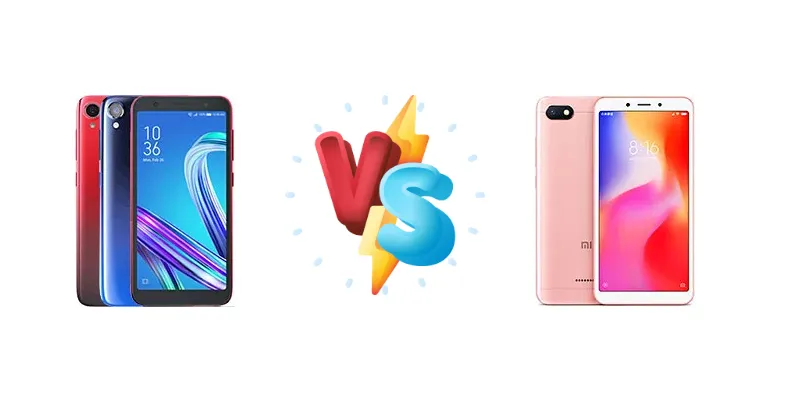
Looking for an affordable smartphone that doesn't completely break the bank? The Asus ZenFone Live L2 and Xiaomi Redmi 6A are popular contenders in the budget phone arena. But which one reigns supreme? Let's dive into a detailed comparison to help you decide.
🏆 Quick Verdict
The Xiaomi Redmi 6A edges out the ZenFone Live L2 thanks to its more modern chipset, faster processor, and improved efficiency. While the ZenFone Live L2 boasts a dedicated front camera flash, the Redmi 6A offers a more well-rounded experience for the price.
| Network |
|---|
| 2G bands | GSM 850 / 900 / 1800 / 1900 | GSM 850 / 900 / 1800 / 1900 |
| 3G bands | HSDPA 850 / 900 / 1900 / 2100 - A version | HSDPA 850 / 900 / 1900 / 2100 |
| 4G bands | 1, 2, 3, 5, 7, 8, 20, 40 - A version | 1, 2, 3, 4, 5, 7, 8, 20, 38, 40 - Global |
| Speed | HSPA 42.2/5.76 Mbps, LTE Cat4 150/50 Mbps | HSPA 21.1/5.76 Mbps, LTE (2CA) Cat7 300/150 Mbps |
| Technology | GSM / HSPA / LTE | GSM / CDMA / HSPA / LTE |
| | 1, 2, 3, 4, 5, 7, 8, 12, 17, 18 - D version | 1, 3, 5, 7, 8, 34, 38, 39, 40, 41 |
| Launch |
|---|
| Announced | 2019, April. Released 2019, May | 2018, June. Released 2018, June |
| Status | Discontinued | Discontinued |
| Body |
|---|
| Build | - | Glass front, plastic back, plastic frame |
| Dimensions | 147.3 x 71.8 x 8.2 mm (5.80 x 2.83 x 0.32 in) | 147.5 x 71.5 x 8.3 mm (5.81 x 2.81 x 0.33 in) |
| SIM | Nano-SIM + Nano-SIM | Nano-SIM + Nano-SIM |
| Weight | 140 g (4.94 oz) | 145 g (5.11 oz) |
| Display |
|---|
| Resolution | 720 x 1440 pixels, 18:9 ratio (~293 ppi density) | 720 x 1440 pixels, 18:9 ratio (~295 ppi density) |
| Size | 5.5 inches, 78.1 cm2 (~73.8% screen-to-body ratio) | 5.45 inches, 76.7 cm2 (~72.7% screen-to-body ratio) |
| Type | IPS LCD | IPS LCD |
| Platform |
|---|
| CPU | Quad-core 1.4 GHz Cortex-A53Octa-core 1.4 GHz Cortex-A53 | Quad-core 2.0 GHz Cortex-A53 |
| Chipset | Qualcomm MSM8917 Snapdragon 425 (28 nm)Qualcomm MSM8937 Snapdragon 430 (28 nm) | Mediatek MT6761 Helio A22 (12 nm) |
| GPU | Adreno 308Adreno 505 | PowerVR GE8320 |
| OS | Android 8.0 Oreo (Go edition), ZenUI 5 | Android 8.1 (Oreo), planned upgrade to Android 10, MIUI 12 |
| Memory |
|---|
| Card slot | microSDXC (dedicated slot) | microSDXC (dedicated slot) |
| Internal | 16GB 2GB RAM, 32GB 2GB RAM | 16GB 2GB RAM, 32GB 2GB RAM, 32GB 3GB RAM |
| | eMMC 5.1 | eMMC 5.1 |
| Main Camera |
|---|
| Features | LED flash, HDR, panorama | LED flash, HDR, panorama |
| Single | 8 MP or 13 MP, f/2.0, PDAF | 13 MP, f/2.2, PDAF |
| Video | 1080p@30fps | 1080p@30fps |
| Selfie camera |
|---|
| Features | LED flash, HDR | - |
| Single | 5 MP, f/2.4 | 5 MP, f/2.2 |
| Sound |
|---|
| 3.5mm jack | Yes | Yes |
| 35mm jack | Yes | Yes |
| Loudspeaker | Yes | Yes |
| Comms |
|---|
| Bluetooth | 4.0, A2DP, LE | 4.2, A2DP, LE |
| NFC | No | No |
| Positioning | GPS, GLONASS, BDS | GPS, GLONASS, BDS |
| Radio | FM radio | FM radio |
| USB | microUSB 2.0 | microUSB 2.0 |
| WLAN | Wi-Fi 802.11 b/g/n, Wi-Fi Direct | Wi-Fi 802.11 b/g/n, Wi-Fi Direct |
| Features |
|---|
| Sensors | Accelerometer, gyro, proximity, compass | Accelerometer, proximity, compass |
| Battery |
|---|
| Type | Li-Ion 3000 mAh, non-removable | Li-Ion 3000 mAh, non-removable |
| Misc |
|---|
| Colors | Rocket Red, Cosmic Blue | Black, Grey, Blue, Gold, Rose Gold |
| Models | - | M1804C3CG, M1804C3CH, M1804C3CI |
| Price | - | About 110 EUR |
| SAR | - | 0.78 W/kg (head) 1.17 W/kg (body) |
| SAR EU | - | 0.66 W/kg (head) 1.52 W/kg (body) |
| Tests |
|---|
| Performance | - |
AnTuTu: 61660 (v7)
GeekBench: 2450 (v4.4)
GFXBench: 3.1fps (ES 3.1 onscreen) |
Asus ZenFone Live (L2)
- Dedicated front camera flash
- Compact design
- Affordable price
- Slower performance
- Outdated chipset
- Can feel sluggish
Xiaomi Redmi 6A
- Faster performance
- More efficient chipset
- Better front camera
- Modern design
- Plastic build quality
- Limited storage options
Display Comparison
Both phones feature a 6.2-inch HD+ (720 x 1520) IPS LCD display. While the resolution is similar, the Redmi 6A's slightly newer design and potentially better color calibration give it a marginal edge in visual quality. Viewing angles and brightness are comparable on both devices.
Camera Comparison
The ZenFone Live L2 features a 13MP rear camera and a 5MP front camera with a dedicated LED flash. The Redmi 6A has a 13MP rear camera and a 8MP front camera. While megapixels aren't everything, the Redmi 6A's front camera generally captures better images, especially in low light, thanks to its higher resolution and potentially better image processing. Both phones offer decent image quality in good lighting conditions, but struggle in challenging environments.
Performance
The Redmi 6A's Mediatek Helio A22 chipset and 2.0 GHz Quad-core Cortex-A53 CPU significantly outperform the ZenFone Live L2's Snapdragon 425/430 (1.4 GHz Quad/Octa-core Cortex-A53). Expect smoother multitasking, faster app loading times, and a more responsive user interface on the Redmi 6A. The ZenFone Live L2 can feel sluggish at times, especially with demanding apps.
Battery Life
The Redmi 6A has a 3000mAh battery, while the ZenFone Live L2 has a 3000mAh battery. Despite the same capacity, the Redmi 6A's more efficient chipset allows it to deliver slightly better battery life. Expect a full day of moderate use on both devices, but the Redmi 6A might squeeze out a few extra hours.
Buying Guide
The Asus ZenFone Live L2 is a good choice for users prioritizing a dedicated front camera flash for selfies and video calls. The Xiaomi Redmi 6A is ideal for those seeking better overall performance, a more modern chipset, and a slightly more refined user experience within a tight budget.
Frequently Asked Questions
❓ Which phone is better for gaming?
The Xiaomi Redmi 6A is significantly better for gaming due to its more powerful chipset and processor. The ZenFone Live L2 struggles with even basic games.
❓ Does the ZenFone Live L2 have NFC?
No, the Asus ZenFone Live L2 does not have NFC capabilities.
❓ What storage options are available for each phone?
Both phones typically come in 32GB storage variants, expandable via microSD card.