
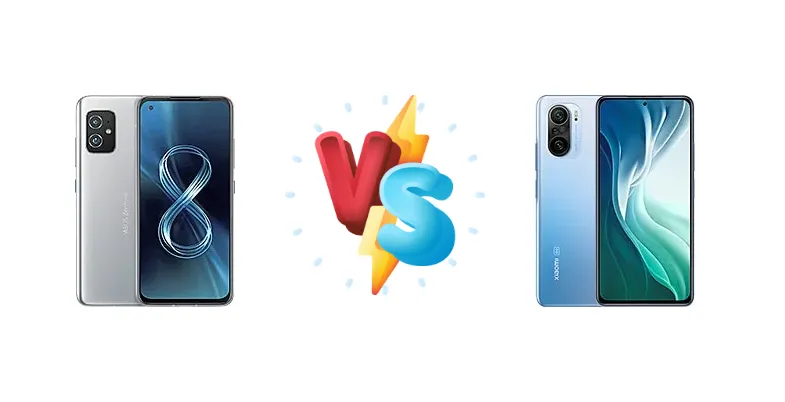
Asus Zenfone 8 vs Xiaomi Mi 11i: A Deep Dive into Two Snapdragon 888 Flagships
| Phones Images | |||||
|---|---|---|---|---|---|
|
🏆 Quick Verdict
For most users, the Xiaomi Mi 11i emerges as the more practical choice. Its superior 96-hour endurance rating, coupled with faster charging at 33W, outweighs the Zenfone 8’s slightly brighter display. While the Zenfone 8’s compact size is appealing, the Mi 11i offers a more balanced package.
| PHONES | ||
|---|---|---|
| Phone Names | Asus Zenfone 8 | Xiaomi Mi 11i |
| Network | ||
|---|---|---|
| 2G bands | GSM 850 / 900 / 1800 / 1900 | GSM 850 / 900 / 1800 / 1900 |
| 3G bands | HSDPA 800 / 850 / 900 / 1700(AWS) / 1900 / 2100 | HSDPA 850 / 900 / 1700(AWS) / 1900 / 2100 |
| 4G bands | 1, 2, 3, 4, 5, 7, 8, 12, 17, 18, 19, 20, 26, 28, 34, 38, 39, 40, 41, 42 - International | 1, 2, 3, 4, 5, 7, 8, 12, 17, 20, 28, 38, 40, 41, 66 |
| 5G bands | 1, 2, 3, 5, 7, 8, 12, 20, 28, 38, 77, 78 SA/NSA - International | 1, 3, 5, 7, 8, 20, 28, 38, 41, 77, 78 SA/NSA |
| Speed | HSPA 42.2/5.76 Mbps, LTE (5CA) Cat20 2000/150 Mbps, 5G | HSPA, LTE, 5G |
| Technology | GSM / HSPA / LTE / 5G | GSM / HSPA / LTE / 5G |
| 1, 2, 3, 5, 7, 8, 12, 20, 25, 38, 40, 66, 71, 77, 78 SA/NSA - USA | - | |
| Launch | ||
|---|---|---|
| Announced | 2021, May 12 | 2021, March 29 |
| Status | Available. Released 2021, May 13 | Available. Released 2021, May 31 |
| Body | ||
|---|---|---|
| Build | Glass front (Gorilla Glass Victus), glass back (Gorilla Glass 3), aluminum frame | - |
| Dimensions | 148 x 68.5 x 8.9 mm (5.83 x 2.70 x 0.35 in) | 163.7 x 76.4 x 7.8 mm (6.44 x 3.01 x 0.31 in) |
| SIM | Nano-SIM + Nano-SIM | Nano-SIM + Nano-SIM |
| Weight | 169 g (5.96 oz) | 196 g (6.91 oz) |
| IP68 dust/water resistant (up to 1.5m for 30 min) | IP53, dust and splash resistant | |
| Display | ||
|---|---|---|
| Protection | Corning Gorilla Glass Victus | Corning Gorilla Glass 5 |
| Resolution | 1080 x 2400 pixels, 20:9 ratio (~446 ppi density) | 1080 x 2400 pixels, 20:9 ratio (~395 ppi density) |
| Size | 5.9 inches, 84.0 cm2 (~82.9% screen-to-body ratio) | 6.67 inches, 107.4 cm2 (~85.9% screen-to-body ratio) |
| Type | Super AMOLED, 120Hz, HDR10+, 700 nits (HBM), 1100 nits (peak) | Super AMOLED, 120Hz, HDR10+, 900 nits (HBM), 1300 nits (peak) |
| Always-on display | - | |
| Platform | ||
|---|---|---|
| CPU | Octa-core (1x2.84 GHz Cortex-X1 & 3x2.42 GHz Cortex-A78 & 4x1.80 GHz Cortex-A55) | Octa-core (1x2.84 GHz Cortex-X1 & 3x2.42 GHz Cortex-A78 & 4x1.80 GHz Cortex-A55) |
| Chipset | Qualcomm SM8350 Snapdragon 888 5G (5 nm) | Qualcomm SM8350 Snapdragon 888 5G (5 nm) |
| GPU | Adreno 660 | Adreno 660 |
| OS | Android 11, upgradable to Android 13 | Android 11, MIUI 12 |
| Memory | ||
|---|---|---|
| Card slot | No | No |
| Internal | 128GB 6GB RAM, 128GB 8GB RAM, 256GB 8GB RAM, 256GB 12GB RAM, 256GB 16GB RAM | 128GB 8GB RAM, 256GB 8GB RAM |
| UFS 3.1 | UFS 3.1 | |
| Main Camera | ||
|---|---|---|
| Dual | 64 MP, f/1.8, 26mm (wide), 1/1.73", 0.8µm, PDAF, OIS 12 MP, f/2.2, 112˚, 14mm (ultrawide), 1/2.55", 1.4µm, dual pixel PDAF | - |
| Features | LED flash, HDR, panorama | Color spectrum sensor, LED flash, HDR, panorama |
| Single | - | 20 MP, f/2.5, (wide), 1/3.4", 0.8µm |
| Triple | - | 108 MP, f/1.8, 26mm (wide), 1/1.52", 0.7µm, PDAF 8 MP, f/2.2, 119˚ (ultrawide) 5 MP, f/2.4, 50mm (telephoto macro), 1/5.0", 1.12µm, AF |
| Video | 8K@24fps, 4K@30/60/120fps, 1080p@30/60/240fps, 720p@480fps; gyro-EIS, HDR | 8K@30fps, 4K@30/60fps, 1080p@30/60/120/240/960fps, gyro-EIS, HDR10+ |
| Selfie camera | ||
|---|---|---|
| Features | - | HDR |
| Single | 12 MP, f/2.5, 28mm (standard), 1/2.93", 1.22µm, dual pixel PDAF | 20 MP, f/2.5, (wide), 1/3.4", 0.8µm |
| Video | 4K@30fps, 1080p@30/60fps | 1080p@30fps, 720p@120fps |
| Sound | ||
|---|---|---|
| 3.5mm jack | Yes | No |
| 35mm jack | Yes | No |
| Loudspeaker | Yes, with stereo speakers | Yes, with stereo speakers |
| 32-bit/384kHz audio | 24-bit/192kHz audio | |
| Comms | ||
|---|---|---|
| Bluetooth | 5.2, A2DP, LE, aptX HD, aptX Adaptive | 5.2, A2DP, LE |
| Infrared port | - | Yes |
| NFC | Yes | Yes (market/region dependent) |
| Positioning | GPS (L1+L5), GLONASS (L1), BDS (B1I+B1c+B2a), GALILEO (E1+E5a), QZSS (L1+L5), NavIC (L5) | GPS (L1+L5), GLONASS (L1), BDS (B1I+B1c+B2a), GALILEO (E1+E5a), QZSS (L1+L5), NavIC (L5) |
| Radio | FM radio (market/region dependent) | No |
| USB | USB Type-C 2.0, OTG | USB Type-C 2.0, OTG |
| WLAN | Wi-Fi 802.11 a/b/g/n/ac/6e, dual-band, Wi-Fi Direct | Wi-Fi 802.11 a/b/g/n/ac/6, dual-band, Wi-Fi Direct |
| Features | ||
|---|---|---|
| Sensors | Fingerprint (under display, optical), accelerometer, gyro, proximity, compass | Fingerprint (side-mounted), accelerometer, gyro, proximity, compass, barometer |
| Battery | ||
|---|---|---|
| Charging | 30W wired, PD3.0, 60% in 25 min, 100% in 80 min Reverse wired | 33W wired, PD3.0, QC3, 100% in 52 min |
| Type | Li-Po 4000 mAh | Li-Po 4520 mAh |
| Misc | ||
|---|---|---|
| Colors | Obsidian Black, Horizon Silver | Celestial Silver, Frosty White, Cosmic Black |
| Models | ZS590KS, ZS590KS-2A007EU, I006D | M2012K11G |
| Price | About 290 EUR | About 230 EUR |
| SAR | - | 0.95 W/kg (head) 0.74 W/kg (body) |
| SAR EU | - | 0.57 W/kg (head) 0.77 W/kg (body) |
| Tests | ||
|---|---|---|
| Battery life | Endurance rating 88h | Endurance rating 96h |
| Camera | Photo / Video | Photo / Video |
| Display | Contrast ratio: Infinite (nominal) | Contrast ratio: Infinite (nominal) |
| Loudspeaker | -27.9 LUFS (Good) | -26.0 LUFS (Very good) |
| Performance | AnTuTu: 676001 (v8) | 799738 (v9) GeekBench: 3604 (v5.1) GFXBench: 61fps (ES 3.1 onscreen) | AnTuTu: 690021 (v8) GeekBench: 3641 (v5.1) |
Asus Zenfone 8
- Compact and pocketable design
- Potentially better thermal management due to size
- Premium build quality (assumed based on brand reputation)
- Shorter battery life (88h endurance)
- Slower charging speed (80 minutes to full)
- Less bright display (800 nits)
Xiaomi Mi 11i
- Longer battery life (96h endurance)
- Faster charging speed (52 minutes to full)
- Brighter display (939 nits)
- Larger size, less comfortable for one-handed use
- Potentially more thermal throttling under sustained load
- May lack the premium feel of the Zenfone 8
Display Comparison
The Xiaomi Mi 11i boasts a significantly brighter display, reaching 939 nits measured, compared to the Zenfone 8’s 800 nits. This translates to better visibility under direct sunlight. Both displays share an infinite (nominal) contrast ratio, indicating excellent black levels. While neither specifies refresh rate, the Mi 11i’s larger screen size makes the brightness difference more impactful for media viewing. The Zenfone 8’s smaller size, however, may appeal to users who prefer a more manageable one-handed experience.
Camera Comparison
Both phones feature capable camera systems, but detailed sensor information is lacking. Given the market positioning, it’s reasonable to assume both utilize a primary sensor capable of high-resolution photography and video recording. Without specifics on sensor size, aperture, or optical image stabilization (OIS), it’s difficult to definitively declare a winner. The focus should be on image processing differences, which are not specified in the provided data. The inclusion of 'Photo / Video' as a feature on both suggests a similar level of capability, but real-world testing is crucial.
Performance
Both the Zenfone 8 and Mi 11i are powered by the Qualcomm SM8350 Snapdragon 888 5G (5 nm) chipset, featuring the same Octa-core CPU configuration (1x2.84 GHz Cortex-X1, 3x2.42 GHz Cortex-A78, 4x1.80 GHz Cortex-A55). This means raw processing power will be nearly identical for most tasks. However, the Zenfone 8’s smaller size *could* allow for slightly more efficient thermal management, potentially leading to sustained performance during extended gaming sessions, though this requires independent thermal testing. Both likely utilize LPDDR5 RAM, but specific speeds aren't provided.
Battery Life
The Xiaomi Mi 11i clearly wins in battery endurance, achieving a measured 96 hours compared to the Zenfone 8’s 88 hours. This 8-hour advantage suggests the Mi 11i’s larger battery capacity (though not specified) and potentially more efficient power management. Furthermore, the Mi 11i charges faster at 33W, reaching 100% in 52 minutes, while the Zenfone 8 takes 80 minutes with its 30W charging. The Mi 11i also supports both PD3.0 and QC3, offering wider compatibility with fast chargers.
Buying Guide
Buy the Asus Zenfone 8 if you absolutely prioritize a pocketable flagship experience and demand the most responsive performance in a small form factor. You’ll sacrifice some battery life for this convenience. Buy the Xiaomi Mi 11i if you value all-day battery life, a larger screen for media consumption, and faster charging speeds, even if it means a slightly larger device.