
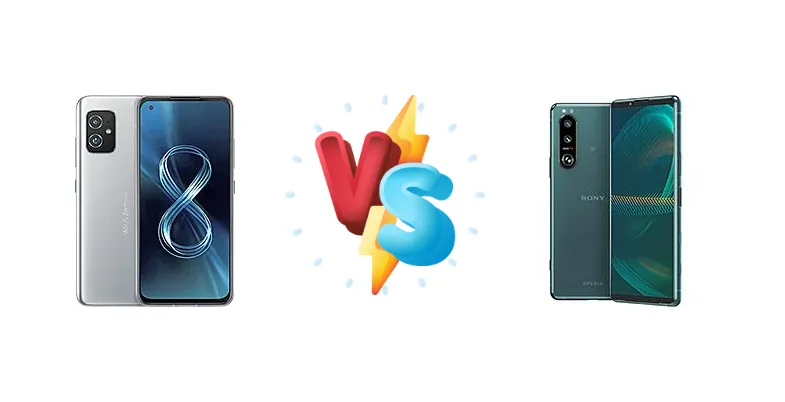
Asus Zenfone 8 vs Sony Xperia 5 III: A Deep Dive into Compact Flagship Performance
| Phones Images | |||||
|---|---|---|---|---|---|
|
🏆 Quick Verdict
For most users, the Sony Xperia 5 III edges out the Zenfone 8 due to its superior battery endurance, offering 100 hours versus the Zenfone 8’s 88 hours. While both share the same chipset, the Xperia 5 III’s larger battery provides a more reliable all-day experience without compromising performance.
| PHONES | ||
|---|---|---|
| Phone Names | Asus Zenfone 8 | Sony Xperia 5 III |
| Network | ||
|---|---|---|
| 2G bands | GSM 850 / 900 / 1800 / 1900 | GSM 850 / 900 / 1800 / 1900 |
| 3G bands | HSDPA 800 / 850 / 900 / 1700(AWS) / 1900 / 2100 | HSDPA 800 / 850 / 900 / 1700(AWS) / 1900 / 2100 |
| 4G bands | 1, 2, 3, 4, 5, 7, 8, 12, 17, 18, 19, 20, 26, 28, 34, 38, 39, 40, 41, 42 - International | 1, 2, 3, 4, 5, 7, 8, 12, 13, 17, 19, 20, 25, 26, 28, 29, 32, 34, 38, 39, 40, 41, 46, 48, 66, 71 - USA |
| 5G bands | 1, 2, 3, 5, 7, 8, 12, 20, 28, 38, 77, 78 SA/NSA - International | 1, 2, 3, 5, 7, 8, 20, 28, 38, 40, 41, 66, 71, 77, 78 SA/NSA/Sub6 - USA |
| Speed | HSPA 42.2/5.76 Mbps, LTE (5CA) Cat20 2000/150 Mbps, 5G | HSPA, LTE, 5G |
| Technology | GSM / HSPA / LTE / 5G | GSM / HSPA / LTE / 5G |
| 1, 2, 3, 5, 7, 8, 12, 20, 25, 38, 40, 66, 71, 77, 78 SA/NSA - USA | 1, 3, 5, 7, 8, 28, 38, 40, 41, 77, 78, 79 SA/NSA/Sub6 - Asia | |
| Launch | ||
|---|---|---|
| Announced | 2021, May 12 | 2021, April 14 |
| Status | Available. Released 2021, May 13 | Available. Released 2021, October 08 |
| Body | ||
|---|---|---|
| Build | Glass front (Gorilla Glass Victus), glass back (Gorilla Glass 3), aluminum frame | Glass front (Gorilla Glass 6), glass back (Gorilla Glass 6), aluminum frame |
| Dimensions | 148 x 68.5 x 8.9 mm (5.83 x 2.70 x 0.35 in) | 157 x 68 x 8.2 mm (6.18 x 2.68 x 0.32 in) |
| SIM | Nano-SIM + Nano-SIM | · Nano-SIM· Nano-SIM + Nano-SIM |
| Weight | 169 g (5.96 oz) | 168 g (5.93 oz) |
| IP68 dust/water resistant (up to 1.5m for 30 min) | IP65/IP68 dust/water resistant (up to 1.5m for 30 min) | |
| Display | ||
|---|---|---|
| Protection | Corning Gorilla Glass Victus | Corning Gorilla Glass 6 |
| Resolution | 1080 x 2400 pixels, 20:9 ratio (~446 ppi density) | 1080 x 2520 pixels, 21:9 ratio (~449 ppi density) |
| Size | 5.9 inches, 84.0 cm2 (~82.9% screen-to-body ratio) | 6.1 inches, 86.9 cm2 (~81.4% screen-to-body ratio) |
| Type | Super AMOLED, 120Hz, HDR10+, 700 nits (HBM), 1100 nits (peak) | OLED, 1B colors, 120Hz, HDR BT.2020 |
| Always-on display | - | |
| Platform | ||
|---|---|---|
| CPU | Octa-core (1x2.84 GHz Cortex-X1 & 3x2.42 GHz Cortex-A78 & 4x1.80 GHz Cortex-A55) | Octa-core (1x2.84 GHz Cortex-X1 & 3x2.42 GHz Cortex-A78 & 4x1.80 GHz Cortex-A55) |
| Chipset | Qualcomm SM8350 Snapdragon 888 5G (5 nm) | Qualcomm SM8350 Snapdragon 888 5G (5 nm) |
| GPU | Adreno 660 | Adreno 660 |
| OS | Android 11, upgradable to Android 13 | Android 11, upgradable to Android 13 |
| Memory | ||
|---|---|---|
| Card slot | No | microSDXC (uses shared SIM slot) |
| Internal | 128GB 6GB RAM, 128GB 8GB RAM, 256GB 8GB RAM, 256GB 12GB RAM, 256GB 16GB RAM | 128GB 8GB RAM, 256GB 8GB RAM |
| UFS 3.1 | UFS 3.X | |
| Main Camera | ||
|---|---|---|
| Dual | 64 MP, f/1.8, 26mm (wide), 1/1.73", 0.8µm, PDAF, OIS 12 MP, f/2.2, 112˚, 14mm (ultrawide), 1/2.55", 1.4µm, dual pixel PDAF | - |
| Features | LED flash, HDR, panorama | Zeiss optics, Zeiss T* lens coating, color spectrum sensor, LED flash, panorama, HDR, eye tracking |
| Single | - | 8 MP, f/2.0, 24mm (wide), 1/4", 1.12µm |
| Triple | - | 12 MP, f/1.7, 24mm (wide), 1/1.7", 1.8µm, dual pixel PDAF, OIS 12 MP, f/2.3, 70mm (telephoto), f/2.8, 105mm (telephoto), 1/2.9", dual pixel PDAF, 3x/4.4x optical zoom, OIS 12 MP, f/2.2, 124˚, 16mm (ultrawide), 1/2.6", dual pixel PDAF |
| Video | 8K@24fps, 4K@30/60/120fps, 1080p@30/60/240fps, 720p@480fps; gyro-EIS, HDR | 4K@24/25/30/60/120fps HDR, 1080p@30/60/120fps; 5-axis gyro-EIS, OIS |
| Selfie camera | ||
|---|---|---|
| Features | - | HDR |
| Single | 12 MP, f/2.5, 28mm (standard), 1/2.93", 1.22µm, dual pixel PDAF | 8 MP, f/2.0, 24mm (wide), 1/4.0", 1.12µm |
| Video | 4K@30fps, 1080p@30/60fps | 1080p@30fps, 5-axis gyro-EIS |
| Sound | ||
|---|---|---|
| 3.5mm jack | Yes | Yes |
| 35mm jack | Yes | Yes |
| Loudspeaker | Yes, with stereo speakers | Yes, with stereo speakers |
| 32-bit/384kHz audio | 24-bit/192kHz audio Dynamic vibration system | |
| Comms | ||
|---|---|---|
| Bluetooth | 5.2, A2DP, LE, aptX HD, aptX Adaptive | 5.2, A2DP, LE, aptX HD, aptX Adaptive |
| NFC | Yes | Yes |
| Positioning | GPS (L1+L5), GLONASS (L1), BDS (B1I+B1c+B2a), GALILEO (E1+E5a), QZSS (L1+L5), NavIC (L5) | GPS, GLONASS, BDS, GALILEO, QZSS |
| Radio | FM radio (market/region dependent) | No |
| USB | USB Type-C 2.0, OTG | USB Type-C 3.1, OTG, video output |
| WLAN | Wi-Fi 802.11 a/b/g/n/ac/6e, dual-band, Wi-Fi Direct | Wi-Fi 802.11 a/b/g/n/ac/6, dual-band, Wi-Fi Direct, DLNA |
| Features | ||
|---|---|---|
| Sensors | Fingerprint (under display, optical), accelerometer, gyro, proximity, compass | Fingerprint (side-mounted), accelerometer, gyro, proximity, barometer, compass |
| - | Native Sony Alpha camera support | |
| Battery | ||
|---|---|---|
| Charging | 30W wired, PD3.0, 60% in 25 min, 100% in 80 min Reverse wired | Wired, PD, 50% in 30 min |
| Type | Li-Po 4000 mAh | Li-Po 4500 mAh |
| Misc | ||
|---|---|---|
| Colors | Obsidian Black, Horizon Silver | Black, Green, Pink |
| Models | ZS590KS, ZS590KS-2A007EU, I006D | XQBQ62/G, XQBQ52G.UKCX, XQBQ52B.UKCX, XQ-BQ52, XQ-BQ72, XQ-BQ42, XQ-BQ62, SO-53B |
| Price | About 290 EUR | € 431.90 / £ 199.99 |
| Tests | ||
|---|---|---|
| Battery life | Endurance rating 88h | Endurance rating 100h |
| Camera | Photo / Video | Photo / Video |
| Display | Contrast ratio: Infinite (nominal) | Contrast ratio: Infinite (nominal) |
| Loudspeaker | -27.9 LUFS (Good) | -26.7 LUFS (Good) |
| Performance | AnTuTu: 676001 (v8) | 799738 (v9) GeekBench: 3604 (v5.1) GFXBench: 61fps (ES 3.1 onscreen) | AnTuTu: 708394 (v9) GeekBench: 3549 (v5.1) GFXBench: 53fps (ES 3.1 onscreen) |
Asus Zenfone 8
- Brighter display for outdoor visibility
- Faster initial charging speed (60% in 25 min)
- Potentially more affordable price point
- Lower battery endurance (88h vs 100h)
- Smaller battery capacity
- Less refined software experience (subjective)
Sony Xperia 5 III
- Superior battery life (100h endurance)
- Potentially better thermal management
- Sony’s imaging expertise and video capabilities
- Dimmer display compared to Zenfone 8
- 21:9 aspect ratio may cause compatibility issues
- Higher price tag
Display Comparison
Both the Zenfone 8 and Xperia 5 III feature displays with an infinite (nominal) contrast ratio, but differ significantly in brightness. The Zenfone 8 boasts a peak brightness of 800 nits, making it more visible outdoors compared to the Xperia 5 III’s 590 nits. While neither utilizes LTPO technology for variable refresh rates, the Zenfone 8’s higher peak brightness is a tangible advantage for users who spend a lot of time outdoors. The Xperia 5 III’s 21:9 aspect ratio, while offering a cinematic viewing experience, may present compatibility issues with some apps and content.
Camera Comparison
Both phones offer capable camera systems, but details are limited to 'Photo / Video' in the provided data. Given Sony’s expertise in imaging sensors, the Xperia 5 III likely benefits from more advanced image processing algorithms and potentially a larger main sensor, though this is speculative. The lack of information on sensor size and aperture makes a definitive comparison impossible. It’s reasonable to assume Sony prioritizes video capabilities, leveraging their Alpha camera technology, while Asus may focus on a more balanced photo/video experience.
Performance
Both devices are powered by the Qualcomm SM8350 Snapdragon 888 5G (5 nm) chipset, featuring an octa-core CPU configuration (1x2.84 GHz Cortex-X1, 3x2.42 GHz Cortex-A78, and 4x1.80 GHz Cortex-A55). This means raw processing power is virtually identical. However, the Xperia 5 III’s larger chassis potentially allows for a more effective thermal dissipation system, potentially mitigating throttling during sustained heavy workloads. Both likely utilize LPDDR5 RAM, though specific speeds aren't provided, and the performance difference will be minimal in everyday tasks.
Battery Life
The Xperia 5 III’s endurance rating of 100 hours significantly surpasses the Zenfone 8’s 88 hours. While both offer fast charging – 30W for the Zenfone 8 and unspecified for the Xperia 5 III (but 50% in 30 minutes) – the Xperia 5 III’s larger battery capacity provides a more substantial buffer. The Zenfone 8 reaches 60% charge in 25 minutes and 100% in 80 minutes, offering a quicker initial boost, but the Xperia 5 III’s overall longevity is a more significant advantage for power users.
Buying Guide
Buy the Asus Zenfone 8 if you prioritize a slightly brighter display and a more aggressively priced compact flagship. It’s ideal for users who frequently use their phone in direct sunlight and want maximum performance per dollar. Buy the Sony Xperia 5 III if you value longer battery life, a more refined software experience, and a phone designed for content creation and consumption, even if it comes at a premium.