
Asus Zenfone 8 vs. Samsung Galaxy S21 FE 5G: A Deep Dive into Two 2021 Flagships
| Phones Images | |||||
|---|---|---|---|---|---|
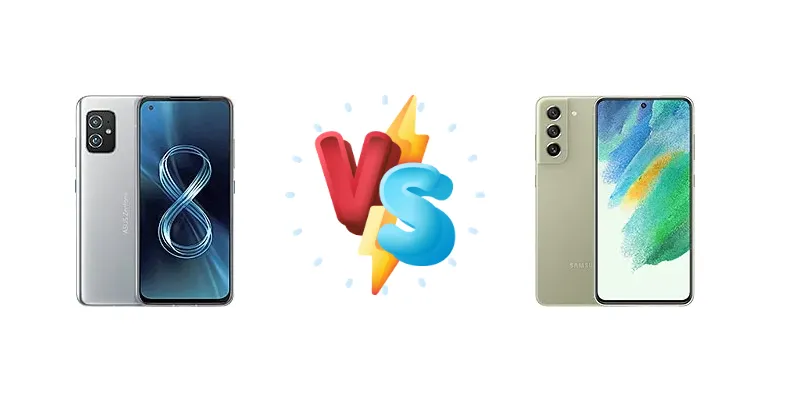
|
🏆 Quick Verdict
For users prioritizing raw speed and a pocketable design, the Asus Zenfone 8 is the clear winner. Its Snapdragon 888 consistently outperforms the S21 FE’s potentially Exynos-equipped variants, and its smaller size is a significant advantage. However, the S21 FE’s slightly better battery endurance and wireless charging capabilities make it a strong contender for those valuing all-day usability.
| PHONES | ||
|---|---|---|
| Phone Names | Asus Zenfone 8 | Samsung Galaxy S21 FE 5G |
| Network | ||
|---|---|---|
| 2G bands | GSM 850 / 900 / 1800 / 1900 | GSM 850 / 900 / 1800 / 1900 |
| 3G bands | HSDPA 800 / 850 / 900 / 1700(AWS) / 1900 / 2100 | HSDPA 850 / 900 / 1700(AWS) / 1900 / 2100 |
| 4G bands | 1, 2, 3, 4, 5, 7, 8, 12, 17, 18, 19, 20, 26, 28, 34, 38, 39, 40, 41, 42 - International | 1, 2, 3, 4, 5, 7, 8, 12, 17, 20, 26, 28, 32, 38, 40, 41, 66 - International |
| 5G bands | 1, 2, 3, 5, 7, 8, 12, 20, 28, 38, 77, 78 SA/NSA - International | 1, 3, 5, 8, 20, 28, 38, 40, 41, 66, 78 SA/NSA/Sub6 - International |
| Speed | HSPA 42.2/5.76 Mbps, LTE (5CA) Cat20 2000/150 Mbps, 5G | HSPA 42.2/5.76 Mbps, LTE (5CA) Cat19 1600/200 Mbps, 5G |
| Technology | GSM / HSPA / LTE / 5G | GSM / CDMA / HSPA / EVDO / LTE / 5G |
| 1, 2, 3, 5, 7, 8, 12, 20, 25, 38, 40, 66, 71, 77, 78 SA/NSA - USA | 41, 66, 71, 260, 261 SA/NSA/Sub6/mmWave - USA | |
| Launch | ||
|---|---|---|
| Announced | 2021, May 12 | 2022, January 04 |
| Status | Available. Released 2021, May 13 | Available. Released 2022, January 07 |
| Body | ||
|---|---|---|
| Build | Glass front (Gorilla Glass Victus), glass back (Gorilla Glass 3), aluminum frame | Glass front (Gorilla Glass Victus), plastic back, aluminum frame |
| Dimensions | 148 x 68.5 x 8.9 mm (5.83 x 2.70 x 0.35 in) | 155.7 x 74.5 x 7.9 mm (6.13 x 2.93 x 0.31 in) |
| SIM | Nano-SIM + Nano-SIM | · Nano-SIM· Nano-SIM + Nano-SIM |
| Weight | 169 g (5.96 oz) | 177 g (6.24 oz) |
| IP68 dust/water resistant (up to 1.5m for 30 min) | IP68 dust/water resistant (up to 1.5m for 30 min) | |
| Display | ||
|---|---|---|
| Protection | Corning Gorilla Glass Victus | Corning Gorilla Glass Victus |
| Resolution | 1080 x 2400 pixels, 20:9 ratio (~446 ppi density) | 1080 x 2340 pixels, 19.5:9 ratio (~403 ppi density) |
| Size | 5.9 inches, 84.0 cm2 (~82.9% screen-to-body ratio) | 6.4 inches, 100.5 cm2 (~86.7% screen-to-body ratio) |
| Type | Super AMOLED, 120Hz, HDR10+, 700 nits (HBM), 1100 nits (peak) | Dynamic AMOLED 2X, 120Hz, HDR10+ |
| Always-on display | Always-on display | |
| Platform | ||
|---|---|---|
| CPU | Octa-core (1x2.84 GHz Cortex-X1 & 3x2.42 GHz Cortex-A78 & 4x1.80 GHz Cortex-A55) | Octa-core (1x2.84 GHz Cortex-X1 & 3x2.42 GHz Cortex-A78 & 4x1.80 GHz Cortex-A55) - Version 1Octa-core (1x2.9 GHz Cortex-X1 & 3x2.80 GHz Cortex-A78 & 4x2.2 GHz Cortex-A55) - Version 2 |
| Chipset | Qualcomm SM8350 Snapdragon 888 5G (5 nm) | Qualcomm SM8350 Snapdragon 888 5G (5 nm) - Version 1Exynos 2100 (5 nm) - Version 2 |
| GPU | Adreno 660 | Adreno 660 - Version 1Mali-G78 MP14 - Version 2 |
| OS | Android 11, upgradable to Android 13 | Android 12, up to 4 major Android upgrades, One UI 8 |
| Memory | ||
|---|---|---|
| Card slot | No | No |
| Internal | 128GB 6GB RAM, 128GB 8GB RAM, 256GB 8GB RAM, 256GB 12GB RAM, 256GB 16GB RAM | 128GB 6GB RAM, 128GB 8GB RAM, 256GB 6GB RAM, 256GB 8GB RAM |
| UFS 3.1 | - | |
| Main Camera | ||
|---|---|---|
| Dual | 64 MP, f/1.8, 26mm (wide), 1/1.73", 0.8µm, PDAF, OIS 12 MP, f/2.2, 112˚, 14mm (ultrawide), 1/2.55", 1.4µm, dual pixel PDAF | - |
| Features | LED flash, HDR, panorama | LED flash, auto-HDR, panorama |
| Single | - | 32 MP, f/2.2, 26mm (wide), 1/2.74", 0.8µm |
| Triple | - | 12 MP, f/1.8, 26mm (wide), 1/1.76", 1.8µm, dual pixel PDAF, OIS 8 MP, f/2.4, 76mm (telephoto), 1/4.5", 1.0µm, PDAF, OIS, 3x optical zoom 12 MP, f/2.2, 13mm, 123˚ (ultrawide), 1/3.0", 1.12µm |
| Video | 8K@24fps, 4K@30/60/120fps, 1080p@30/60/240fps, 720p@480fps; gyro-EIS, HDR | 4K@30/60fps, 1080p@30/60/120/240fps, HDR10+, gyro-EIS |
| Selfie camera | ||
|---|---|---|
| Features | - | HDR |
| Single | 12 MP, f/2.5, 28mm (standard), 1/2.93", 1.22µm, dual pixel PDAF | 32 MP, f/2.2, 26mm (wide), 1/2.74", 0.8µm |
| Video | 4K@30fps, 1080p@30/60fps | 4K@30/60fps, 1080p@30/60fps, gyro-EIS |
| Sound | ||
|---|---|---|
| 3.5mm jack | Yes | No |
| 35mm jack | Yes | No |
| Loudspeaker | Yes, with stereo speakers | Yes, with stereo speakers |
| 32-bit/384kHz audio | 32-bit/384kHz audio | |
| Comms | ||
|---|---|---|
| Bluetooth | 5.2, A2DP, LE, aptX HD, aptX Adaptive | 5.0, A2DP, LE |
| NFC | Yes | Yes |
| Positioning | GPS (L1+L5), GLONASS (L1), BDS (B1I+B1c+B2a), GALILEO (E1+E5a), QZSS (L1+L5), NavIC (L5) | GPS, GLONASS, BDS, GALILEO |
| Radio | FM radio (market/region dependent) | Unspecified |
| USB | USB Type-C 2.0, OTG | USB Type-C, OTG |
| WLAN | Wi-Fi 802.11 a/b/g/n/ac/6e, dual-band, Wi-Fi Direct | Wi-Fi 802.11 a/b/g/n/ac/6, dual-band, Wi-Fi Direct |
| Features | ||
|---|---|---|
| Sensors | Fingerprint (under display, optical), accelerometer, gyro, proximity, compass | Fingerprint (under display, optical), accelerometer, gyro, proximity, compass |
| - | Bixby natural language commands and dictation Samsung Pay (Visa, MasterCard certified) Samsung DeX (desktop experience support) | |
| Battery | ||
|---|---|---|
| Charging | 30W wired, PD3.0, 60% in 25 min, 100% in 80 min Reverse wired | 25W wired, PD3.0, 50% in 30 min 15W wireless Reverse wireless |
| Type | Li-Po 4000 mAh | Li-Ion 4500 mAh |
| Misc | ||
|---|---|---|
| Colors | Obsidian Black, Horizon Silver | White, Graphite, Lavender, Olive |
| Models | ZS590KS, ZS590KS-2A007EU, I006D | SM-G990B, SM-G990B/DS, SM-G990U, SM-G990U1, SM-G990W, SM-G990E, SM-G9900, SM-G990B2, SM-G990U2, SM-G990W2, SM-G990U3 |
| Price | About 290 EUR | € 199.00 / $ 143.95 / £ 154.99 / ₹ 29,990 |
| SAR | - | 0.77 W/kg (head) 0.90 W/kg (body) |
| SAR EU | - | 0.95 W/kg (head) 1.48 W/kg (body) |
| Tests | ||
|---|---|---|
| Battery life | Endurance rating 88h | Endurance rating 92h |
| Camera | Photo / Video | Photo / Video |
| Display | Contrast ratio: Infinite (nominal) | Contrast ratio: Infinite (nominal) |
| Loudspeaker | -27.9 LUFS (Good) | -26.9 LUFS (Good) |
| Performance | AnTuTu: 676001 (v8) | 799738 (v9) GeekBench: 3604 (v5.1) GFXBench: 61fps (ES 3.1 onscreen) | AnTuTu: 566529 (v8), 719696 (v9) GeekBench: 3049 (v5.1) GFXBench: 56fps (ES 3.1 onscreen) |
Asus Zenfone 8
- Significantly more compact and pocketable design.
- Generally superior performance with the Snapdragon 888.
- Faster wired charging speeds.
- Potentially better thermal management due to smaller size.
- Smaller battery capacity and slightly lower endurance rating.
- Lacks wireless charging capabilities.
Samsung Galaxy S21 FE 5G
- Larger display for enhanced media consumption.
- Wireless charging and reverse wireless charging.
- Slightly better battery endurance.
- Potentially more versatile camera system (depending on lens configuration).
- Can be equipped with the less efficient Exynos 2100 chipset.
- Larger size may be less comfortable for one-handed use.
Display Comparison
Both the Zenfone 8 and S21 FE boast 'Infinite' contrast ratios, typical of OLED panels. However, the Zenfone 8 edges out the S21 FE with a measured peak brightness of 800 nits versus 792 nits, offering slightly better visibility in direct sunlight. While both offer excellent viewing experiences, the Zenfone 8’s smaller 5.9-inch display contributes to its overall compactness, while the S21 FE’s 6.4-inch panel provides more screen real estate for media consumption and multitasking. Neither specification details refresh rate, but both are expected to have 120Hz panels.
Camera Comparison
Both phones offer versatile camera systems, but their approaches differ. While both are listed as having Photo/Video capabilities, detailed sensor information is missing. The S21 FE likely benefits from Samsung’s extensive image processing algorithms, potentially delivering more vibrant and shareable photos. The Zenfone 8, with its focus on compactness, may prioritize a more natural color profile. The presence of a 2MP macro camera on the S21 FE is largely inconsequential, offering limited improvements over the main sensor. Without specific sensor size and aperture details, it’s difficult to definitively declare a winner, but the S21 FE’s broader feature set (likely including ultrawide and telephoto lenses) provides more creative flexibility.
Performance
The core performance difference lies in the chipset variations. Both phones can be equipped with the Qualcomm Snapdragon 888 5G (5nm), but the S21 FE also has an Exynos 2100 (5nm) variant. While both chipsets share the same CPU core configuration (1x2.84 GHz Cortex-X1, 3x2.42 GHz Cortex-A78, 4x1.80 GHz Cortex-A55), the Snapdragon 888 generally exhibits superior GPU performance and thermal management. The S21 FE’s Exynos variant has a slightly higher peak CPU clock speed (2.9 GHz vs 2.84 GHz), but this doesn’t translate to a noticeable real-world advantage. Both phones utilize LPDDR5 RAM, but the Zenfone 8’s smaller size may lead to more efficient thermal dissipation, preventing throttling during sustained workloads.
Battery Life
The Samsung Galaxy S21 FE 5G holds a slight edge in battery endurance with a rating of 92 hours, compared to the Zenfone 8’s 88 hours. However, this difference is partially offset by the Zenfone 8’s faster 30W wired charging (60% in 25 minutes, 100% in 80 minutes) versus the S21 FE’s 25W charging (50% in 30 minutes). The S21 FE also adds 15W wireless charging and reverse wireless charging, features absent on the Zenfone 8. For users who prioritize convenience and all-day battery life, the S21 FE is the better choice, but the Zenfone 8’s faster wired charging mitigates its smaller battery capacity.
Buying Guide
Buy the Asus Zenfone 8 if you need a truly compact, high-performance phone that fits comfortably in one hand and excels at demanding tasks like gaming. Buy the Samsung Galaxy S21 FE 5G if you prefer a larger display, a more versatile camera system, and the convenience of wireless charging, even if it means sacrificing some raw processing power and portability.