
Asus Zenfone 8 vs. Google Pixel 6a: A Deep Dive into Compact Android Power
| Phones Images | |||||
|---|---|---|---|---|---|
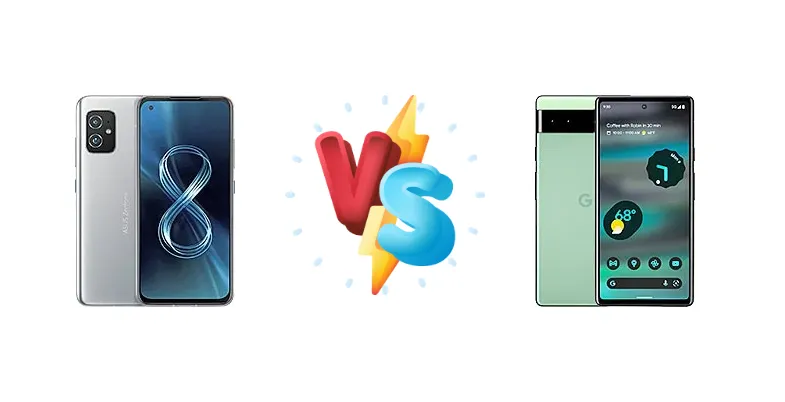
|
🏆 Quick Verdict
For users prioritizing unadulterated speed and a genuinely pocketable form factor, the Asus Zenfone 8 is the clear winner. However, the Google Pixel 6a’s superior battery life and Google’s renowned camera processing make it a compelling choice for those valuing longevity and effortless photography.
| PHONES | ||
|---|---|---|
| Phone Names | Asus Zenfone 8 | Google Pixel 6a |
| Network | ||
|---|---|---|
| 2G bands | GSM 850 / 900 / 1800 / 1900 | GSM 850 / 900 / 1800 / 1900 |
| 3G bands | HSDPA 800 / 850 / 900 / 1700(AWS) / 1900 / 2100 | HSDPA 800 / 850 / 900 / 1700(AWS) / 1900 / 2100 |
| 4G bands | 1, 2, 3, 4, 5, 7, 8, 12, 17, 18, 19, 20, 26, 28, 34, 38, 39, 40, 41, 42 - International | 1, 2, 3, 4, 5, 7, 8, 12, 13, 14, 17, 18, 19, 20, 25, 26, 28, 29, 30, 38, 39, 40, 41, 42, 48, 66, 71 - GX7AS, GB62Z (USA/Canada) |
| 5G bands | 1, 2, 3, 5, 7, 8, 12, 20, 28, 38, 77, 78 SA/NSA - International | 1, 2, 3, 5, 7, 8, 12, 20, 25, 28, 30, 38, 40, 41, 48, 66, 71, 77, 78 SA/NSA/Sub6 - GX7AS (USA/Canada) |
| Speed | HSPA 42.2/5.76 Mbps, LTE (5CA) Cat20 2000/150 Mbps, 5G | HSPA, LTE, 5G |
| Technology | GSM / HSPA / LTE / 5G | GSM / HSPA / LTE / 5G |
| 1, 2, 3, 5, 7, 8, 12, 20, 25, 38, 40, 66, 71, 77, 78 SA/NSA - USA | 1, 2, 3, 5, 7, 8, 12, 20, 25, 28, 30, 40, 48, 66, 71, 77, 78 SA/NSA/Sub6 - G1AZG (International) | |
| Launch | ||
|---|---|---|
| Announced | 2021, May 12 | 2022, May 11 |
| Status | Available. Released 2021, May 13 | Available. Released 2022, July 21 |
| Body | ||
|---|---|---|
| Build | Glass front (Gorilla Glass Victus), glass back (Gorilla Glass 3), aluminum frame | Glass front (Gorilla Glass 3), aluminum frame, plastic back |
| Dimensions | 148 x 68.5 x 8.9 mm (5.83 x 2.70 x 0.35 in) | 152.2 x 71.8 x 8.9 mm (5.99 x 2.83 x 0.35 in) |
| SIM | Nano-SIM + Nano-SIM | Nano-SIM + eSIM |
| Weight | 169 g (5.96 oz) | 178 g (6.28 oz) |
| IP68 dust/water resistant (up to 1.5m for 30 min) | IP67 dust/water resistant (up to 1m for 30 min) | |
| Display | ||
|---|---|---|
| Protection | Corning Gorilla Glass Victus | Corning Gorilla Glass 3 |
| Resolution | 1080 x 2400 pixels, 20:9 ratio (~446 ppi density) | 1080 x 2400 pixels, 20:9 ratio (~429 ppi density) |
| Size | 5.9 inches, 84.0 cm2 (~82.9% screen-to-body ratio) | 6.1 inches, 90.7 cm2 (~83.0% screen-to-body ratio) |
| Type | Super AMOLED, 120Hz, HDR10+, 700 nits (HBM), 1100 nits (peak) | OLED, HDR |
| Always-on display | Always-on display | |
| Platform | ||
|---|---|---|
| CPU | Octa-core (1x2.84 GHz Cortex-X1 & 3x2.42 GHz Cortex-A78 & 4x1.80 GHz Cortex-A55) | Octa-core (2x2.80 GHz Cortex-X1 & 2x2.25 GHz Cortex-A76 & 4x1.80 GHz Cortex-A55) |
| Chipset | Qualcomm SM8350 Snapdragon 888 5G (5 nm) | Google Tensor (5 nm) |
| GPU | Adreno 660 | Mali-G78 MP20 |
| OS | Android 11, upgradable to Android 13 | Android 12, upgradable to Android 15, up to 5 major Android upgrades |
| Memory | ||
|---|---|---|
| Card slot | No | No |
| Internal | 128GB 6GB RAM, 128GB 8GB RAM, 256GB 8GB RAM, 256GB 12GB RAM, 256GB 16GB RAM | 128GB 6GB RAM |
| UFS 3.1 | UFS 3.1 | |
| Main Camera | ||
|---|---|---|
| Dual | 64 MP, f/1.8, 26mm (wide), 1/1.73", 0.8µm, PDAF, OIS 12 MP, f/2.2, 112˚, 14mm (ultrawide), 1/2.55", 1.4µm, dual pixel PDAF | 12.2 MP, f/1.7, 27mm, (wide), 1/2.55", 1.4µm, dual pixel PDAF, OIS 12 MP, f/2.2, 17mm, 114˚ (ultrawide), 1.25µm |
| Features | LED flash, HDR, panorama | Dual-LED flash, Pixel Shift, Auto-HDR, panorama |
| Single | - | 8 MP, f/2.0, 24mm (wide), 1.12µm |
| Video | 8K@24fps, 4K@30/60/120fps, 1080p@30/60/240fps, 720p@480fps; gyro-EIS, HDR | 4K@30/60fps, 1080p@30/60/120/240fps; gyro-EIS, OIS |
| Selfie camera | ||
|---|---|---|
| Features | - | HDR, panorama |
| Single | 12 MP, f/2.5, 28mm (standard), 1/2.93", 1.22µm, dual pixel PDAF | 8 MP, f/2.0, 24mm (wide), 1.12µm |
| Video | 4K@30fps, 1080p@30/60fps | 1080p@30fps |
| Sound | ||
|---|---|---|
| 3.5mm jack | Yes | No |
| 35mm jack | Yes | No |
| Loudspeaker | Yes, with stereo speakers | Yes, with stereo speakers |
| 32-bit/384kHz audio | - | |
| Comms | ||
|---|---|---|
| Bluetooth | 5.2, A2DP, LE, aptX HD, aptX Adaptive | 5.2, A2DP, LE |
| NFC | Yes | Yes |
| Positioning | GPS (L1+L5), GLONASS (L1), BDS (B1I+B1c+B2a), GALILEO (E1+E5a), QZSS (L1+L5), NavIC (L5) | GPS, GLONASS, GALILEO, QZSS |
| Radio | FM radio (market/region dependent) | No |
| USB | USB Type-C 2.0, OTG | USB Type-C 3.1 |
| WLAN | Wi-Fi 802.11 a/b/g/n/ac/6e, dual-band, Wi-Fi Direct | Wi-Fi 802.11 a/b/g/n/ac/6e, dual-band, Wi-Fi Direct |
| Features | ||
|---|---|---|
| Sensors | Fingerprint (under display, optical), accelerometer, gyro, proximity, compass | Fingerprint (under display, optical), accelerometer, gyro, proximity, compass, barometer |
| Battery | ||
|---|---|---|
| Charging | 30W wired, PD3.0, 60% in 25 min, 100% in 80 min Reverse wired | 18W wired, PD3.0 |
| Type | Li-Po 4000 mAh | Li-Po 4410 mAh |
| Misc | ||
|---|---|---|
| Colors | Obsidian Black, Horizon Silver | Chalk, Charcoal, Sage |
| Models | ZS590KS, ZS590KS-2A007EU, I006D | GX7AS, GB62Z, G1AZG, GB17L |
| Price | About 290 EUR | $ 138.99 / C$ 228.74 / ₹ 23,999 |
| Tests | ||
|---|---|---|
| Battery life | Endurance rating 88h | Endurance rating 94h |
| Camera | Photo / Video | - |
| Display | Contrast ratio: Infinite (nominal) | Contrast ratio: Infinite (nominal) |
| Loudspeaker | -27.9 LUFS (Good) | - |
| Performance | AnTuTu: 676001 (v8) | 799738 (v9) GeekBench: 3604 (v5.1) GFXBench: 61fps (ES 3.1 onscreen) | - |
Asus Zenfone 8
- Superior raw processing power with Snapdragon 888
- More compact and pocketable design
- Faster 30W wired charging with reverse wireless charging
- Shorter battery life compared to Pixel 6a
- Potentially more thermal throttling under sustained load
Google Pixel 6a
- Excellent battery life and efficiency
- Google’s industry-leading camera software and image processing
- Guaranteed software updates directly from Google
- Less powerful processor compared to Snapdragon 888
- Slower 18W wired charging
Display Comparison
Both the Zenfone 8 and Pixel 6a feature displays with infinite (nominal) contrast ratios, typical of OLED panels. However, the Pixel 6a edges out the Zenfone 8 in peak brightness, reaching 876 nits compared to the Zenfone 8’s 800 nits. This difference, while not massive, translates to slightly better visibility under direct sunlight. Neither phone specifies refresh rates, but the Zenfone 8’s smaller 5.9-inch display likely contributes to a higher pixel density, resulting in a sharper image. The lack of LTPO technology on either device means refresh rate is fixed, impacting power consumption.
Camera Comparison
Both phones prioritize computational photography, but approach it differently. The Pixel 6a benefits from Google’s renowned image processing algorithms, consistently delivering excellent dynamic range and accurate colors. While specific sensor details are missing for the Zenfone 8, Asus historically focuses on versatile camera systems. The Pixel 6a’s strength lies in its software optimization, particularly in low-light conditions. The Zenfone 8’s video capabilities are likely strong, given the Snapdragon 888’s image signal processor, but without detailed specs, it’s difficult to definitively compare. The absence of a dedicated telephoto lens on either device limits optical zoom capabilities.
Performance
The core difference lies in the chipsets. The Zenfone 8 boasts the Qualcomm Snapdragon 888 5G (5nm), featuring a prime Cortex-X1 core clocked at 2.84 GHz. The Pixel 6a utilizes Google’s in-house Tensor chip (5nm) with a similar Cortex-X1 configuration at 2.80 GHz. While clock speeds are close, the Snapdragon 888 generally delivers higher peak CPU and GPU performance. The Pixel 6a’s Tensor chip excels in AI and machine learning tasks, powering features like Magic Eraser and Real Tone. Both phones utilize an octa-core configuration, but the Pixel 6a’s use of Cortex-A76 cores (vs the Zenfone 8’s A78) represents a slight architectural step back in raw processing power. The Zenfone 8’s superior thermal design, crucial for sustained performance, is a key advantage for gamers.
Battery Life
The Pixel 6a claims a slight edge in battery endurance with a rating of 94 hours, compared to the Zenfone 8’s 88 hours. This difference is likely due to the more efficient Tensor chip and potentially larger battery capacity (though not specified). The Zenfone 8 compensates with faster charging – 30W wired with PD3.0, achieving 60% charge in 25 minutes and 100% in 80 minutes. The Pixel 6a is limited to 18W wired charging, a significantly slower pace. The Zenfone 8 also offers reverse wired charging, a feature absent on the Pixel 6a.
Buying Guide
Buy the Asus Zenfone 8 if you need a powerful, compact phone for demanding tasks like gaming or video editing, and you don't mind slightly shorter battery life. Buy the Google Pixel 6a if you prefer a phone with exceptional battery endurance, a consistently excellent camera experience, and guaranteed software updates directly from Google, even if it means sacrificing some raw processing power.