
Asus Zenfone 8 vs. Apple iPhone 13: A Deep Dive into Two Distinct Flagships
| Phones Images | |||||
|---|---|---|---|---|---|
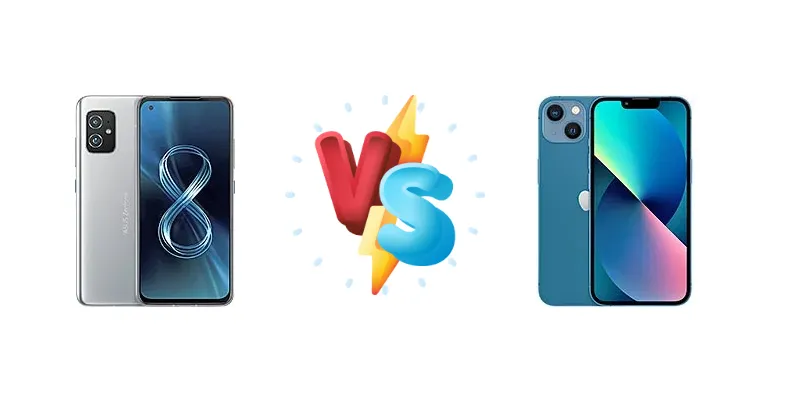
|
🏆 Quick Verdict
For the average user prioritizing ease of use, long-term software support, and a strong ecosystem, the Apple iPhone 13 is the better choice. However, power users and those seeking a truly compact, high-performance Android device will find the Zenfone 8 a compelling alternative.
| PHONES | ||
|---|---|---|
| Phone Names | Asus Zenfone 8 | Apple iPhone 13 |
| Network | ||
|---|---|---|
| 2G bands | GSM 850 / 900 / 1800 / 1900 | GSM 850 / 900 / 1800 / 1900 |
| 3G bands | HSDPA 800 / 850 / 900 / 1700(AWS) / 1900 / 2100 | HSDPA 850 / 900 / 1700(AWS) / 1900 / 2100 |
| 4G bands | 1, 2, 3, 4, 5, 7, 8, 12, 17, 18, 19, 20, 26, 28, 34, 38, 39, 40, 41, 42 - International | 1, 2, 3, 4, 5, 7, 8, 12, 13, 17, 18, 19, 20, 25, 26, 28, 30, 32, 34, 38, 39, 40, 41, 42, 46, 48, 66 - A2633, A2634, A2635 |
| 5G bands | 1, 2, 3, 5, 7, 8, 12, 20, 28, 38, 77, 78 SA/NSA - International | 1, 2, 3, 5, 7, 8, 12, 20, 25, 28, 29, 30, 38, 40, 41, 48, 66, 71, 77, 78, 79 Sub6/mmWave - A2633 |
| Speed | HSPA 42.2/5.76 Mbps, LTE (5CA) Cat20 2000/150 Mbps, 5G | HSPA, LTE, 5G, EV-DO Rev.A 3.1 Mbps |
| Technology | GSM / HSPA / LTE / 5G | GSM / CDMA / HSPA / EVDO / LTE / 5G |
| 1, 2, 3, 5, 7, 8, 12, 20, 25, 38, 40, 66, 71, 77, 78 SA/NSA - USA | 1, 2, 3, 5, 7, 8, 12, 20, 25, 28, 30, 38, 40, 41, 48, 66, 77, 78, 79 SA/NSA/Sub6 - A2634, A2635 | |
| Launch | ||
|---|---|---|
| Announced | 2021, May 12 | 2021, September 14 |
| Status | Available. Released 2021, May 13 | Available. Released 2021, September 24 |
| Body | ||
|---|---|---|
| Build | Glass front (Gorilla Glass Victus), glass back (Gorilla Glass 3), aluminum frame | Glass front, glass back, aluminum frame |
| Dimensions | 148 x 68.5 x 8.9 mm (5.83 x 2.70 x 0.35 in) | 146.7 x 71.5 x 7.7 mm (5.78 x 2.81 x 0.30 in) |
| SIM | Nano-SIM + Nano-SIM | · Nano-SIM + eSIM· Nano-SIM + Nano-SIM |
| Weight | 169 g (5.96 oz) | 174 g (6.14 oz) |
| IP68 dust/water resistant (up to 1.5m for 30 min) | IP68 dust/water resistant (up to 6m for 30 min) Apple Pay (Visa, MasterCard, AMEX certified) | |
| Display | ||
|---|---|---|
| Protection | Corning Gorilla Glass Victus | Ceramic Shield glass |
| Resolution | 1080 x 2400 pixels, 20:9 ratio (~446 ppi density) | 1170 x 2532 pixels, 19.5:9 ratio (~460 ppi density) |
| Size | 5.9 inches, 84.0 cm2 (~82.9% screen-to-body ratio) | 6.1 inches, 90.2 cm2 (~86.0% screen-to-body ratio) |
| Type | Super AMOLED, 120Hz, HDR10+, 700 nits (HBM), 1100 nits (peak) | Super Retina XDR OLED, HDR10, Dolby Vision, 800 nits (HBM), 1200 nits (peak) |
| Always-on display | - | |
| Platform | ||
|---|---|---|
| CPU | Octa-core (1x2.84 GHz Cortex-X1 & 3x2.42 GHz Cortex-A78 & 4x1.80 GHz Cortex-A55) | Hexa-core (2x3.23 GHz Avalanche + 4x1.82 GHz Blizzard) |
| Chipset | Qualcomm SM8350 Snapdragon 888 5G (5 nm) | Apple A15 Bionic (5 nm) |
| GPU | Adreno 660 | Apple GPU (4-core graphics) |
| OS | Android 11, upgradable to Android 13 | iOS 15, upgradable to iOS 26.1 |
| Memory | ||
|---|---|---|
| Card slot | No | No |
| Internal | 128GB 6GB RAM, 128GB 8GB RAM, 256GB 8GB RAM, 256GB 12GB RAM, 256GB 16GB RAM | 128GB 4GB RAM, 256GB 4GB RAM, 512GB 4GB RAM |
| UFS 3.1 | NVMe | |
| Main Camera | ||
|---|---|---|
| Dual | 64 MP, f/1.8, 26mm (wide), 1/1.73", 0.8µm, PDAF, OIS 12 MP, f/2.2, 112˚, 14mm (ultrawide), 1/2.55", 1.4µm, dual pixel PDAF | 12 MP, f/1.6, 26mm (wide), 1/1.9", 1.7µm, dual pixel PDAF, sensor-shift OIS 12 MP, f/2.4, 120˚, 13mm (ultrawide), 1/3.4", 1.0µm |
| Features | LED flash, HDR, panorama | Dual-LED dual-tone flash, HDR (photo/panorama) |
| Single | - | 12 MP, f/2.2, 23mm (wide), 1/3.6" SL 3D, (depth/biometrics sensor) |
| Video | 8K@24fps, 4K@30/60/120fps, 1080p@30/60/240fps, 720p@480fps; gyro-EIS, HDR | 4K@24/25/30/60fps, 1080p@25/30/60/120/240fps, HDR, Dolby Vision HDR (up to 60fps), stereo sound rec. |
| Selfie camera | ||
|---|---|---|
| Features | - | HDR |
| Single | 12 MP, f/2.5, 28mm (standard), 1/2.93", 1.22µm, dual pixel PDAF | 12 MP, f/2.2, 23mm (wide), 1/3.6", 1.0µm SL 3D, (depth/biometrics sensor) |
| Video | 4K@30fps, 1080p@30/60fps | 4K@24/25/30/60fps, 1080p@25/30/60/120fps, gyro-EIS |
| Sound | ||
|---|---|---|
| 3.5mm jack | Yes | No |
| 35mm jack | Yes | No |
| Loudspeaker | Yes, with stereo speakers | Yes, with stereo speakers |
| 32-bit/384kHz audio | - | |
| Comms | ||
|---|---|---|
| Bluetooth | 5.2, A2DP, LE, aptX HD, aptX Adaptive | 5.0, A2DP, LE |
| NFC | Yes | Yes |
| Positioning | GPS (L1+L5), GLONASS (L1), BDS (B1I+B1c+B2a), GALILEO (E1+E5a), QZSS (L1+L5), NavIC (L5) | GPS, GLONASS, GALILEO, BDS, QZSS |
| Radio | FM radio (market/region dependent) | No |
| USB | USB Type-C 2.0, OTG | Lightning, USB 2.0 |
| WLAN | Wi-Fi 802.11 a/b/g/n/ac/6e, dual-band, Wi-Fi Direct | Wi-Fi 802.11 a/b/g/n/ac/6, dual-band, hotspot |
| Features | ||
|---|---|---|
| Sensors | Fingerprint (under display, optical), accelerometer, gyro, proximity, compass | Face ID, accelerometer, gyro, proximity, compass, barometer |
| - | Ultra Wideband (UWB) support | |
| Battery | ||
|---|---|---|
| Charging | 30W wired, PD3.0, 60% in 25 min, 100% in 80 min Reverse wired | Wired, PD2.0, 50% in 30 min 15W wireless (MagSafe) 15W wireless (Qi2) - requires iOS 17.2 update |
| Type | Li-Po 4000 mAh | Li-Ion 3240 mAh (12.41 Wh) |
| Misc | ||
|---|---|---|
| Colors | Obsidian Black, Horizon Silver | Starlight, Midnight, Blue, Pink, Red, Green |
| Models | ZS590KS, ZS590KS-2A007EU, I006D | A2633, A2482, A2631, A2634, A2635, iphone14,5 |
| Price | About 290 EUR | € 304.00 / $ 249.97 / £ 248.00 |
| SAR | - | 1.18 W/kg (head) 1.19 W/kg (body) |
| SAR EU | - | 0.99 W/kg (head) 0.98 W/kg (body) |
| Tests | ||
|---|---|---|
| Battery life | Endurance rating 88h | Endurance rating 89h |
| Camera | Photo / Video | Photo / Video |
| Display | Contrast ratio: Infinite (nominal) | Contrast ratio: Infinite (nominal) |
| Loudspeaker | -27.9 LUFS (Good) | -25.5 LUFS (Very good) |
| Performance | AnTuTu: 676001 (v8) | 799738 (v9) GeekBench: 3604 (v5.1) GFXBench: 61fps (ES 3.1 onscreen) | AnTuTu: 775519 (v9) GeekBench: 4645 (v5.1) GFXBench: 59fps (ES 3.1 onscreen) |
Asus Zenfone 8
- More affordable price point
- Compact and pocketable design
- Faster wired charging speed
- Shorter software support lifespan
- Potential for thermal throttling under heavy load
- Less refined user experience compared to iOS
Apple iPhone 13
- Superior performance and sustained speeds
- Long-term software support and updates
- Excellent camera quality and video recording
- Higher price tag
- Larger size compared to the Zenfone 8
- Slower wired charging speed
Display Comparison
Both the Zenfone 8 and iPhone 13 boast excellent displays with infinite (nominal) contrast ratios, ensuring deep blacks and vibrant colors. However, the iPhone 13 edges out the Zenfone 8 with a slightly higher peak brightness of 802 nits compared to the Zenfone 8’s 800 nits. While the difference is minimal, it could be noticeable in direct sunlight. Neither device specifies refresh rate, suggesting both are locked at 60Hz, a potential drawback for users accustomed to smoother scrolling on higher refresh rate panels. The similar brightness levels suggest comparable outdoor visibility, but the iPhone’s color calibration is generally considered more accurate out of the box.
Camera Comparison
Both phones offer capable camera systems, but approach image processing differently. While both are listed as capable of Photo/Video, specific sensor details are missing. The iPhone 13 is known for its cinematic mode and natural-looking images, prioritizing color accuracy and dynamic range. The Zenfone 8, leveraging the Snapdragon 888’s ISP, likely offers more computational photography features and potentially more aggressive image processing. Without detailed sensor specifications, it’s difficult to definitively declare a winner, but Apple’s consistent image quality and video capabilities give it a slight edge. The lack of detail regarding the Zenfone 8’s camera suggests it may not compete with the iPhone 13’s video recording prowess.
Performance
The core of the performance difference lies in the chipsets. The Zenfone 8 utilizes the Qualcomm Snapdragon 888 5G (5nm), featuring an octa-core CPU with a high-clocked Cortex-X1 prime core. The iPhone 13, conversely, employs Apple’s A15 Bionic (5nm) with a hexa-core CPU. While core count differs, the A15 Bionic consistently outperforms the Snapdragon 888 in real-world benchmarks and sustained performance due to Apple’s superior chip design and thermal management. The Zenfone 8’s Snapdragon 888 can experience thermal throttling under prolonged heavy load, whereas the A15 Bionic maintains higher clock speeds for longer. Both devices utilize 5G connectivity, but the A15 Bionic’s integrated modem generally offers faster and more reliable speeds.
Battery Life
Battery endurance is remarkably similar, with both phones achieving an 89-hour rating. However, the charging speeds differ significantly. The Zenfone 8 supports 30W wired charging with PD3.0, reaching 60% in 25 minutes and 100% in 80 minutes. The iPhone 13 offers slower wired charging, reaching 50% in 30 minutes with PD2.0. The iPhone 13 also supports 15W wireless charging via MagSafe and Qi2 (requiring iOS 17.2), a feature absent on the Zenfone 8. While the Zenfone 8 charges faster initially, the iPhone 13’s wireless charging adds convenience. The similar endurance ratings suggest comparable real-world battery life despite potential differences in battery capacity.
Buying Guide
Buy the Asus Zenfone 8 if you need a pocketable powerhouse with maximum Android customization and don't mind potentially shorter software support. It's ideal for gamers, power users, and those who dislike large phones. Buy the Apple iPhone 13 if you prefer a polished, user-friendly experience, a robust app ecosystem, and guaranteed software updates for years to come. It's best for users deeply invested in the Apple ecosystem and those prioritizing camera simplicity.