
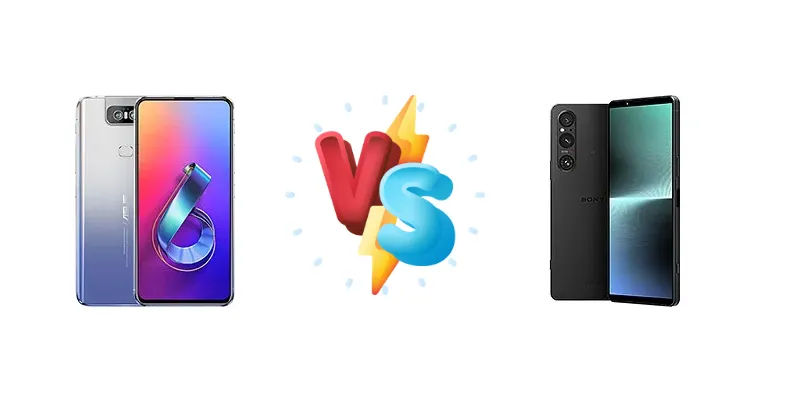
Asus Zenfone 6 vs Sony Xperia 1 V: A Clash of Titans
| Phones Images | |||||
|---|---|---|---|---|---|
|
🏆 Quick Verdict
The Sony Xperia 1 V is the clear winner overall, boasting a significantly faster processor, brighter display, and faster charging. However, the Zenfone 6 offers incredible value for its age, especially if you prioritize battery life and don't need the absolute latest tech.
| PHONES | ||
|---|---|---|
| Phone Names | Asus Zenfone 6 ZS630KL | Sony Xperia 1 V |
| Network | ||
|---|---|---|
| 2G bands | GSM 850 / 900 / 1800 / 1900 | GSM 850 / 900 / 1800 / 1900 |
| 3G bands | HSDPA 850 / 900 / 1900 / 2100 - A version | HSDPA 800 / 850 / 900 / 1700(AWS) / 1900 / 2100 |
| 4G bands | 1, 2, 3, 5, 7, 8, 20, 28, 38, 40, 41 - A version | 1, 2, 3, 4, 5, 7, 8, 12, 13, 17, 19, 20, 25, 26, 28, 29, 32, 34, 38, 39, 40, 41, 46, 66 - Europe |
| 5G bands | - | 1, 3, 5, 7, 8, 20, 28, 38, 40, 41, 77, 78 SA/NSA/Sub6 - Europe |
| Speed | HSPA 42.2/5.76 Mbps, LTE (5CA) Cat18 1200/150 Mbps | HSPA, LTE, 5G |
| Technology | GSM / HSPA / LTE | GSM / HSPA / LTE / 5G |
| 1, 2, 3, 4, 5, 7, 8, 12, 17, 18, 19, 26, 28, 38, 39, 41, 46 - C version | 1, 3, 5, 7, 8, 28, 38, 40, 41, 77, 78, 79 SA/NSA/Sub6 - Asia | |
| Launch | ||
|---|---|---|
| Announced | 2019, May 16. Released 2019, May | 2023, May 11 |
| Status | Discontinued | Available. Released 2023, July 28 |
| Body | ||
|---|---|---|
| Build | Glass front (Gorilla Glass 6), glass back (Gorilla Glass 3), aluminum frame | Glass front (Gorilla Glass Victus 2), glass back (Gorilla Glass Victus), aluminum frame |
| Dimensions | 159.1 x 75.4 x 9.2 mm (6.26 x 2.97 x 0.36 in) | 165 x 71 x 8.3 mm (6.50 x 2.80 x 0.33 in) |
| SIM | Nano-SIM + Nano-SIM | · Nano-SIM + eSIM· Nano-SIM + Nano-SIM |
| Weight | 190 g (6.70 oz) | 187 g (6.60 oz) |
| - | IP65/IP68 dust/water resistant (up to 1.5m for 30 min) | |
| Display | ||
|---|---|---|
| Protection | Corning Gorilla Glass 6 | Corning Gorilla Glass Victus 2 |
| Resolution | 1080 x 2340 pixels, 19.5:9 ratio (~403 ppi density) | 1644 x 3840 pixels, 21:9 ratio (~643 ppi density) |
| Size | 6.4 inches, 100.5 cm2 (~83.8% screen-to-body ratio) | 6.5 inches, 98.6 cm2 (~84.2% screen-to-body ratio) |
| Type | IPS LCD, HDR10 | OLED, 1B colors, 120Hz, HDR BT.2020 |
| Platform | ||
|---|---|---|
| CPU | Octa-core (1x2.84 GHz Kryo 485 & 3x2.42 GHz Kryo 485 & 4x1.78 GHz Kryo 485) | Octa-core (1x3.2 GHz Cortex-X3 & 2x2.8 GHz Cortex-A715 & 2x2.8 GHz Cortex-A710 & 3x2.0 GHz Cortex-A510) |
| Chipset | Qualcomm SM8150 Snapdragon 855 (7 nm) | Qualcomm SM8550-AB Snapdragon 8 Gen 2 (4 nm) |
| GPU | Adreno 640 | Adreno 740 |
| OS | Android 9.0 (Pie), upgradable to Android 11, ZenUI | Android 13, upgradable to Android 15 |
| Memory | ||
|---|---|---|
| Card slot | microSDXC (dedicated slot) | microSDXC (uses shared SIM slot) |
| Internal | 64GB 6GB RAM, 128GB 6GB RAM, 256GB 8GB RAM, 512GB 12GB RAM | 256GB 12GB RAM, 512GB 12GB RAM |
| UFS 2.1 | UFS | |
| Main Camera | ||
|---|---|---|
| Dual | 48 MP, f/1.8, 26mm (wide), 1/2.0", 0.8µm, PDAF 13 MP, f/2.4, 11mm (ultrawide) | - |
| Features | Laser AF, Dual-LED flash, HDR, auto panorama (motorized rotation) | Zeiss optics, Zeiss T* lens coating, color spectrum sensor, LED flash, panorama, HDR, eye tracking |
| Triple | - | 48 MP, f/1.9, 24mm (wide), 1/1.35", 1.12µm, dual pixel PDAF, OIS 12 MP, f/2.3, 85mm (telephoto), f/2.8, 125mm (telephoto), 1/3.5", dual pixel PDAF, 3.5x-5.2x continuous optical zoom, OIS 12 MP, f/2.2, 16mm (ultrawide), 1/2.5", dual pixel PDAF |
| Video | 4K@30/60fps, 1080p@30/60/240fps, 720p@480fps; gyro-EIS (except @240/480fps) | 4K@24/25/30/60/120fps HDR, 1080p@30/60/120fps; 5-axis gyro-EIS, OIS |
| Selfie camera | ||
|---|---|---|
| Dual | Motorized flip-up main camera module | - |
| Features | Dual-LED flash, HDR, auto panorama (motorized rotation) | HDR |
| Single | - | 12 MP, f/2.0, 24mm (wide), 1/2.9", 1.25µm |
| Video | 4K@30/60fps, 1080p@30/60/240fps, 720p@480fps; gyro-EIS (except @240/480fps) | 4K@30/60fps, 1080p@30/60fps, 5-axis gyro-EIS |
| Sound | ||
|---|---|---|
| 3.5mm jack | Yes | Yes |
| 35mm jack | Yes | Yes |
| Loudspeaker | Yes, with stereo speakers | Yes, with stereo speakers |
| 24-bit/192kHz audio | 24-bit/192kHz audio Dynamic vibration system | |
| Comms | ||
|---|---|---|
| Bluetooth | 5.0, A2DP, LE, aptX HD | 5.3, A2DP, LE Audio, aptX HD, aptX Adaptive, aptX Lossless |
| NFC | Yes | Yes |
| Positioning | GPS (L1+L5), GLONASS (G1), BDS (B1), GALILEO (E1+E5a), QZSS (L1+L5) | GPS, GLONASS, BDS, GALILEO, QZSS |
| Radio | FM radio | No |
| USB | USB Type-C 2.0 | USB Type-C 3.2, OTG, video output |
| WLAN | Wi-Fi 802.11 a/b/g/n/ac, dual-band, Wi-Fi Direct | Wi-Fi 802.11 a/b/g/n/ac/6e, tri-band, Wi-Fi Direct, DLNA |
| Features | ||
|---|---|---|
| Sensors | Fingerprint (rear-mounted), accelerometer, gyro, proximity, compass | Fingerprint (side-mounted), accelerometer, gyro, proximity, barometer, compass |
| - | Native Sony Alpha camera support | |
| Battery | ||
|---|---|---|
| Charging | 18W wired 10W reverse wired, QC4 | 30W wired, PD3.0, PPS, 50% in 30 min Wireless Reverse wireless |
| Stand-by | Up to 624 h (3G) | - |
| Talk time | Up to 33 h (3G) | - |
| Type | Li-Po 5000 mAh, non-removable | Li-Po 5000 mAh |
| Misc | ||
|---|---|---|
| Colors | Midnight Black, Twilight Silver | Black, Khaki Green, Platinum Silver |
| Models | ASUS_I01WD, ZS630KL, I01WD | XQDQ62/B, XQ-DQ72, XQ-DQ54 |
| Price | About 500 EUR | € 684.00 / $ 1,409.99 / £ 519.99 |
| Tests | ||
|---|---|---|
| Audio quality | Noise -85.8dB / Crosstalk -76.2dB | - |
| Battery life | Endurance rating 112h | Endurance rating 115h |
| Camera | Photo / Video | Photo / Video |
| Display | Contrast ratio: 1201:1 (nominal) | Contrast ratio: Infinite (nominal) |
| Loudspeaker | -25.7 LUFS (Very good) | -25.4 LUFS (Very good) |
| Performance | AnTuTu: 361679 (v7), 447774 (v8) GeekBench: 10721 (v4.4), 2609 (v5.1) GFXBench: 36fps (ES 3.1 onscreen) | AnTuTu: 1127931 (v9) GeekBench: 4916 (v6) GFXBench: 96fps (ES 3.1 onscreen) |
Asus Zenfone 6 ZS630KL
- Excellent battery life
- Large display
- Powerful Snapdragon 855 processor (for its age)
- Affordable price (due to age)
- Outdated chipset
- Slower charging
- No wireless charging
- Lower display brightness
Sony Xperia 1 V
- Cutting-edge Snapdragon 8 Gen 2 processor
- Bright and vibrant display (120Hz)
- Excellent camera system
- Fast charging (30W)
- Wireless and reverse wireless charging
- Higher price
- Sony's UI can be divisive
- Battery life, while good, isn't as exceptional as the Zenfone 6
Display Comparison
The Xperia 1 V's 936 nits peak brightness blows the Zenfone 6's 455 nits out of the water, making it far more usable outdoors. While both offer excellent contrast ratios (1201:1 for Zenfone 6, Infinite for Xperia 1 V), the Xperia 1 V's superior brightness and potentially more accurate color calibration give it the edge. The Xperia 1 V also features a 120Hz refresh rate, providing smoother scrolling and animations.
Camera Comparison
Sony's camera expertise shines in the Xperia 1 V. It offers a more versatile camera system with advanced features like Exmor T for mobile and more manual controls. While the Zenfone 6's camera is capable, it simply can't compete with the Xperia 1 V's image quality, dynamic range, and video capabilities. The Xperia 1 V also benefits from Sony's computational photography advancements.
Performance
The Snapdragon 8 Gen 2 in the Xperia 1 V is a generational leap over the Snapdragon 855 in the Zenfone 6. Expect significantly faster app loading, smoother multitasking, and better performance in demanding games. The Xperia 1 V's newer architecture also contributes to improved power efficiency despite the increased performance.
Battery Life
Both phones offer impressive endurance ratings (112h and 115h respectively). However, the Xperia 1 V's faster charging (30W vs 18W) means you'll spend less time plugged in. The Xperia 1 V also supports wireless and reverse wireless charging, features absent in the Zenfone 6.
Buying Guide
The Asus Zenfone 6 is ideal for budget-conscious users who want a large screen, solid performance, and exceptional battery life. The Sony Xperia 1 V is for photography enthusiasts, power users, and those who appreciate a premium design and cutting-edge features.