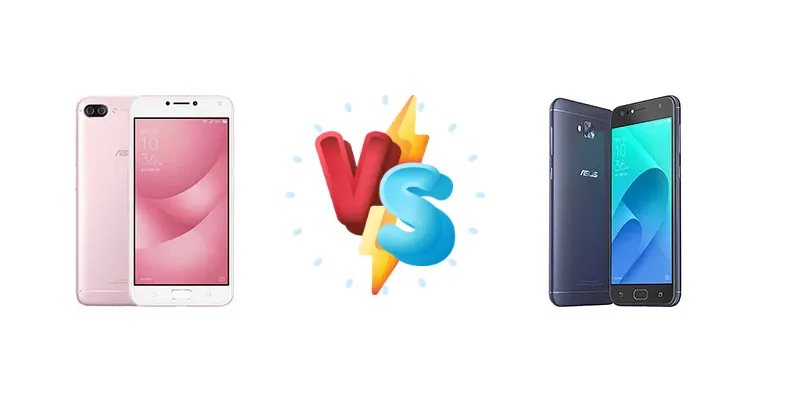
The Asus Zenfone 4 series offered a range of budget-friendly smartphones, and the Max and Selfie models were two popular choices. While sharing a similar core processor, they catered to different user priorities. This comparison dives deep into the differences to help you decide which one is right for you.
🏆 Quick Verdict
The Zenfone 4 Max ZC554KL edges out the Selfie ZD553KL thanks to its larger battery and reverse charging capability. Both offer solid performance for the price, but the Max's extended battery life makes it a more practical daily driver for many users.
| Network |
|---|
| 2G bands | GSM 850 / 900 / 1800 / 1900 - SIM 1 & SIM 2 | GSM 850 / 900 / 1800 / 1900 - SIM 1 & SIM 2 |
| 3G bands | HSDPA 850 / 900 / 1900 / 2100 | HSDPA 850 / 900 / 2100 - Global, India, Indonesia |
| 4G bands | 1, 3, 5, 7, 8, 20, 40 | 1, 3, 5, 7, 8, 20, 40 - Global, India, Indonesia |
| Speed | HSPA 42.2/5.76 Mbps, LTE Cat4 150/50 Mbps | HSPA 42.2/5.76 Mbps, LTE Cat4 150/50 Mbps |
| Technology | GSM / HSPA / LTE | GSM / HSPA / LTE |
| | 1, 2, 3, 4, 5, 7, 8, 17, 18, 19, 26, 28, 38, 41 - USA, Canada | 1, 3, 5, 7, 8, 18, 19, 26, 28, 38, 41 - TW/JP/HK/PH/BR |
| Launch |
|---|
| Announced | 2017, July. Released 2017, September | 2017, August. Released 2017, October |
| Status | Discontinued | Discontinued |
| Body |
|---|
| Build | Glass front (Gorilla Glass), aluminum back, aluminum frame | Glass front, aluminum back, aluminum frame |
| Dimensions | 154 x 76.9 x 8.9 mm (6.06 x 3.03 x 0.35 in) | 155.7 x 75.9 x 7.9 mm (6.13 x 2.99 x 0.31 in) |
| SIM | Nano-SIM + Nano-SIM | Nano-SIM + Nano-SIM |
| Weight | 181 g (6.38 oz) | 144 g (5.08 oz) |
| Display |
|---|
| Protection | Corning Gorilla Glass (unspecified version) | - |
| Resolution | 720 x 1280 pixels, 16:9 ratio (~267 ppi density) | 720 x 1280 pixels, 16:9 ratio (~267 ppi density) |
| Size | 5.5 inches, 83.4 cm2 (~70.4% screen-to-body ratio) | 5.5 inches, 83.4 cm2 (~70.6% screen-to-body ratio) |
| Type | S-IPS LCD | IPS LCD |
| Platform |
|---|
| CPU | Octa-core 1.4 GHz Cortex-A53 | Octa-core 1.4 GHz Cortex-A53 |
| Chipset | Qualcomm MSM8937 Snapdragon 430 (28 nm) | Qualcomm MSM8937 Snapdragon 430 (28 nm) |
| GPU | Adreno 505 | Adreno 505 |
| OS | Android 7 (Nougat), ZenUI 4 | Android 7.0 (Nougat), upgradable to Android 8.1 (Oreo), ZenUI 5 |
| Memory |
|---|
| Card slot | microSDXC (dedicated slot) | microSDXC (dedicated slot) |
| Internal | 32GB 3GB RAM | 64GB 4GB RAM |
| | eMMC 5.1 | eMMC 5.1 |
| Main Camera |
|---|
| Dual | 13 MP, f/2.0, 25mm (wide), AF
13 MP, f/2.0, 12mm, no AF | - |
| Features | LED flash, HDR, panorama | LED flash, panorama, HDR |
| Single | - | 16 MP, 26mm (wide), PDAF |
| Video | 1080p@30fps | 1080p@30fps |
| Selfie camera |
|---|
| Dual | - | 20 MP, f/2.0, 31mm (standard), 1/2.8", 1.0µm
8 MP, 12mm (ultrawide) |
| Features | LED flash | LED flash, panorama, HDR |
| Single | 8 MP, f/2.2, 24mm (wide) | - |
| Sound |
|---|
| 3.5mm jack | Yes | Yes |
| 35mm jack | Yes | Yes |
| Loudspeaker | Yes | Yes |
| Comms |
|---|
| Bluetooth | 4.1, A2DP, LE | 4.1, A2DP, EDR, LE |
| NFC | No | No |
| Positioning | GPS, GLONASS, BDS | GPS, GLONASS, BDS, GALILEO |
| Radio | FM radio | FM radio |
| USB | microUSB 2.0, OTG | microUSB 2.0, OTG |
| WLAN | Wi-Fi 802.11 b/g/n, Wi-Fi Direct | Wi-Fi 802.11 b/g/n, Wi-Fi Direct |
| Features |
|---|
| Sensors | Fingerprint (front-mounted), accelerometer, gyro, proximity, compass | Fingerprint (front-mounted), accelerometer, gyro, proximity, compass |
| Battery |
|---|
| Charging | 10W wired
Reverse wired | - |
| Type | Li-Po 5000 mAh, non-removable | Li-Ion 3000 mAh, non-removable |
| Misc |
|---|
| Colors | Titanium Gray, Rose Pink, Sand Gold, Deepsea Black | Deepsea Black, Mint Green, Rose Pink, Sunlight Gold |
| Models | X00ID, X00IS, X00HDA, ZC554KL | X00LD |
| Price | About 270 EUR | About 250 EUR |
Asus Zenfone 4 Max ZC554KL
- Larger 4100mAh battery
- Reverse wired charging
- Potentially better image stabilization
- Generally more affordable
- Slightly larger and heavier than the Selfie
- Front camera not as impressive as the Selfie's
Asus Zenfone 4 Selfie ZD553KL
- Superior 20MP front-facing camera with flash
- Slightly more compact design
- Good display quality
- Smaller 3000mAh battery
- No reverse charging
- Can drain quickly with heavy usage
Display Comparison
Both phones feature a 5.5-inch IPS LCD display with a resolution of 1920 x 1080 pixels (Full HD). While the panels are similar in quality, the Selfie model might have slightly better color calibration due to its focus on selfie photography, but this is often negligible. Viewing angles and brightness are comparable on both.
Camera Comparison
The Zenfone 4 Selfie's primary selling point was its 20MP front-facing camera with soft light LED flash, designed for enhanced selfies. The rear cameras are both 13MP, capable of decent photos in good lighting conditions. The Max model might have slightly better image stabilization due to its larger size allowing for a more robust stabilization system, but the Selfie's front camera is the clear winner.
Performance
Both devices are powered by the Qualcomm MSM8937 Snapdragon 430 chipset and an Octa-core 1.4 GHz Cortex-A53 CPU. Performance will be very similar in everyday tasks like browsing, social media, and light gaming. Don't expect flagship-level performance, but they are capable for their price point. RAM configurations varied, with 2GB/3GB/4GB options available for both, impacting multitasking ability.
Battery Life
The Zenfone 4 Max boasts a significantly larger 4100mAh battery compared to the Selfie's 3000mAh battery. This translates to noticeably longer battery life, easily lasting a full day with moderate usage. The Max also features reverse wired charging, allowing it to act as a power bank for other devices – a feature absent in the Selfie.
Buying Guide
The Asus Zenfone 4 Max ZC554KL is ideal for users who prioritize battery life and occasional power bank functionality. The Zenfone 4 Selfie ZD553KL is a better fit for those who heavily value front-facing camera quality and a slightly more compact design, though at the expense of battery endurance.
Frequently Asked Questions
❓ What is the difference between the Zenfone 4 Max and Selfie?
The main differences are the battery size (4100mAh vs 3000mAh) and the front-facing camera (20MP with flash on the Selfie vs 8MP on the Max). The Max also has reverse charging.
❓ Which Zenfone 4 is better for gaming?
Both phones offer similar performance for casual gaming. Neither is a powerhouse, but the Max's larger battery might provide slightly longer playtime.