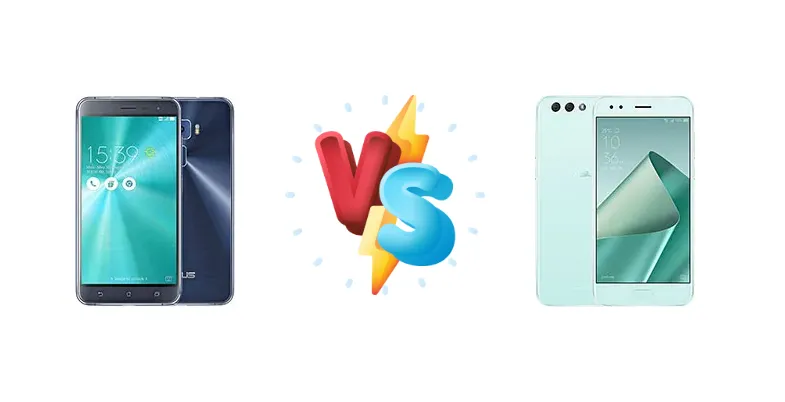
The Asus Zenfone series has long been known for offering impressive features at competitive prices. Today, we're pitting two popular models against each other: the Zenfone 3 ZE552KL and the Zenfone 4 ZE554KL. Which one reigns supreme in terms of performance, camera, and overall value?
🏆 Quick Verdict
The Zenfone 4 ZE554KL generally edges out the Zenfone 3 due to its more powerful processor, potentially improved camera capabilities (depending on the specific 630/660 variant), and faster charging. However, the Zenfone 3 still holds value with its exceptional battery life and strong contrast ratio display.
| Network |
|---|
| 2G bands | GSM 850 / 900 / 1800 / 1900 - SIM 1 & SIM 2 | GSM 850 / 900 / 1800 / 1900 - SIM 1 & SIM 2 |
| 3G bands | HSDPA 850 / 900 / 1900 / 2100 - Global | HSDPA 850 / 900 / 1800 / 1900 / 2100 |
| 4G bands | 1, 2, 3, 5, 7, 8, 20 - Global | 1, 2, 3, 5, 7, 8, 18, 19, 20, 26, 28, 32, 38, 39, 40, 41 |
| Speed | HSPA 42.2/5.76 Mbps, LTE Cat4 150/50 Mbps (Global), LTE (2CA) Cat6 300/50 Mbps (Taiwan) | HSPA 42.2/5.76 Mbps, LTE (3CA) Cat12 600/150 Mbps |
| Technology | GSM / HSPA / LTE | GSM / HSPA / LTE |
| | 1, 2, 3, 4, 5, 7, 8, 17, 28 - USA/Brazil | 1, 3, 5, 7, 8, 20, 40 - India, Indonesia |
| Launch |
|---|
| Announced | 2016, May. Released 2016, August | 2017, August. Released 2017, October |
| Status | Discontinued | Discontinued |
| Body |
|---|
| Build | Glass front (Gorilla Glass 3), glass back (Gorilla Glass 3), aluminum frame | Glass front (Gorilla Glass 5), glass back (Gorilla Glass 5), aluminum frame |
| Dimensions | 152.6 x 77.4 x 7.7 mm (6.01 x 3.05 x 0.30 in) | 155.4 x 75.2 x 7.7 mm (6.12 x 2.96 x 0.30 in) |
| SIM | Nano-SIM + Micro-SIM | Nano-SIM + Nano-SIM |
| Weight | 155 g (5.47 oz) | 165 g (5.82 oz) |
| Display |
|---|
| Protection | Corning Gorilla Glass 3 | Corning Gorilla Glass 3 |
| Resolution | 1080 x 1920 pixels, 16:9 ratio (~401 ppi density) | 1080 x 1920 pixels, 16:9 ratio (~401 ppi density) |
| Size | 5.5 inches, 83.4 cm2 (~70.6% screen-to-body ratio) | 5.5 inches, 83.4 cm2 (~71.4% screen-to-body ratio) |
| Type | Super IPS+ | IPS LCD |
| Platform |
|---|
| CPU | Octa-core 2.0 GHz Cortex-A53 | Octa-core (4x2.2 GHz Cortex-A53 & 4x1.8 GHz Cortex A53)Octa-core (4x2.2 GHz Kryo 260 Gold & 4x1.8 GHz Kryo 260 Silver) |
| Chipset | Qualcomm MSM8953 Snapdragon 625 (14 nm) | Qualcomm SDM630 Snapdragon 630 (14 nm)Qualcomm SDM660 Snapdragon 660 (14 nm) |
| GPU | Adreno 506 | Adreno 508Adreno 512 |
| OS | Android 6.0.1 (Marshmallow), upgradable to 7.0 (Nougat), ZenUI 3 | Android 7.1.1 (Nougat), ZenUI 4 |
| Memory |
|---|
| Card slot | microSDXC (uses shared SIM slot) | microSDXC (uses shared SIM slot) |
| Internal | 32GB 3GB RAM, 64GB 4GB RAM | 64GB 4GB RAM, 64GB 6GB RAM |
| | eMMC 5.1 | eMMC 5.1 |
| Main Camera |
|---|
| Dual | - | 12 MP, f/1.8, 25mm (wide), 1/2.55", 1.4µm, dual pixel PDAF, OIS
8 MP, 12mm (ultrawide), 1/4.0", 1.12µm, no AF |
| Features | Laser AF, Dual-LED dual-tone flash, panorama, HDR | Dual-LED dual-tone flash, HDR, panorama |
| Single | 16 MP, f/2.0, PDAF, 3-axis OIS | - |
| Video | 4K@30fps | 4K@30fps |
| Selfie camera |
|---|
| Features | - | HDR, panorama |
| Single | 8 MP, f/2.0 | 8 MP, f/2.0, 24mm (wide) |
| Video | 1080p@30fps | 1080p@30fps |
| Sound |
|---|
| 3.5mm jack | Yes | Yes |
| 35mm jack | Yes | Yes |
| Loudspeaker | Yes | Yes, dual speakers |
| | 24-bit/192kHz audio
| 24-bit/192kHz audio
|
| Comms |
|---|
| Bluetooth | 4.2, A2DP, EDR, LE | 5.0, A2DP, EDR, LE |
| NFC | No | Yes |
| Positioning | GPS, GLONASS | GPS, GLONASS, BDS, GALILEO |
| Radio | FM radio | FM radio |
| USB | USB Type-C 2.0, OTG | USB Type-C 2.0, OTG |
| WLAN | Wi-Fi 802.11 a/b/g/n/ac, Wi-Fi Direct | Wi-Fi 802.11 a/b/g/n/ac, dual-band, Wi-Fi Direct |
| Features |
|---|
| Sensors | Fingerprint (rear-mounted), accelerometer, gyro, proximity, compass | Fingerprint (front-mounted), accelerometer, gyro, proximity, compass |
| Battery |
|---|
| Charging | - | 18W wired |
| Type | Li-Ion 3000 mAh, non-removable | Li-Ion 3300 mAh, non-removable |
| Misc |
|---|
| Colors | Sapphire Black, Moonlight White, Shimmer Gold | Moonlight white, Mint Green, Midnight Black |
| Models | Z012DB, Z012D, Z012DA, Z012DC, Z012S, Z012DE | Z01KD, Z01KDA, Z01KS |
| Price | About 330 EUR | About 350 EUR |
| Tests |
|---|
| Audio quality |
Noise -86.6dB / Crosstalk -91.1dB | - |
| Battery life |
Endurance rating 74h
| - |
| Camera |
Photo / Video |
Photo / Video |
| Display |
Contrast ratio: 1355 (nominal), 2.563 (sunlight) | - |
| Loudspeaker |
Voice 65dB / Noise 70dB / Ring 76dB
| - |
| Performance |
Basemark OS II 2.0: 1205 |
AnTuTu: 86978 (v7)
GeekBench: 4145 (v4.4)
GFXBench: 5.3fps (ES 3.1 onscreen) |
Asus Zenfone 3 ZE552KL
- Exceptional battery life (74h endurance)
- Excellent contrast ratio display
- Affordable price
- Older processor (Snapdragon 625)
- Potentially less capable camera
- Slower charging
Asus Zenfone 4 ZE554KL
- More powerful processor (Snapdragon 630/660)
- Faster charging (18W)
- Potentially improved camera
- Shorter battery life compared to Zenfone 3
- May be slightly more expensive
Display Comparison
Both phones feature 5.5-inch displays, but the Zenfone 3 boasts an impressive contrast ratio of 1355 (nominal) and 2.563 in sunlight, suggesting excellent visibility even outdoors. The Zenfone 4's display details are less readily available, but it likely offers good color accuracy and sharpness. The Zenfone 3's sunlight readability is a significant advantage.
Camera Comparison
Camera performance is a bit more nuanced. Both phones have 'Photo / Video' capabilities listed, but specifics are lacking. However, the Snapdragon 630 and 660 in the Zenfone 4 generally offer improved image processing and potentially better low-light performance compared to the Snapdragon 625 in the Zenfone 3. Real-world camera tests would be needed for a definitive comparison.
Performance
The Zenfone 4 holds a clear advantage here. While the Zenfone 3 uses a Snapdragon 625, the Zenfone 4 offers either a Snapdragon 630 or 660 – both representing a noticeable performance upgrade. The 660, in particular, with its Kryo 260 cores, provides significantly faster processing speeds and better multitasking capabilities. Expect smoother app loading and improved gaming performance on the Zenfone 4.
Battery Life
The Zenfone 3 shines in this category. Its endurance rating of 74 hours is exceptional. The Zenfone 4, while offering 18W fast charging, likely has a slightly smaller battery and therefore won't match the Zenfone 3's sheer battery longevity.
Buying Guide
The Asus Zenfone 3 ZE552KL is a good choice for budget-conscious users prioritizing long battery life and a vibrant display. The Zenfone 4 ZE554KL is better suited for those who need more processing power for gaming or multitasking and appreciate faster charging speeds.
Frequently Asked Questions
❓ Is the Zenfone 4 worth the upgrade from the Zenfone 3?
If you prioritize performance and faster charging, the Zenfone 4 is a worthwhile upgrade. However, if battery life is your top priority, the Zenfone 3 remains a strong contender.
❓ What Snapdragon chipset does the Zenfone 4 have?
The Zenfone 4 ZE554KL can come with either the Snapdragon 630 or the Snapdragon 660 chipset, both offering improvements over the Zenfone 3's Snapdragon 625.