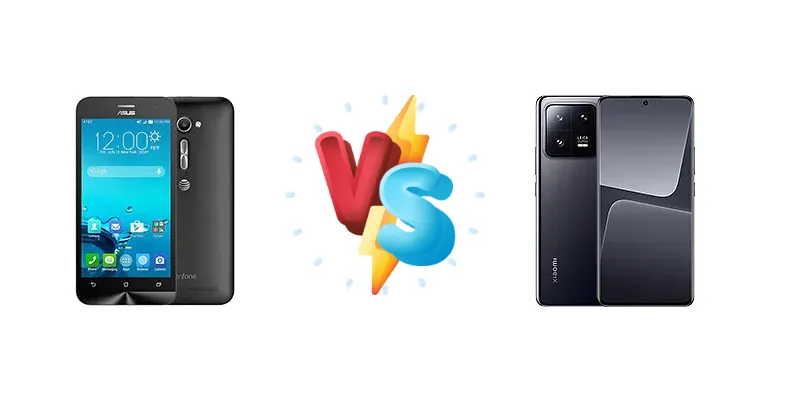
The Asus Zenfone 2E represents a bygone era of budget smartphones, while the Xiaomi 13 Pro embodies modern flagship technology. This comparison explores how these two devices stack up against each other, highlighting the vast differences in performance, features, and overall value. Prepare for a significant contrast!
🏆 Quick Verdict
The Xiaomi 13 Pro utterly dominates the Zenfone 2E across nearly every metric. Its cutting-edge Snapdragon 8 Gen 2 chipset, stunning display, advanced camera system, and blazing-fast charging make it a clear winner, despite the Zenfone 2E's affordability.
| Network |
|---|
| 2G bands | GSM 850 / 900 / 1800 / 1900 | GSM 850 / 900 / 1800 / 1900 |
| 3G bands | HSDPA 850 / 900 / 1900 / 2100 | HSDPA 800 / 850 / 900 / 1700(AWS) / 1900 / 2100 |
| 4G bands | LTE | 1, 2, 3, 4, 5, 7, 8, 12, 13, 17, 18, 19, 20, 25, 26, 28, 32, 38, 39, 40, 41, 42, 48, 66 - International |
| 5G bands | - | 1, 3, 5, 7, 8, 20, 28, 38, 40, 41, 66, 71, 75, 77, 78 SA/NSA - International |
| Speed | HSPA, LTE | HSPA, LTE, 5G |
| Technology | GSM / HSPA / LTE | GSM / CDMA / HSPA / CDMA2000 / LTE / 5G |
| | - | 1, 3, 5, 8, 28, 38, 40, 41, 77, 78, 79 SA/NSA - China |
| Launch |
|---|
| Announced | 2015, July. Released 2015, July | 2022, December 11 |
| Status | Discontinued | Available. Released 2022, December 14 |
| Body |
|---|
| Build | - | Glass front (Gorilla Glass Victus), ceramic back or silicone polymer back, aluminum frame |
| Dimensions | 148.1 x 71.4 x 10.9 mm (5.83 x 2.81 x 0.43 in) | 162.9 x 74.6 x 8.4 mm or 8.7 mm |
| SIM | Micro-SIM | · Nano-SIM + eSIM· Nano-SIM + Nano-SIM |
| Weight | 155.1 g (5.47 oz) | 210 g or 229 g (7.41 oz) |
| | - | IP68 dust/water resistant (up to 1.5m for 30 min) |
| Display |
|---|
| Protection | - | Corning Gorilla Glass Victus |
| Resolution | 720 x 1280 pixels, 16:9 ratio (~294 ppi density) | 1440 x 3200 pixels, 20:9 ratio (~522 ppi density) |
| Size | 5.0 inches, 68.9 cm2 (~65.2% screen-to-body ratio) | 6.73 inches, 108.9 cm2 (~89.6% screen-to-body ratio) |
| Type | IPS LCD | LTPO AMOLED, 1B colors, 120Hz, Dolby Vision, HDR10+, 1200 nits (HBM), 1900 nits (peak) |
| Platform |
|---|
| CPU | Dual-core 1.6 GHz | Octa-core (1x3.2 GHz Cortex-X3 & 2x2.8 GHz Cortex-A715 & 2x2.8 GHz Cortex-A710 & 3x2.0 GHz Cortex-A510) |
| Chipset | Intel Atom Z2560 | Qualcomm SM8550-AB Snapdragon 8 Gen 2 (4 nm) |
| GPU | PowerVR SGX544MP2 | Adreno 740 |
| OS | Android 5.0 (Lollipop), ZenUI | Android 13, upgradable to Android 14, HyperOS |
| Memory |
|---|
| Card slot | microSDXC (dedicated slot) | No |
| Internal | 8GB 1GB RAM | 128GB 8GB RAM, 256GB 8GB RAM, 256GB 12GB RAM, 512GB 12GB RAM |
| | - | UFS 3.1 - 128GB
UFS 4.0 - 256/512GB |
| Main Camera |
|---|
| Features | LED flash, panorama, HDR | Laser AF, color spectrum sensor, Leica lens, Dual-LED dual-tone flash, HDR, panorama |
| Single | 8 MP, AF | - |
| Triple | - | 50.3 MP, f/1.9, 23mm (wide), 1.0"-type, 1.6µm, dual pixel PDAF, OIS
50 MP, f/2.0, 75mm (telephoto), PDAF (10cm - ∞), 3.2x optical zoom
50 MP, f/2.2, 14mm, 115˚ (ultrawide), AF |
| Video | 1080p@30fps | 8K@24fps (HDR), 4K@24/30/60fps (HDR10+, 10-bit Dolby Vision HDR, 10-bit LOG), 1080p@30/120/240/960fps, 1080p@1920fps, gyro-EIS |
| Selfie camera |
|---|
| Features | - | HDR, panorama |
| Single | 2 MP | 32 MP, f/2.0, 22mm (wide), 1/3.14", 0.7µm |
| Video | - | 1080p@30fps |
| Sound |
|---|
| 3.5mm jack | Yes | No |
| 35mm jack | Yes | No |
| Loudspeaker | Yes | Yes, with stereo speakers |
| | - | 24-bit/192kHz audio |
| Comms |
|---|
| Bluetooth | 4.0, A2DP | 5.3, A2DP, aptX HD, aptX Adaptive |
| Infrared port | - | Yes |
| NFC | No | Yes |
| Positioning | GPS | GPS (L1+L5), GLONASS (G1), BDS (B1I+B1c+B2a), GALILEO (E1+E5a), QZSS (L1+L5), NavIC (L5) |
| Radio | No | No |
| USB | microUSB 2.0 | USB Type-C 2.0, OTG |
| WLAN | Wi-Fi 802.11 b/g/n, Wi-Fi Direct, hotspot | Wi-Fi 802.11 a/b/g/n/ac/6e, dual-band, Wi-Fi Direct |
| Features |
|---|
| Sensors | Accelerometer, proximity, compass | Fingerprint (under display, optical), accelerometer, proximity, gyro, compass, barometer |
| Battery |
|---|
| Charging | - | 120W wired, PD3.0, QC4, 100% in 19 min
50W wireless, 100% in 36 min
10W reverse wireless |
| Talk time | Up to 19 h (3G) | - |
| Type | Li-Po 2500 mAh, non-removable | Li-Po 4820 mAh |
| Misc |
|---|
| Colors | Charcoal Black, Pearl White | Ceramic White, Ceramic Black, Ceramic Flora Green, Mountain Blue |
| Models | - | 2210132G, 2210132C |
| Price | About 110 EUR | About 750 EUR |
| Tests |
|---|
| Battery life | - |
Endurance rating 115h
|
| Camera | - |
Photo / Video |
| Display | - |
Contrast ratio: Infinite (nominal) |
| Loudspeaker | - |
-25.6 LUFS (Very good)
|
| Performance | - |
AnTuTu: 1281666 (v9)
GeekBench: 5087 (v5.1), 5323 (v6)
GFXBench: 64fps (ES 3.1 onscreen) |
Asus Zenfone 2E
- Extremely affordable
- Compact size
- Decent battery life for basic use
- Outdated chipset
- Poor camera quality
- Low-resolution display
- Slow charging
Xiaomi 13 Pro
- Flagship performance
- Excellent camera system
- Stunning display
- Fast charging
- Premium design
- Expensive
- Large size (for some)
- Potential software bloat (depending on region)
Display Comparison
The Xiaomi 13 Pro boasts a vibrant, high-resolution display with a peak brightness of 1253 nits and an infinite contrast ratio, offering exceptional viewing experiences. The Zenfone 2E's display is significantly less impressive, with lower resolution and brightness, resulting in a noticeably inferior visual experience.
Camera Comparison
The Xiaomi 13 Pro's camera system is a powerhouse, capturing stunning photos and videos with advanced features. The Zenfone 2E's camera is basic and produces mediocre results, especially in low-light conditions.
Performance
The Xiaomi 13 Pro's Snapdragon 8 Gen 2 chipset delivers unparalleled performance, effortlessly handling demanding games and applications. The Zenfone 2E's Intel Atom Z2560 struggles with modern tasks, exhibiting noticeable lag and limitations.
Battery Life
The Xiaomi 13 Pro offers exceptional battery life and incredibly fast 120W wired charging, alongside 50W wireless charging. The Zenfone 2E's battery life is adequate for its limited capabilities, but charging speeds are slow by today's standards.
Buying Guide
The Asus Zenfone 2E is for those seeking an incredibly budget-friendly device for basic tasks like calls, texts, and light browsing. The Xiaomi 13 Pro is for users who demand top-tier performance, a premium camera, and a long-lasting battery, and are willing to pay a premium.
Frequently Asked Questions
❓ Is the Zenfone 2E still usable in 2024?
Yes, but its performance is severely limited by its outdated hardware. It's suitable only for very basic tasks.
❓ What is the biggest difference between these two phones?
The biggest difference is the generational gap. The Xiaomi 13 Pro represents current flagship technology, while the Zenfone 2E is a relic from a much earlier era of smartphones.
❓ Can the Zenfone 2E run modern apps?
Many modern apps may not be compatible or may run poorly on the Zenfone 2E due to its outdated chipset and limited RAM.