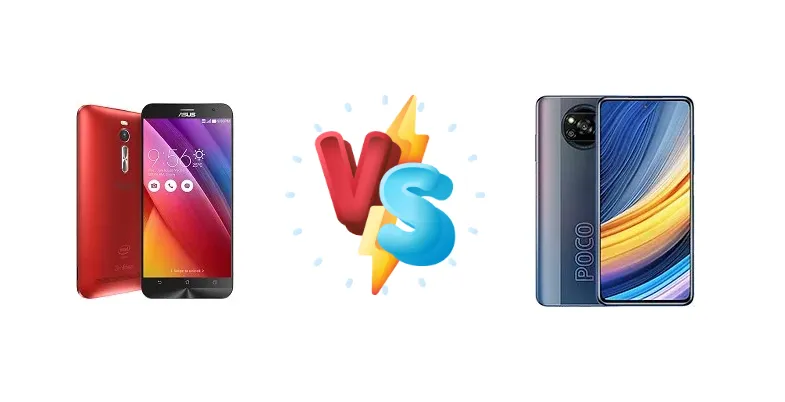
The Asus Zenfone 2 was a popular budget contender, known for its impressive specs at the time. Now, years later, it faces off against the Xiaomi Poco X3 Pro, a modern powerhouse. Can the Zenfone 2 still compete, or is the Poco X3 Pro simply too advanced?
🏆 Quick Verdict
The Xiaomi Poco X3 Pro utterly dominates this comparison. While the Zenfone 2 offered good value in its era, the Poco X3 Pro's vastly superior performance, modern features, and significantly better camera make it the clear winner for anyone seeking a capable and affordable smartphone today.
| Network |
|---|
| 2G bands | GSM 850 / 900 / 1800 / 1900 - SIM 1 & SIM 2 | GSM 850 / 900 / 1800 / 1900 |
| 3G bands | HSDPA 850 / 900 / 1900 / 2100 | HSDPA 850 / 900 / 1700(AWS) / 1900 / 2100 |
| 4G bands | 1, 2, 3, 4, 5, 8, 28 - Taiwan | 1, 2, 3, 4, 5, 7, 8, 20, 28, 38, 40, 41 - International |
| Speed | HSPA 42.2/5.76 Mbps, LTE Cat4 150/50 Mbps | HSPA, LTE |
| Technology | GSM / HSPA / LTE | GSM / HSPA / LTE |
| | 1, 3, 38, 39, 40, 41 - China & India | 1, 2, 3, 5, 8, 38, 40, 41 - India |
| Launch |
|---|
| Announced | 2015, March. Released 2015, March | 2021, March 22 |
| Status | Discontinued | Available. Released 2021, March 24 |
| Body |
|---|
| Build | - | Glass front (Gorilla Glass 6), plastic back |
| Dimensions | 152.5 x 77.2 x 10.9 mm (6.00 x 3.04 x 0.43 in) | 165.3 x 76.8 x 9.4 mm (6.51 x 3.02 x 0.37 in) |
| SIM | Dual SIM (Micro-SIM, dual stand-by) | Nano-SIM + Nano-SIM |
| Weight | 170 g (6.00 oz) | 215 g (7.58 oz) |
| | - | IP53, dust and splash resistant |
| Display |
|---|
| Protection | Corning Gorilla Glass 3 | Corning Gorilla Glass 6 |
| Resolution | 720 x 1280 pixels, 16:9 ratio (~267 ppi density) | 1080 x 2400 pixels, 20:9 ratio (~395 ppi density) |
| Size | 5.5 inches, 83.4 cm2 (~70.8% screen-to-body ratio) | 6.67 inches, 107.4 cm2 (~84.6% screen-to-body ratio) |
| Type | IPS LCD | IPS LCD, 120Hz, 2404Hz PWM, HDR10, 450 nits (typ) |
| Platform |
|---|
| CPU | Quad-core 1.8 GHz | Octa-core (1x2.96 GHz Kryo 485 Gold & 3x2.42 GHz Kryo 485 Gold & 4x1.78 GHz Kryo 485 Silver) |
| Chipset | Intel Atom Z3560 | Qualcomm Snapdragon 860 (7 nm) |
| GPU | PowerVR G6430 | Adreno 640 |
| OS | Android 5.0 (Lollipop), upgradable to 6.0 (Marshmallow), ZenUI | Android 11, upgradable to Android 12, MIUI 13 for POCO |
| Memory |
|---|
| Card slot | microSDXC (dedicated slot) | microSDXC (uses shared SIM slot) |
| Internal | 16GB 2GB RAM | 128GB 6GB RAM, 128GB 8GB RAM, 256GB 6GB RAM, 256GB 8GB RAM |
| | - | UFS 3.1 |
| Main Camera |
|---|
| Features | Dual-LED dual-tone flash, panorama, HDR | Dual-LED flash, HDR, panorama |
| Quad | - | 48 MP, f/1.8, (wide), 1/2.0", 0.8µm, PDAF
8 MP, f/2.2, 119˚ (ultrawide), 1.0µm
2 MP (macro)
Auxiliary lens |
| Single | 13 MP, f/2.0, AF | 20 MP, f/2.2, (wide), 1/3.4", 0.8µm |
| Video | 1080p@30fps | 4K@30fps, 1080p@30/60/120/240fps, 1080p@960fps, gyro-EIS |
| Selfie camera |
|---|
| Features | - | HDR, panorama |
| Single | 5 MP, f/2.0 | 20 MP, f/2.2, (wide), 1/3.4", 0.8µm |
| Video | - | 1080p@30fps |
| Sound |
|---|
| 3.5mm jack | Yes | Yes |
| 35mm jack | Yes | Yes |
| Loudspeaker | Yes | Yes, with stereo speakers |
| | - | 24-bit/192kHz audio |
| Comms |
|---|
| Bluetooth | 4.0, A2DP, EDR | 5.0, A2DP, LE |
| Infrared port | - | Yes |
| NFC | No | Yes (market/region dependent) |
| Positioning | GPS, GLONASS | GPS, GLONASS, GALILEO, BDS |
| Radio | FM radio | FM radio, recording |
| USB | microUSB 2.0, OTG | USB Type-C 2.0, OTG |
| WLAN | Wi-Fi 802.11 a/b/g/n/ac, Wi-Fi Direct, hotspot | Wi-Fi 802.11 a/b/g/n/ac, dual-band, Wi-Fi Direct |
| Features |
|---|
| Sensors | Accelerometer, proximity, compass | Fingerprint (side-mounted), accelerometer, gyro, proximity, compass |
| Battery |
|---|
| Charging | - | 33W wired, 59% in 30 min, 100% in 59 min |
| Type | Li-Po 3000 mAh, non-removable | Li-Po 5160 mAh |
| Misc |
|---|
| Colors | Osmium Black, Glamor Red, Ceramic White | Phantom Black, Frost Blue, Metal Bronze |
| Models | Z008D, Z008 | M2102J20SG, M2102J20SI |
| Price | About 250 EUR | $ 128.04 / £ 249.99 |
| SAR | - | 0.99 W/kg (head) 0.67 W/kg (body) |
| SAR EU | 0.35 W/kg (head) | 0.57 W/kg (head) 0.90 W/kg (body) |
| Tests |
|---|
| Battery life | - |
Endurance rating 112h
|
| Camera | - |
Photo / Video |
| Display | - |
Contrast ratio: 1401:1 (nominal) |
| Loudspeaker | - |
-26.1 LUFS (Good)
|
| Performance | - |
AnTuTu: 453223 (v8)
GeekBench: 2574 (v5.1)
GFXBench: 38fps (ES 3.1 onscreen) |
Asus Zenfone 2 ZE550ML
- Affordable (when new)
- Decent RAM for its time
- Compact size
- Outdated chipset
- Poor performance
- Low-resolution camera
- Slow charging
- Limited software support
Xiaomi Poco X3 Pro
- Powerful Snapdragon 860 chipset
- Excellent battery life
- Fast charging
- Good camera system
- Modern features
- Large display
- Plastic build
- MIUI can be bloated (subjective)
Display Comparison
The Poco X3 Pro boasts a modern display with vibrant colors and good brightness, a significant upgrade over the Zenfone 2's older panel. While both have a nominal contrast ratio of 1401:1, the Poco X3 Pro's display technology is far more advanced, offering a better viewing experience.
Camera Comparison
The Poco X3 Pro's camera system is a major advantage. It offers better image quality, more features, and improved low-light performance. The Zenfone 2's camera is adequate for basic snapshots but falls far short of the Poco X3 Pro's capabilities.
Performance
The Poco X3 Pro's Snapdragon 860 chipset is in a different league compared to the Zenfone 2's Intel Atom Z3560. Expect significantly faster app loading, smoother multitasking, and the ability to handle demanding games with ease. The Zenfone 2 struggles with modern apps and heavier workloads.
Battery Life
The Poco X3 Pro's endurance rating of 112h is exceptional, and its 33W fast charging is a huge benefit. The Zenfone 2's battery life is considerably shorter, and it lacks fast charging capabilities.
Buying Guide
Who should buy the Asus Zenfone 2 ZE550ML? Primarily those seeking a very basic, functional phone for light tasks and nostalgia. Who should buy the Xiaomi Poco X3 Pro? Anyone looking for a powerful, feature-rich smartphone at an excellent price point, ideal for gaming, photography, and everyday use.
Frequently Asked Questions
❓ Is the Zenfone 2 still usable in 2024?
Yes, it can still be used for basic tasks like calls, texts, and light browsing, but its performance is severely limited by its outdated hardware. Don't expect it to run modern apps smoothly.
❓ Why is the Poco X3 Pro so much better?
The Poco X3 Pro utilizes a significantly more powerful processor, a modern display, a better camera, and a larger battery with fast charging – all advancements that the Zenfone 2 simply doesn't have.