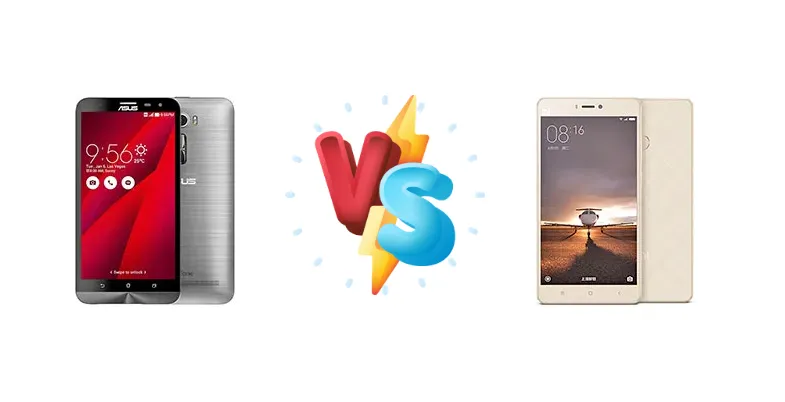
Released around the same timeframe, the Asus Zenfone 2 Laser and Xiaomi Mi 4s represent compelling options in the mid-range smartphone market. While both aimed for affordability, they took different approaches to achieving it, primarily diverging in their chipset choices. This comparison dissects those differences, focusing on real-world implications for the user.
🏆 Quick Verdict
For the average user prioritizing performance and future-proofing, the Xiaomi Mi 4s is the clear winner. Its Snapdragon 808 chipset delivers a significantly faster experience than the Zenfone 2 Laser’s Snapdragon 615, despite both phones offering similar battery endurance. However, the Zenfone 2 Laser remains a viable option for those on a tighter budget.
| Network |
|---|
| 2G bands | GSM 850 / 900 / 1800 / 1900 - SIM 1 & SIM 2 | GSM 850 / 900 / 1800 / 1900 - SIM 1 & SIM 2 |
| 3G bands | HSDPA 850 / 900 / 1900 / 2100 - TW/WW version | HSDPA 850 / 1900 / 2100 |
| 4G bands | 1, 2, 3, 5, 8, 9, 28 - TW version | 1, 3, 7, 38, 39, 40, 41 |
| Speed | HSPA 42.2/5.76 Mbps, LTE Cat4 150/50 Mbps | HSPA, LTE Cat4 150/50 Mbps |
| Technology | GSM / HSPA / LTE | GSM / CDMA / HSPA / LTE |
| | 1, 2, 3, 5, 7, 8, 20 - WW version | TD-SCDMA |
| Launch |
|---|
| Announced | 2015, October. Released 2016, January | 2016, February. Released 2016, March |
| Status | Discontinued | Discontinued |
| Body |
|---|
| Dimensions | 164.6 x 84 x 10.6 mm (6.48 x 3.31 x 0.42 in) | 139.3 x 70.8 x 7.8 mm (5.48 x 2.79 x 0.31 in) |
| SIM | Dual SIM (Micro-SIM, dual stand-by) | Nano-SIM + Micro-SIM |
| Weight | 190 g (6.70 oz) | 133 g (4.69 oz) |
| Display |
|---|
| Protection | Corning Gorilla Glass 4 | - |
| Resolution | 720 x 1280 pixels, 16:9 ratio (~245 ppi density) | 1080 x 1920 pixels, 16:9 ratio (~441 ppi density) |
| Size | 6.0 inches, 99.2 cm2 (~71.8% screen-to-body ratio) | 5.0 inches, 68.9 cm2 (~69.9% screen-to-body ratio) |
| Type | IPS LCD | IPS LCD |
| Platform |
|---|
| CPU | Octa-core (4x1.7 GHz Cortex-A53 & 4x1.0 GHz Cortex-A53) | Hexa-core (4x1.4 GHz Cortex-A53 & 2x1.8 GHz Cortex-A57) |
| Chipset | Qualcomm MSM8939 Snapdragon 615 (28 nm) | Qualcomm MSM8992 Snapdragon 808 (20 nm) |
| GPU | Adreno 405 | Adreno 418 |
| OS | Android 5.0 (Lollipop), upgradable to 6.0 (Marshmallow), ZenUI | Android 5.1 (Lollipop), upgradable to 7.0 (Nougat), MIUI 10 |
| Memory |
|---|
| Card slot | microSDXC (dedicated slot) | microSDXC (uses shared SIM slot) |
| Internal | 16GB 2GB RAM, 32GB 3GB RAM | 64GB 3GB RAM |
| | eMMC 4.5 | eMMC 5.0 |
| Main Camera |
|---|
| Features | Laser AF, Dual-LED dual-tone flash, panorama, HDR | Dual-LED dual-tone flash, panorama, HDR |
| Single | 13 MP, f/2.0 | 13 MP, f/2.0, PDAF |
| Video | 1080p@30fps, 720p@60fps | 1080p@30fps, 720p@120fps |
| Selfie camera |
|---|
| Single | 5 MP, f/2.0 | 5 MP, f/2.0 |
| Video | - | 1080p@30fps |
| Sound |
|---|
| 3.5mm jack | Yes | Yes |
| 35mm jack | Yes | Yes |
| Loudspeaker | Yes, dual speakers | Yes |
| Comms |
|---|
| Bluetooth | 4.1, A2DP, EDR | 4.1, A2DP |
| Infrared port | - | Yes |
| NFC | No | No |
| Positioning | GPS, GLONASS, BDS | GPS, GLONASS, BDS |
| Radio | No | No |
| USB | microUSB 2.0 | USB Type-C |
| WLAN | Wi-Fi 802.11 a/b/g/n/ac, Wi-Fi Direct, hotspot | Wi-Fi 802.11 a/b/g/n/ac, dual-band, Wi-Fi Direct, hotspot |
| Features |
|---|
| Sensors | Accelerometer, gyro, proximity, compass | Fingerprint (rear-mounted), accelerometer, gyro, proximity, compass |
| Battery |
|---|
| Charging | - | 18W wired, QC2, 40% in 60 min |
| Type | Li-Po 3000 mAh, removable | Li-Ion 3260 mAh, non-removable |
| Misc |
|---|
| Colors | Glacier Gray, Sheer Gold, Glamour Red | Black, White, Gold, Pink |
| Models | Z00MD | - |
| Price | About 310 EUR | About 220 EUR |
| Tests |
|---|
| Audio quality | - |
Noise -94.9dB / Crosstalk -82.6dB |
| Battery life | - |
Endurance rating 75h
|
| Camera | - |
Photo / Video |
| Display | - |
Contrast ratio: 975:1 (nominal), 2.095 (sunlight) |
| Loudspeaker | - |
Voice 73dB / Noise 68dB / Ring 82dB
|
| Performance | - |
Basemark OS II 2.0: 1545Basemark X: 12990 |
Asus Zenfone 2 Laser ZE600KL
- Potentially lower price point
- Laser autofocus (potentially faster focusing)
- Acceptable battery life
- Significantly weaker processor
- Less efficient 28nm process
- Likely inferior camera performance
Xiaomi Mi 4s
- Much faster Snapdragon 808 processor
- More efficient 20nm process
- Faster charging with Quick Charge 2.0
- Potentially higher price
- Similar battery endurance to Zenfone 2 Laser
- No specific camera advantages detailed
Display Comparison
Both the Zenfone 2 Laser and Mi 4s share a similar contrast ratio of 975:1 (nominal) and 2.095 (sunlight), suggesting comparable outdoor visibility. However, detailed display specs like resolution and panel type are missing for the Zenfone 2 Laser. Given the Mi 4s’s positioning, it likely features a higher-quality IPS panel, offering better color accuracy and viewing angles. The shared contrast ratio indicates both phones aimed for acceptable, but not exceptional, display performance.
Camera Comparison
Both phones are listed as having 'Photo / Video' capabilities, but specific details are absent. Without sensor size, aperture, or image processing details, a direct comparison is difficult. However, given Xiaomi’s historical focus on camera quality, the Mi 4s likely features a more advanced camera system. The Zenfone 2 Laser’s name suggests a laser autofocus system, which could offer faster focusing speeds in certain conditions, but this doesn’t necessarily translate to better overall image quality. The absence of details necessitates assuming the Mi 4s has a more refined camera experience.
Performance
The core difference lies in the chipsets. The Xiaomi Mi 4s boasts the Qualcomm MSM8992 Snapdragon 808, a 20nm processor with a hexa-core CPU (4x1.4 GHz Cortex-A53 & 2x1.8 GHz Cortex-A57). This is a substantial upgrade over the Asus Zenfone 2 Laser’s MSM8939 Snapdragon 615 (28nm) and its octa-core configuration (4x1.7 GHz Cortex-A53 & 4x1.0 GHz Cortex-A53). The Snapdragon 808’s Cortex-A57 cores provide significantly higher single-core performance, crucial for responsive app launches and smoother UI navigation. The 20nm process also contributes to better thermal efficiency, reducing the likelihood of throttling under sustained load. The Mi 4s will demonstrably outperform the Zenfone 2 Laser in demanding tasks like gaming and video editing.
Battery Life
Interestingly, both devices share an endurance rating of 75 hours. This suggests similar real-world battery life despite the Mi 4s’s more powerful processor. The Snapdragon 808’s 20nm process likely contributes to this efficiency. The Mi 4s also supports 18W wired charging with Quick Charge 2.0, allowing for a 40% charge in 60 minutes. Charging speed information is missing for the Zenfone 2 Laser, implying a slower charging experience.
Buying Guide
Buy the Asus Zenfone 2 Laser ZE600KL if you need a functional, affordable smartphone for basic tasks like calling, texting, and light social media use, and are willing to compromise on processing power. Buy the Xiaomi Mi 4s if you prioritize smoother multitasking, faster app loading times, and a more responsive user experience, and are willing to spend slightly more for a more capable device.
Frequently Asked Questions
❓ Will the Snapdragon 615 in the Zenfone 2 Laser struggle with modern apps?
Yes, the Snapdragon 615 is a relatively old processor. While it can handle basic tasks, it will likely exhibit noticeable lag and slowdowns when running demanding apps or multitasking heavily. Modern apps are increasingly optimized for more powerful chipsets.
❓ Does the Xiaomi Mi 4s support USB Type-C?
No, the Xiaomi Mi 4s uses a Micro-USB port for charging and data transfer. This is common for phones released around 2015, before USB Type-C became the standard.
❓ Is the laser autofocus on the Zenfone 2 Laser a significant advantage?
Laser autofocus can be faster in low-light conditions, but it doesn't guarantee better overall image quality. The Mi 4s likely has a more sophisticated camera system with better image processing, which is more important for overall photo quality.
❓ Can the Xiaomi Mi 4s handle gaming?
The Snapdragon 808 in the Mi 4s is capable of handling many games from that era, and even some modern titles at lower settings. The 20nm process helps prevent overheating and throttling during extended gaming sessions.