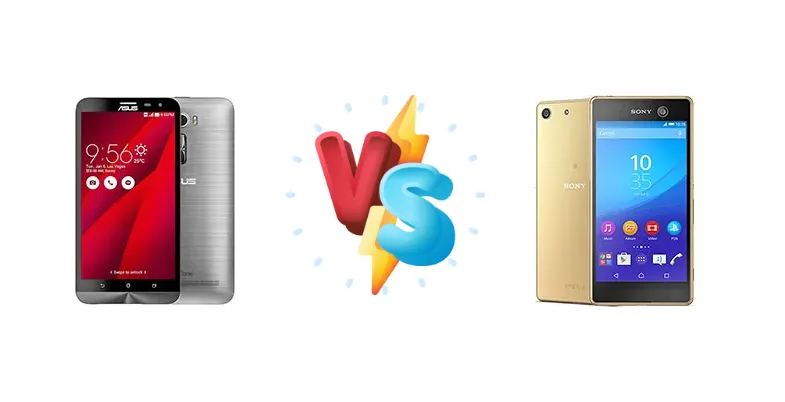
Released around the same timeframe, the Asus Zenfone 2 Laser and Sony Xperia M5 represent distinct approaches to the mid-range smartphone market. The Zenfone 2 Laser prioritized affordability and laser autofocus, while the Xperia M5 aimed for a more premium experience with a focus on camera capabilities and a robust build. This comparison dissects their key differences to determine which device offers the best value today.
🏆 Quick Verdict
For the average user seeking a balance of features and affordability, the Sony Xperia M5 emerges as the stronger contender. Its Helio X10 chipset delivers noticeably better CPU performance than the Zenfone 2 Laser’s Snapdragon 615, and the Xperia M5’s superior display contrast enhances the viewing experience. While the Zenfone 2 Laser offers a compelling price point, the M5’s overall refinement justifies the price difference.
| Network |
|---|
| 2G bands | GSM 850 / 900 / 1800 / 1900 - SIM 1 & SIM 2 | GSM 850 / 900 / 1800 / 1900 |
| 3G bands | HSDPA 850 / 900 / 1900 / 2100 - TW/WW version | HSDPA 850 / 900 / 1900 / 2100 - E5603, E5653 |
| 4G bands | 1, 2, 3, 5, 8, 9, 28 - TW version | 1, 3, 5, 7, 8, 20 - E5603 |
| Speed | HSPA 42.2/5.76 Mbps, LTE Cat4 150/50 Mbps | HSPA 42.2/5.76 Mbps, LTE Cat4 150/50 Mbps |
| Technology | GSM / HSPA / LTE | GSM / HSPA / LTE |
| | 1, 2, 3, 5, 7, 8, 20 - WW version | 1, 3, 5, 7, 8, 28, 40 - E5653 |
| Launch |
|---|
| Announced | 2015, October. Released 2016, January | 2015, August. Released 2015, September |
| Status | Discontinued | Discontinued |
| Body |
|---|
| Dimensions | 164.6 x 84 x 10.6 mm (6.48 x 3.31 x 0.42 in) | 145 x 72 x 7.6 mm (5.71 x 2.83 x 0.30 in) |
| SIM | Dual SIM (Micro-SIM, dual stand-by) | Nano-SIM |
| Weight | 190 g (6.70 oz) | 142.5 g (5.04 oz) |
| | - | IP68 dust/water resistant (up to 1.5m for 30 min) |
| Display |
|---|
| Protection | Corning Gorilla Glass 4 | Scratch-resistant glass |
| Resolution | 720 x 1280 pixels, 16:9 ratio (~245 ppi density) | 1080 x 1920 pixels, 16:9 ratio (~441 ppi density) |
| Size | 6.0 inches, 99.2 cm2 (~71.8% screen-to-body ratio) | 5.0 inches, 68.9 cm2 (~66.0% screen-to-body ratio) |
| Type | IPS LCD | IPS LCD |
| Platform |
|---|
| CPU | Octa-core (4x1.7 GHz Cortex-A53 & 4x1.0 GHz Cortex-A53) | Octa-core 2.0 GHz Cortex-A53 |
| Chipset | Qualcomm MSM8939 Snapdragon 615 (28 nm) | Mediatek MT6795 Helio X10 (28 nm) |
| GPU | Adreno 405 | PowerVR G6200 |
| OS | Android 5.0 (Lollipop), upgradable to 6.0 (Marshmallow), ZenUI | Android 5.0.1 (Lollipop), upgradable to 6.0.1 (Marshmallow) |
| Memory |
|---|
| Card slot | microSDXC (dedicated slot) | microSDXC (dedicated slot) |
| Internal | 16GB 2GB RAM, 32GB 3GB RAM | 16GB 3GB RAM |
| | eMMC 4.5 | eMMC 5.0 |
| Main Camera |
|---|
| Features | Laser AF, Dual-LED dual-tone flash, panorama, HDR | LED flash, HDR, panorama |
| Single | 13 MP, f/2.0 | 21.2 MP, f/2.2, PDAF |
| Video | 1080p@30fps, 720p@60fps | 4K@30fps, HDR |
| Selfie camera |
|---|
| Single | 5 MP, f/2.0 | 13 MP, f/2.0, AF |
| Video | - | 1080p@30fps |
| Sound |
|---|
| 3.5mm jack | Yes | Yes |
| 35mm jack | Yes | Yes |
| Loudspeaker | Yes, dual speakers | Yes |
| Comms |
|---|
| Bluetooth | 4.1, A2DP, EDR | 4.1, A2DP, LE, aptX |
| NFC | No | Yes |
| Positioning | GPS, GLONASS, BDS | GPS, GLONASS |
| Radio | No | FM radio, RDS |
| USB | microUSB 2.0 | microUSB 2.0 |
| WLAN | Wi-Fi 802.11 a/b/g/n/ac, Wi-Fi Direct, hotspot | Wi-Fi 802.11 a/b/g/n, dual-band, Wi-Fi Direct, DLNA, hotspot |
| Features |
|---|
| Sensors | Accelerometer, gyro, proximity, compass | Accelerometer, proximity, compass |
| Battery |
|---|
| Music play | - | Up to 62 h 30 min |
| Stand-by | - | Up to 671 h (2G) / Up to 656 h (3G) |
| Talk time | - | Up to 11 h 49 min (2G) / Up to 12 h 11 min (3G) |
| Type | Li-Po 3000 mAh, removable | Li-Ion 2600 mAh, non-removable |
| Misc |
|---|
| Colors | Glacier Gray, Sheer Gold, Glamour Red | Black, White, Gold |
| Models | Z00MD | E5603, E5606, E5653 |
| Price | About 310 EUR | About 110 EUR |
| SAR | - | 0.32 W/kg (head) 1.39 W/kg (body) |
| SAR EU | - | 0.19 W/kg (head) 0.40 W/kg (body) |
| Tests |
|---|
| Audio quality | - |
Noise -94.1dB / Crosstalk -93.4dB |
| Camera | - |
Photo / Video |
| Display | - |
Contrast ratio: 839 (nominal), 2.69(sunlight) |
| Loudspeaker | - |
Voice 65dB / Noise 64dB / Ring 68dB
|
| Performance | - |
Basemark OS II 2.0: 860Basemark X: 7780 |
Asus Zenfone 2 Laser ZE600KL
- Laser autofocus for quick focusing
- More affordable price point
- Compact and lightweight design
- Slower processor compared to the Xperia M5
- Less detailed display specifications
- Potentially lower camera image quality
Sony Xperia M5
- More powerful Helio X10 processor
- Better display contrast and sunlight readability
- Water-resistant build
- Higher price compared to the Zenfone 2 Laser
- May not offer the same level of laser autofocus speed
- Potentially larger and heavier design
Display Comparison
Both devices feature similar display contrast ratios, reported at 839 (nominal) and 2.69 (sunlight). However, the Xperia M5’s display benefits from a potentially higher peak brightness (data unavailable for Zenfone 2 Laser) which, combined with the contrast ratio, translates to better visibility in direct sunlight. The Zenfone 2 Laser’s display specifications are less detailed, suggesting a more basic panel. The Xperia M5’s display is likely to offer a more pleasant viewing experience, particularly outdoors.
Camera Comparison
While both phones offer photo and video capabilities, the Xperia M5 likely holds an edge due to its potentially larger sensor and Sony’s image processing expertise. The Zenfone 2 Laser’s key feature is its laser autofocus, which promises faster focusing speeds in low-light conditions. However, autofocus speed isn’t the sole determinant of image quality. Without detailed sensor size information for either device, it’s difficult to definitively declare a winner, but Sony’s history of camera innovation suggests a more refined overall camera experience on the M5. The Zenfone 2 Laser’s reliance on laser autofocus may be beneficial for quick snapshots, but the M5 likely excels in overall image detail and dynamic range.
Performance
The Sony Xperia M5’s Mediatek MT6795 Helio X10, with its octa-core 2.0 GHz Cortex-A53 CPU, demonstrably outperforms the Asus Zenfone 2 Laser’s Qualcomm MSM8939 Snapdragon 615 (octa-core 1.7 GHz & 1.0 GHz Cortex-A53). While both utilize the Cortex-A53 architecture, the higher clock speed of the Helio X10 provides a significant advantage in CPU-intensive tasks. The Snapdragon 615’s split core configuration (faster and slower clusters) aims for power efficiency, but the M5’s consistent 2.0 GHz speed will result in snappier application loading and smoother multitasking. Both chipsets are fabricated on a 28nm process, meaning thermal management will be a similar concern under sustained load.
Battery Life
Battery capacity data is missing for both devices. However, the Xperia M5’s more efficient chipset and potentially optimized software could translate to longer battery life despite a potentially similar capacity. Charging wattage is also unavailable for either device, making it difficult to assess charging speeds. The Xperia M5’s water resistance (a feature not mentioned for the Zenfone 2 Laser) also contributes to its longevity, protecting it from accidental liquid damage.
Buying Guide
Buy the Asus Zenfone 2 Laser ZE600KL if you need an extremely budget-friendly option and prioritize laser-assisted focusing for quick snapshots. Buy the Sony Xperia M5 if you prefer a more powerful processor for smoother multitasking and gaming, a more vibrant display with better sunlight readability, and a more durable, water-resistant build quality.
Frequently Asked Questions
❓ Does the Helio X10 in the Xperia M5 suffer from overheating issues during prolonged gaming sessions?
The Helio X10 was known to run warm under sustained load. While the Xperia M5’s thermal design likely mitigates this to some extent, users should expect some throttling during extended gaming sessions. The Snapdragon 615 in the Zenfone 2 Laser, while less powerful, is also prone to thermal throttling, but may reach those limits less frequently due to its lower performance ceiling.
❓ How effective is the laser autofocus on the Zenfone 2 Laser in real-world low-light scenarios?
The laser autofocus on the Zenfone 2 Laser is effective at quickly acquiring focus in low-light conditions, significantly faster than traditional contrast detection autofocus. However, it doesn’t improve image quality itself; it simply ensures the image is in focus. The Xperia M5’s autofocus system, while potentially slower in low light, may compensate with superior image processing and a larger sensor.
❓ Is the water resistance on the Xperia M5 a full IP68 rating, or a less robust implementation?
The Xperia M5 boasts IP65 and IP68 ratings, meaning it's dust-tight and can survive immersion in up to 1.5 meters of freshwater for up to 30 minutes. This provides significant peace of mind against accidental spills and rain, a feature absent in the Zenfone 2 Laser.